

Israeli venture group Team8 has raised $365 million in new capital to invest in the next generation of AI-native enterprise startups, bringing its total assets under management to nearly $2 billion.
The funding includes $265 million for Team8 Capital’s third fund and more than $100 million for follow-on investments in portfolio companies in which the firm has the highest conviction.
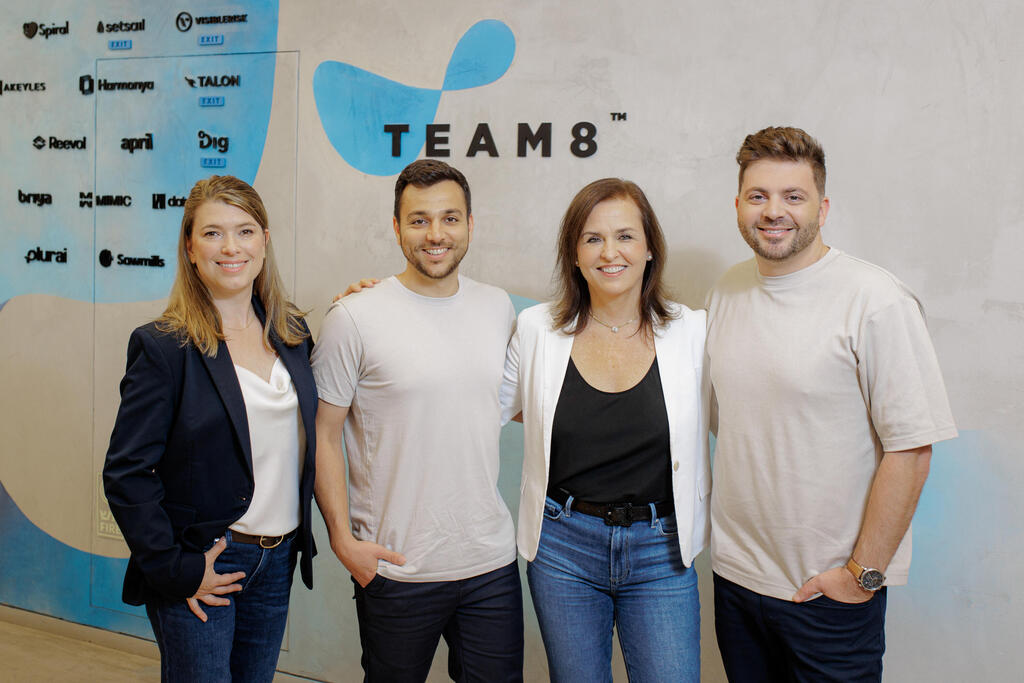
Hadar Siterman Norris, Ori Barzilai, Sarit Firon and Liran Grinberg
(Photo: Omer Hacohen)
The third fund, led by managing partners Sarit Firon and Liran Grinberg alongside partners Ori Barzilay and Hadar Siterman, will invest primarily at the Seed and Series A stages in cybersecurity, software and AI infrastructure, fintech and digital health.
The fund has already made nine investments over the past year while fundraising was underway and recorded its first exit even before reaching its final close. Palo Alto Networks reportedly acquired portfolio company Koi Security for about $400 million in February 2026.
Team8’s two previous capital funds invested in companies including Classiq, which develops an operating system for quantum computing and has raised more than $200 million; FundGuard, a financial software infrastructure company that completed a $100 million funding round; and Port, whose platform is designed for software development in the agentic AI era and which raised $100 million at an $800 million valuation.
Team8 said its portfolio companies have raised about $1 billion from venture investors overall, including roughly $762 million over the past year alone.
Firon said the new fund has attracted both institutional investors and, for the first time, Indian software giant Infosys, which has also shown interest in Israeli startups previously backed by Team8.
“After the difficult period at the height of the war in Israel, we have recently begun to see investors returning to Israeli funds,” Firon told Calcalist. “They are drawn here because they understand that the innovation is significant, and beyond that, concerns about uncertainty surrounding AI are stronger today than almost anything else. So when they see funds that understand AI investing, they are willing to come.”
The rapid evolution of artificial intelligence has reshaped the criteria Team8 uses when evaluating founders, she said.
“Technology today is easy and cheap to develop, so what matters more is the product and the sales organization. Everything has to happen simultaneously and quickly,” Firon said. “That means we are looking today for more well-rounded entrepreneurs, not only technologists, who are capable of running everything at the same time. It is not really a matter of experience, by the way, but more a matter of personality.”
Despite growing investor interest in chips, data centers and other hardware infrastructure, Firon and Grinberg said Team8 intends to remain focused exclusively on software.
They argue that easier and cheaper software development does not mean software products are becoming less important. Instead, they expect the software layer to evolve as AI changes how products are built and used.
That transformation is also creating new security problems for major companies.
A Team8 survey of 111 senior security executives at its annual CISO Village Summit found that 97% of organizations have begun adopting AI agents, while 80% are already running them in production or other critical environments. Yet respondents rated their average confidence in their ability to secure those systems at just 2.32 out of 5.
Team8 says that gap between adoption and security will be one of the central investment themes of its new fund. The firm plans to focus on AI-native companies developing infrastructure that enables enterprises to deploy artificial intelligence more rapidly while maintaining security, governance and control.
Potential investment areas include AI infrastructure, orchestration, identity, data and cybersecurity.
“AI is fundamentally rewriting the economics of company building. Developing breakthrough technology has never been easier; building a company that endures has never been harder,” Firon said.
“As AI capabilities continue to evolve at a pace none of us has seen before, competitive advantage won't come from the model underneath a product. It will come from solving fundamental enterprise problems that stay relevant across technology cycles.”
Grinberg said the firm sees the biggest opportunities emerging in the underlying infrastructure and security layers required for widespread enterprise AI adoption.
“Our new fund investors aren't just backing a track record, they're backing Team8's ability to spot the enterprise problems that matter years before everyone else, and to turn that insight into companies that define entire categories,” he said.
“As AI accelerates change and creates real uncertainty across every enterprise, we're more convinced than ever that the biggest opportunities sit in the infrastructure and cybersecurity layers that let enterprises adopt this technology with confidence.”
Founded in 2014, Team8 now manages nearly $2 billion across eight funds. In addition to providing capital, the group operates a company-building platform offering startups access to enterprise executives, market validation, recruiting, go-to-market support and other services through a team of more than 90 in-house company builders.