

“Everything is expensive. The cost of living here has completely spun out of control. Prices of goods and services since the summer war have jumped by 40 or 50 percent. There is no longer any price supervision and inflation is raging. For us — young, single people living alone or with roommates — it has a huge impact. But I cannot even imagine parents who have to take care of children with the same salary that now buys so much less. You find yourself constantly thinking about how to cut back and save. You buy only the food you absolutely need, look for smaller, shabbier apartments or rooms at lower prices, unplug anything electrical that is not in use, shower sparingly. An entire population here is living in poverty.
Among young people, there is a kind of cooperative system. If I am going somewhere, I check whether someone else needs to go there too, or whether I can bring something back for someone. We share clothes, do laundry together, reuse baking paper several times. That is the reality. Aside from trash bags, there are no disposable products anymore. Haircuts are done at friends’ homes. There is also a health aspect: people smoke much less. Every cigarette is part of the budget.
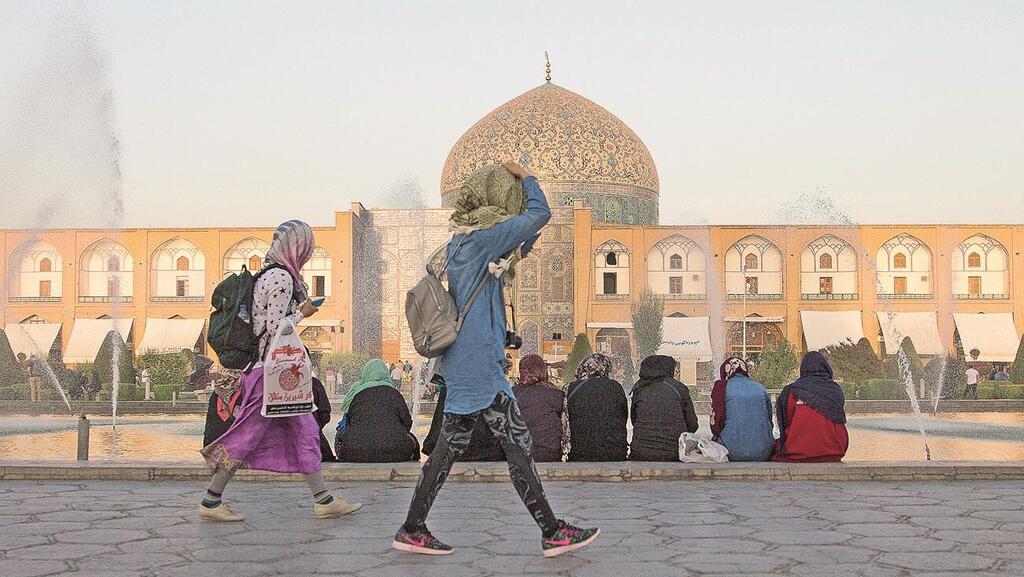
Iranian women at a public square in central Isfahan
(Photo: Sun_Shine/Shutterstock)
We go out into the streets, but we do not take out our wallets to buy drinks or food. These are luxuries we cannot afford right now, mainly because of the uncertainty. We do not know how long this will last or how bad it will get. I would say we are saving, but I laugh even as I say that. There is nothing to save. It sounds humiliating, and at first it really was, but we have passed that stage. We are in survival mode.
Humiliation and total despair
For young people, life has come to a halt. We cannot even think about buying a home. We are trying to survive and are busy fighting the regime, so there is no room for thoughts of settling down or starting a family. You cannot think about personal or social matters when your daily reality is choosing whether to eat eggs or meat because both are too expensive. And that is before winter and the energy costs, which have risen by nearly 50 percent compared with last year.
More and more families and people from the middle class feel their standard of living slipping. They look at the regime and see no answer. When you cut back on food, when you tell your child you will not go to the doctor because the illness is not serious enough yet, it creates despair, total hopelessness, humiliation. That is why more and more people are going out into the streets. On the one hand, it deeply frightens the regime. On the other, the regime has no real way to fix the situation other than telling the West it is surrendering to the sanctions. Our feeling is that they would rather die than surrender. But we want to live.
We want reforms, more democracy that would also eliminate corruption and inequality and injustice. But the government will not allow that. It will continue to subsidize and finance failing factories and businesses. It is impossible to continue for long with sanctions and shrinking oil revenues. The government talks about raising income through new taxes, but there is nothing left to take, and such a decision would only inflame the streets even more.
More than 30 million Iranians — a third of the population — are below the poverty line, and more are falling into it. Those newly pushed down from the middle class are struggling, making adjustments and cutting back. Those who were already there are now battling food insecurity. We laugh and cry about it all the time. We know that people our age in the West take out loans to buy a home, pay for studies or a car. Here, we buy rice or bread in installments and go into future debt just to eat.
This whole idea of crying until you start laughing is not new here. The authorities talk about increasing revenues by removing subsidies and raising jet fuel prices. Then you read in the newspaper or see on television commentators explaining how this will greatly affect ticket prices. And you have to laugh. We earn about $200 a month. A domestic plane ticket costs half a salary. What are they even talking about?
Hungry children in school
I have friends who are schoolteachers who say that more and more students arrive in class with empty backpacks: no pencils, no notebooks, no food. This followed a 50 percent rise in public transportation and school transport costs. What a horrifying choice for a parent: buy a pen and a notebook and know it may come at the expense of your child going to bed hungry. And the government? It continues running campaigns encouraging people to have more children.
At the same time, more and more talent leaves as soon as it can. Teachers here earn roughly the minimum wage — about $150 a month. If you live in Tehran, your monthly cost of living is about three times that. So they emigrate as soon as possible. Iranian teachers are in high demand in the Gulf states. Naturally, less qualified teachers replace them, and the quality of education declines.
Before the war, the price of a liter of milk jumped from 180,000 rials to 230,000. After the war, it rose to 390,000 rials. In six months, we experienced price increases that usually take decades. And it is everything: eggs, chicken, of course all dairy products.
In the past, many people could be blinded by stories about America and Israel and the need to be strong. The war shattered that in two ways. First, people realized the regime is not really capable of protecting them. Second, people who were once middle class and could afford a normal life — a vacation, a movie, a restaurant, an ice cream — can no longer afford those luxuries. They are in survival mode. Everyone knows about inflation and the collapse in the value of our currency. That is why this round of protests is much broader and far more frightening for the regime. These are protests of hungry stomachs.
These include those falling from above — people who have slipped out of the middle class. But the regime’s more serious problem is with those coming from below: young people entering the labor market and waiting for work. Official unemployment in Iran is about 7 to 8 percent. Among young people, it is around 25 percent, and among women in this age group, it reaches 35 percent. One in three young women in Iran is unemployed, and to barely survive, those who do work often need two jobs. They call themselves “the generation of empty pockets.” Luxuries are out of the question — no shoes, no clothes, no cosmetic treatments. Nothing.
Chronic anxiety attack
Even animals are paying the price. You see more and more abandoned pets on the streets. These are animals that once had homes, but their owners can no longer afford to buy food or care for them, so they leave them outside.
There is a mix of despair, enormous anger and hopelessness about the future. People see protests in other countries and want change too. They do not care about dying. On the contrary, many young people I spoke with talk about death as a kind of escape from reality. They are no longer willing to heed calls about an external enemy or narratives that only we are right and everyone else is against us.
We also constantly hear from friends who managed to escape. We hear about very simple things: speaking freely, planning your future, breathing without fear. That is what we want. Existential and economic anxiety has driven away all our dreams. The social contract that exists between citizens and authorities in any country no longer exists here. The regime has abandoned us.
What we are seeing in the streets is something we knew would come. There is an entire generation living with a chronic anxiety attack over how to make it to the end of the month. This is a generation that grew up amid the protests following the killing of Mahsa Amini in 2022. They have courage and awareness, and they have access to the internet. They see how the world lives on social media and feel there is another world, parallel to theirs. You can see the influence in how they organize protests — with goggles and face coverings to protect themselves from tear gas. That is what they saw in protests abroad.
There have already been dozens of people killed in protests in Iran, and we believe that 80 percent of them are civilians aged 15 to 24. I like to follow their slogans. They start in private chats, then move to social media, and from there burst into public spaces. At first, it was, “I am ready to be next, if I will be the last.” Then, “If I do not protest, what am I supposed to do with my life?” And now there is the slogan I love most for its basic simplicity: “We just want normality.”
Brought to publication by Zeev Avrahami