


Israel is paying sharply higher prices for desalinated water in an effort to keep privately operated plants running through an algae contamination crisis, a move that is exposing the financial and operational risks built into one of the country’s most critical infrastructure systems.
The Water Authority has raised the price paid for desalinated water to about 4 shekels per cubic meter, up from normal rates that range between roughly 1.5 shekels and 2.7 shekels depending on the facility.
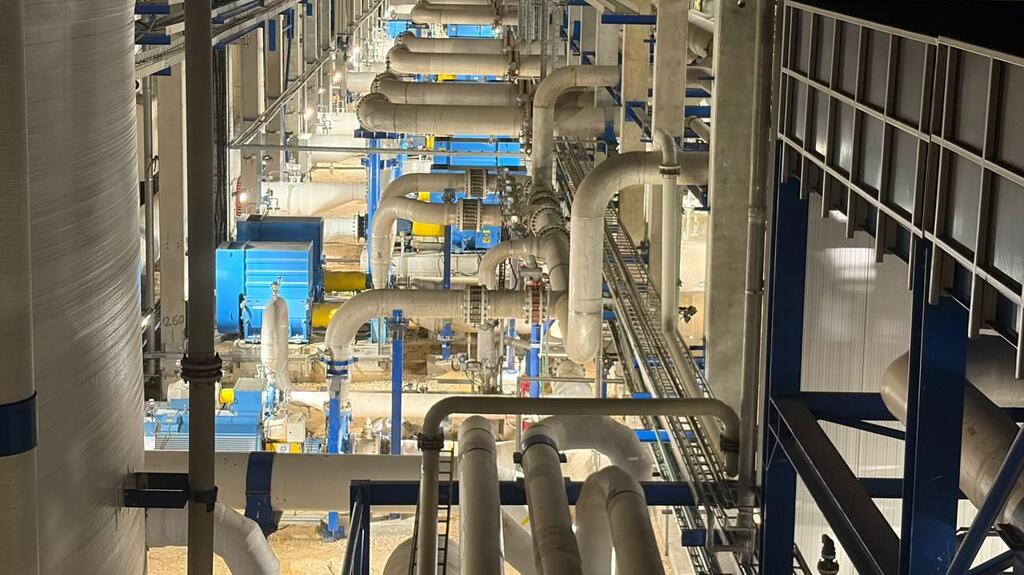
The Sorek B desalination plant
(Photo: Meir Turgeman)
Compared with the upper end of the usual range, the emergency rate represents an increase of nearly 50%.
The higher payments are intended to encourage private operators to continue producing water despite conditions that can accelerate wear and cause expensive damage to filtration systems and membranes.
Mekorot, Israel’s national water company, receives the desalinated water and pays the companies operating the plants.
All six of Israel’s major desalination facilities are privately owned. The system became fully privatized after Mekorot sold the operation of the Ashdod desalination plant several years ago.
That structure is now coming under scrutiny as the algae crisis disrupts production.
The Hadera desalination plant is the only major facility that has not been affected. Sorek B, operated by IDE Technologies, and Palmachim, operated by BlueGen and Migdal, have continued operating despite the contamination.
Doing so carries significant risk. Algae can damage sensitive components, particularly the membranes at the heart of the desalination process, potentially leading to premature wear and repair costs running into millions of shekels.
Sorek A, owned by Dan Capital, only recently returned to operation after being affected by the crisis.
The emergency pricing decision is also raising a broader question: how resilient is Israel’s water system when the infrastructure on which it increasingly depends is entirely in private hands?
The Water Authority chose to raise payments in order to offset the risk being taken by operators. But the current crisis illustrates what could happen in a more severe emergency if operating a plant became too costly or commercially unattractive.
Would private companies still keep the system running if the financial exposure became significantly greater?
The issue has become more pressing as Israel continues to expand its reliance on privately developed desalination infrastructure.
Just three months ago, the government approved a framework allowing private companies to plan additional large desalination plants as part of an effort to speed up national infrastructure development.
Those projects can have production capacities of at least 100 million cubic meters of desalinated water per year.
At the same time, the state has struggled to advance other projects that could have provided greater redundancy and given the water system more room to absorb disruptions such as the current algae bloom.
Environmental advocacy group Adam Teva V’Din said the crisis illustrates the price of insufficient backup capacity.
“The current event also illustrates the cost of insufficient redundancy,” the organization said.
“When the state is required to return desalination plants to operation under emergency conditions, it is forced, according to reports, to pay about 4 shekels per cubic meter instead of around 2.7 shekels under normal conditions, while at the same time committing to compensate operators in the event of damage to membranes and filtration systems, damage that could reach millions of shekels.”
The group argued that investment in wells and alternative sources should not be measured solely according to the routine cost of producing each cubic meter of water.
Instead, such infrastructure should be treated as a form of insurance against future disruption.
“Upfront investment in resilience and backup sources can reduce damage to the economy during a crisis, as well as the need to pay an expensive emergency premium afterward in order to ensure continued water supplies,” it said.
IDE Technologies said it had not requested the higher rate and stressed that the decision was made by the Water Authority.
“All decisions, including operating instructions and tariffs, were determined completely unilaterally by the Water Authority, without prior discussion with us,” the company said.
“IDE has mobilized fully for the country and for Israel’s citizens. The company is operating around the clock at maximum production capacity, demonstrating national responsibility, professionalism and full commitment to ensuring water security and continuity of supply during this difficult period.”
BlueGen declined to comment.
The Water Authority had not responded by publication time.