


“I’ve been through some very difficult things in my life, to put it mildly. Standing up to them proved to those around me, and to myself, that I am a strong woman. I managed to turn crises into opportunities, lemons into lemonade, risks into chances. I did not give up even when the road was so hard it seemed impossible. During one of the most difficult crises I experienced, professionally and within my family, in the 1990s, I was treated by a psychologist. He told me: ‘Rosette, not every woman could have come out of a situation like the one you were in. You are a strong woman, an iron woman.’” Rosette Hinawi, chairwoman and owner of the Hinawi George Beverages Group, tells ynet.
In August, Rosette will celebrate her 70th birthday with her extended family. Although she can afford to retire and enjoy the fruits she herself cultivated, she has no intention of changing her routine. What interests her is seeing the group — which includes the Wine & More chain and the importing and marketing company Enoteca — continue to grow, while she, as chairwoman, remains involved in every move.
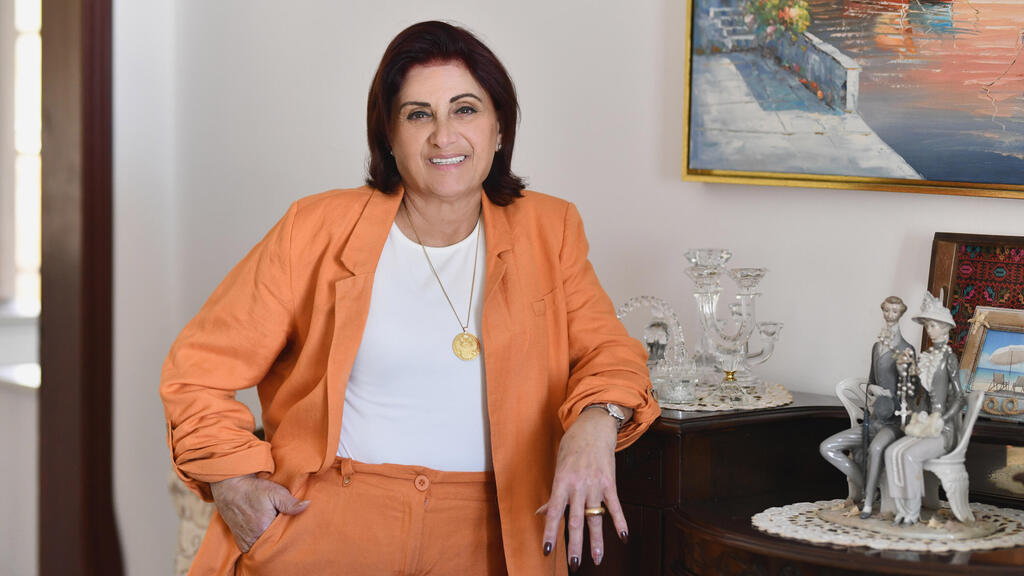
Forty years have passed since her husband, George, for whom the chain is named, died suddenly. Rosette was forced to cope with running the business without George, who had been the dominant professional figure. More than that, she faced quite a few challenges simply because she was a woman and a manager, and in a field that was not conventional for the conservative society in which she grew up. At her side, she stresses, stood her two brothers, Wadia and Elias, who stepped up to the task in the difficult moments. “I would not have gotten through the crises I experienced without them,” she admits.
You are a woman who grew up in a conservative society, and you run an alcohol business. Was there no opposition to you?
“I set goals for myself and moved toward them. When you establish a fact, people accept it. I often felt jealousy toward me, but it did not stop me from continuing on my path. Over time, I also became a trailblazer. For example, when I finished building the house in Jaffa, I was the only woman who had built one. No one at that time had built a house like that in Jaffa. People raised an eyebrow. Suddenly, everyone started building after me. Alongside the jealousy, there were also many people who supported me.”
She was born in Jaffa to a Christian family — the fifth child after four daughters, followed by two sons — and still lives there today. Until age 12, she studied at a school run by nuns, then moved to Nazareth to study at St. Joseph School, which is owned by the monastery of the same name. After two years, she moved to Haifa. She completed high school at the Nazareth Nuns School, which is still ranked among Israel’s top high schools.
“From early childhood I received a Christian education,” she says. “Beyond knowledge, I internalized values of forgiveness, love and giving, on which Christianity is based. Being educated at a school run by nuns and in a boarding school also means understanding the importance of discipline, determination and responsibility. I was never afraid to take responsibility for myself.”
With a high school diploma in hand, she returned home to Jaffa and began studying business administration at the Open University. “At that time, it was difficult. I found myself the only young woman among businessmen. Fear paralyzed me. I left and turned to hotel management studies at Tadmor, with the goal of becoming a hotel manager.”
And did you?
“No,” she smiles. “I finished my studies, but life had other plans for me. At the graduation party, I met George Hinawi, who was my brother-in-law’s brother. The Hinawi family was already known in Jaffa then as a family of successful businesspeople. At the end of the party, he offered to walk me home, and from there we never parted.”
Like in the movies, did you know from the first moment that this was it, that he would be your husband?
“No. I liked him and he suited me, but love developed over time. We met in July and married after a short engagement on Oct. 4. When we married, I was 18 and George was 24.”
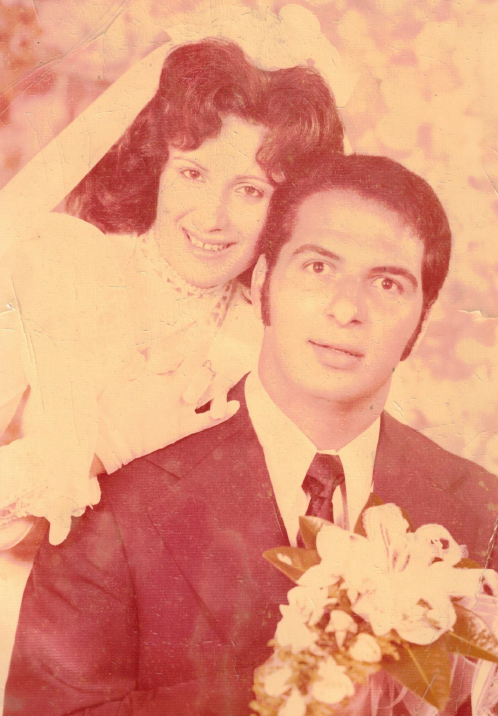
George and Rosette on their wedding day
(Photo: Private album)
After they married, Rosette began helping her husband in the business, which was then a single store in Jaffa. The Hinawi family’s first liquor store was founded by Karim Hinawi in Jaffa in the late 1940s, offering a range of wines and luxury alcoholic beverages from around the world. In 1974, George took over the store, expanded its selection of beverages and, among other things, personally imported rare and expensive wines for some customers.
“George was a wonderful person,” Rosette says. “We lived together in friendship and love, and built a family. We had three sons: the eldest, Tawfiq, lives today in Montreal, Canada, is married and has three children. He owns the Hinnawi Bros. Bagels & Coffee chain in Montreal. Andrei, 46, is CEO of Enoteca, the group’s importing company, and is married with two children. Wasim, the youngest, 41, is CEO of the group. He is married and does not yet have children.”
Carrying on his path
On the surface, everything looked secure, stable and glittering for the young woman. But in 1986, her life was turned upside down. George died at age 36, and she was left a 28-year-old widow with three young children — ages 8, 4 and 18 months — and a developing business.
“George had a heart attack. His heart muscle grew weaker and weaker. We flew to Houston in the United States, where a Lebanese doctor operated on him. Immediately after the surgery, he explained that George would not live much longer,” Rosette recalls sadly. “The operation succeeded, but the patient died.”
Rosette had no hesitation about continuing her husband’s path in business. Together with her brother, Elias Abu Maneh, and Andre Hinawi, she continued managing it, while also beginning to build the dream house her husband had planned before his death.
“For me, it was part of George’s will, since he did not get to see his dream built,” she says. She completed the construction while managing the business and the family, through difficult periods, especially shortly after George’s death. “It was hard, but we held on,” she says. One milestone on the way up came in 1997, when the second branch opened in Herzliya Pituah and became a major success.
Meanwhile, her sons grew up, and when they wanted to study at university in the United States, she rented the house to the British Embassy and used the rent to finance their studies in San Diego. “My mother taught me that the most important thing is a diploma. She used to say that a diploma is like a weapon in your hand. That is how I raised them too.”
Involved in every decision
If one had to identify the start of the chain’s momentum, it came in 2004, when Rosette returned from six months in the United States, where she had been sent by the Center for Jewish-Arab Economic Development. There she studied, among other things, how to expand an existing business. At the same time, her three sons also returned from the United States, and together they charged toward the goal: establishing a professional chain for alcohol and wine sales — Wine & More. Alongside it, they acquired the Enoteca company.
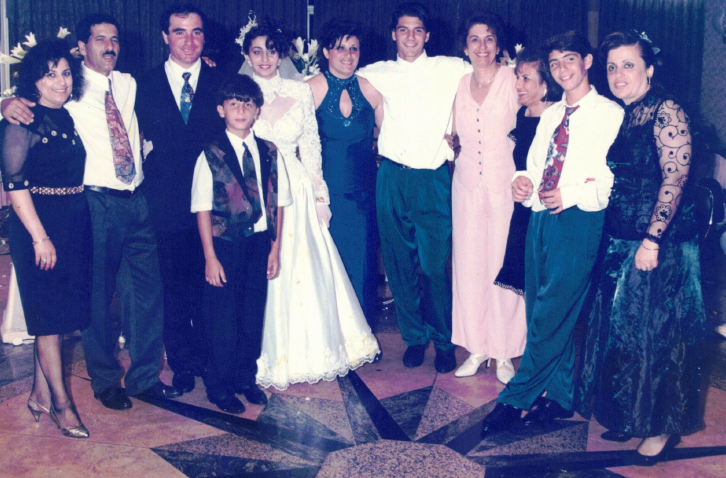
The entire Hinawi family, Rosette is at center, next to the bride
(Photo: Private album)
Today, the chain has 11 branches offering beverages, premium butcher counters, cheese delis and related products. Annual turnover stands at 100 million shekels.
“In 2004, when my sons returned from the U.S. and joined the company, my older brother asked to retire,” she recalls, describing another moment of crisis that she says was resolved with love. “My eldest son, who is now in Canada, took the reins at the time and began managing the business. When he decided to move with his family to Canada, the two sons who stayed here and I sat down, talked and made a decision. They manage, and I oversee from above. I am involved in everything. I received an open-minded education at home, and I am that way too. I have three amazing sons, and each of them is happy where he is today.”
You were widowed at 28 and never remarried.
“True. We married ‘by the book,’ as is customary with us, and it took time for the relationship to grow stronger. And just when things began to get easier and better, the man disappeared. I am a person of faith, but in the first months after his death, I was angry. I did not understand how this had happened to me. It is not that we are forbidden to remarry, but it was not in my mind. I wanted to continue his path in business and raise the children. I did not put myself at the front. I always received great support from the family, and there is no substitute for that. I also discovered strengths in myself that I did not know existed. When I took the reins, both to build the house and the business, it was not simple. It was not just keeping my head above water, but fighting and proving that, despite being a woman, I knew what I wanted and would not give up. A significant part of my self-confidence came from the education I received at home and from George himself.”
Explain.
“My parents raised me with an open and free mind. I studied and chose my path in life. And George? I lived for 11 years with a husband who one day told me he had bought me a car so I could fly even higher. It was not like today; in those years, it was a statement, proof that I was strong. The thought that I received the car because I was making an effort and succeeding gave me strength and motivation, because I understood that George believed in me.
“As a businesswoman, I always loved having a vision, seeing something others had not yet seen. After George died, I said: If my husband began the business vision, to succeed and expand, why should I stop it? If it happened today, I would fly even higher with the experience I have gained. My mother-in-law also used to tell me the Arabic saying: ‘If you grab sand, it turns into gold in your hands.’ That is the result of combining vision with the fact that we do not compromise on quality,” she says, while sending less-than-subtle hints at competitors. “As an importing chain, of course we want to make a profit, but not at any price. We will not bring in wine for one shekel and sell it for 100 shekels. My son has refined taste. We import wines from unique wineries. The value of the bottle being sold is real.”
The chain currently has 11 branches. Are there plans to expand?
“The company is young and we are planning, but then wars and things like that come along and everything stops.”
Speaking of wars, as someone born and raised here, you have been through wars. As someone who lives in a mixed city, have you ever felt uncomfortable as an Arab Christian?
“Never. I felt threatened like everyone else in the country, because a missile does not choose where to go. In general, what differences between us are people talking about? They put things in our heads that do not exist. Most people work together, get along and invite one another, and then, when a war comes, suddenly people remember to say, this one is Jewish and that one is Arab? As a person, I can live with anyone. I do not believe in differences of religion, race or gender. I invite you to believe in whatever you want, and let me believe in whatever I want. As the owner of Café Rozette in Jaffa’s Clock Tower Square, it serves for me as a place to realize a vision of coexistence and bringing together the residents of Jaffa and Tel Aviv.
“As a Christian, I love our religion, I respect the church and the priest once a week, I go to pray every Sunday, I find calm there, but I am a free person. My family’s first language is Hebrew. Our country is Israel. When I go to Amman, I always say I represent my country. Unfortunately, we have gone through a difficult two and a half years here. I do not want to get into politics, but people like Ben-Gvir and Smotrich should not represent the country. The State of Israel needs to return to the high standing it once had. For example, why wait for the U.S. to tell us what to do? For that, we need proper and strong leadership.”
As someone who lives in a mixed city, and whose family is spread across mixed cities such as Lod, do you still believe in tolerance?
“Of course. That is the long road. If the country follows the path of Ben-Gvir and Smotrich, the road will be very short. We need to learn to give way, to respect one another, in order to live here quietly and together.”
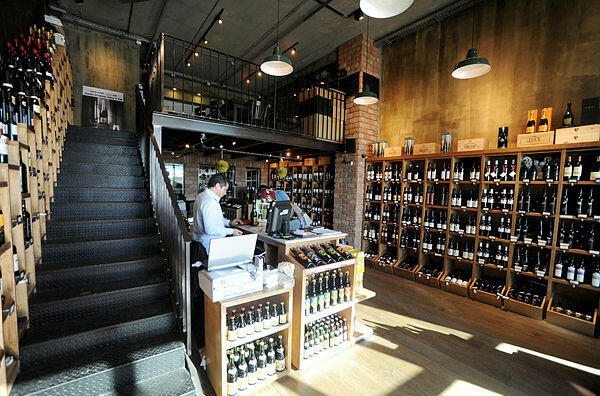
A Wine&More store
(Photo: PR)
Rosette may have reached an age and a position where, on the face of it, she could take her foot off the gas and let go. But it seems she has no intention of doing so. We speak shortly before she flies to Montreal to visit her eldest son and grandchildren, and when she returns, she says, she will continue making full use of every day’s 24 hours, pushing for new things — such as a vegetarian sandwich, which is certainly an innovation for a chain focused on meat. She will also continue training with a personal trainer twice a week, focusing on family life and finding time for friends.
“We are in a year of uncertainty, after a war. We do not know what will happen with Lebanon and Iran, and it is an election year. I get angry when I hear that businesses are closing. I advise every business owner not to give up on the business, but in this specific year, we must preserve what we have. The dollar and the euro are falling. We must be realistic, with our feet on the ground, and protect what we have. I make sure to teach the younger generation the value of tolerance, and also that not everything is money. Anyone who knows how to make money will know how to make it from anything. We make the money; it does not make us. We need to preserve values.”
Does age scare you?
“No. You cannot turn back the clock. Age guides me not to overload myself too much. To keep doing, but calmly.”
If another piece is needed in the puzzle of this busy and determined woman’s life, it can be found in her role as chairwoman of the Jasmine association and as part of its leadership. The nonprofit was founded to promote business entrepreneurship among Jewish and Arab women, enabling women in Israel to take part in the Israeli economy.
“Unfortunately, women from all sectors and layers of Israeli society still do not have rights equal to men,” she says. “Our ability as an association to strengthen women who want to grow and develop, and to act to bring more women into the business sector, is the way to create change. I bring to the role my belief that we can lead social and economic change through business and success. In principle, a woman is freed and can draw out all the strength she has only when she is strong. That is why women must be strengthened and empowered. I come to this also from my personal story. My three sons, who joined the business led by their mother, also know that women can and should lead businesses.”
You define yourself as a strong woman. Where is the softness?
“In the family. There was a period when I left everything and went to be with my son in San Diego because he needed me then. I am a mother. Nothing comes before that.”