

Israel’s government is preparing to transfer roughly 40 billion shekels, about $12 billion, in additional funding to the defense establishment, a move that would push the 2026 defense budget to 184 billion shekels, the second-highest in the country’s history after the 188 billion shekels spent in 2024.
The increase, which would require breaking the existing state budget framework and securing legislative and government approval, was agreed last week by Prime Minister Benjamin Netanyahu and Finance Minister Bezalel Smotrich after months of delayed decisions and growing mistrust between the Finance and Defense ministries.
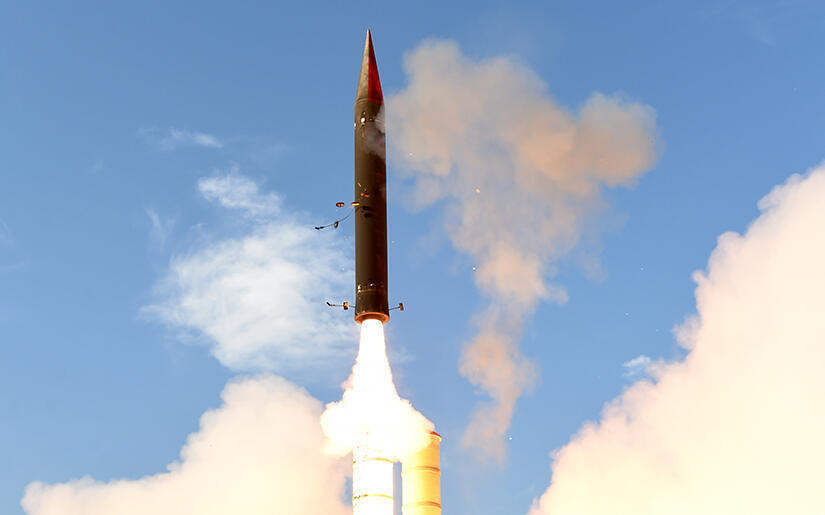
An Arrow 3 missile
(Photo: IAI)
The basic arrangement had already been reached more than two months ago: The Finance Ministry would immediately transfer 15 billion shekels, while a decision on an additional 25 billion would be made toward the end of the year. Treasury officials wanted to ensure that the military’s forecasts underpinning its funding demands were not overly pessimistic or inflated.
That distrust is expected to persist even after the additional funding is brought before the government on Wednesday. Finance Ministry officials increasingly view the defense budget as a financial “black hole” that has escaped effective control, question the management of Defense Ministry Director-General Amir Baram and warn that a security establishment still shaped by the trauma of October 7 risks losing control of public spending and damaging Israel’s long-term economic future.
The Treasury’s abrupt decision to meet much of the defense establishment’s demand has also been interpreted politically as an attempt by Netanyahu and Smotrich to strengthen their security credentials ahead of the election after a prolonged and inconclusive war eroded public confidence in their handling of defense issues.
For the military establishment, however, the immediate pressure is financial rather than political. Several missile and artillery-shell production lines at Israeli defense companies could be forced to slow or stop in the coming weeks without funding for new orders.
“This isn’t how Sparta operates. This is chaos,” a senior defense official said, referring to Netanyahu’s repeated vision of Israel becoming a more self-reliant military power.
The money is needed to replenish weapons stocks depleted during the war, cover ongoing combat costs and maintain readiness along Israel’s borders. It is also expected to help reduce the Defense Ministry’s roughly 15.5 billion shekel debt to Israel’s three largest defense manufacturers: about 5.5 billion to Israel Aerospace Industries, 7 billion to Rafael and 3 billion to Elbit Systems.
The unpaid bills are already affecting the companies. Some have delayed payments to suppliers and subcontractors. Israel Aerospace Industries reported negative cash flow of about $795 million in the second quarter, compared with positive cash flow of $170 million in the same period a year earlier, even as revenue rose 35% and its order backlog reached a record $35 billion.
Attempts by defense companies to persuade the Defense and Finance ministries to cover financing costs associated with the debt, estimated at around 1 billion shekels, have so far failed.
But the new funding is primarily intended to address immediate pressures. The defense establishment is also awaiting approval for a much larger acceleration of procurement and military buildup programs based on an additional multiyear budget of between 350 billion and 400 billion shekels.
Part of that planning is intended to prepare Israel for the possible end of current U.S. military assistance arrangements after 2028, currently worth about $3.8 billion annually.
The proposal expected to reach the government would include long-term authorization allowing the Defense Ministry to place weapons orders against additional funding beginning in 2027 and extending for another 10 to 15 years.
Those commitments would bind future governments to enormous expenditures at a time when Israel is approaching an election.
Defense officials also warn that continued delays could cause Israel to lose production slots at U.S. manufacturers to other countries engaged in major rearmament programs. In some cases, that could postpone delivery of aircraft and helicopters by years.
Procurements under consideration include 12 Apache attack helicopters, eight CH-53K heavy-lift helicopters, missiles and other munitions, bunker-busting weapons, unmanned vehicles for border defense and remotely operated naval vessels.
Israel also approved the purchase of two additional fighter squadrons in May, comprising F-15IA and F-35 aircraft.
On Thursday, the second Boeing aerial refueling aircraft ordered by Israel arrived at Nevatim Air Base, four and a half years after the order was placed.
For defense officials, that delay illustrates the problem confronting Israel’s military buildup: In a world where countries are rearming and production lines are booked years in advance, even hundreds of billions of shekels cannot recover time lost to delayed decisions.