

Million Dollar Baby was playing at Rav Chen in Petah Tikva in 2005 when Yakov Borover reported for his first shift as a cinema usher. He had dreamed of working in a movie theater even before joining the army and had put his name on a waiting list for the coveted job. When the manager finally called him for an interview and asked when he could start, Borover had an immediate answer: “Now.” That “now” has lasted more than 20 years.
Today, at 39, Borover manages Planet’s cinema operations in three countries: Israel, Romania and Bulgaria. Yet when he talks about the industry and the route that took him from an usher in Petah Tikva to movie theaters across Europe, the enthusiasm is still unmistakable. “What does it mean to work in cinema? It means bringing happiness to people,” he said.
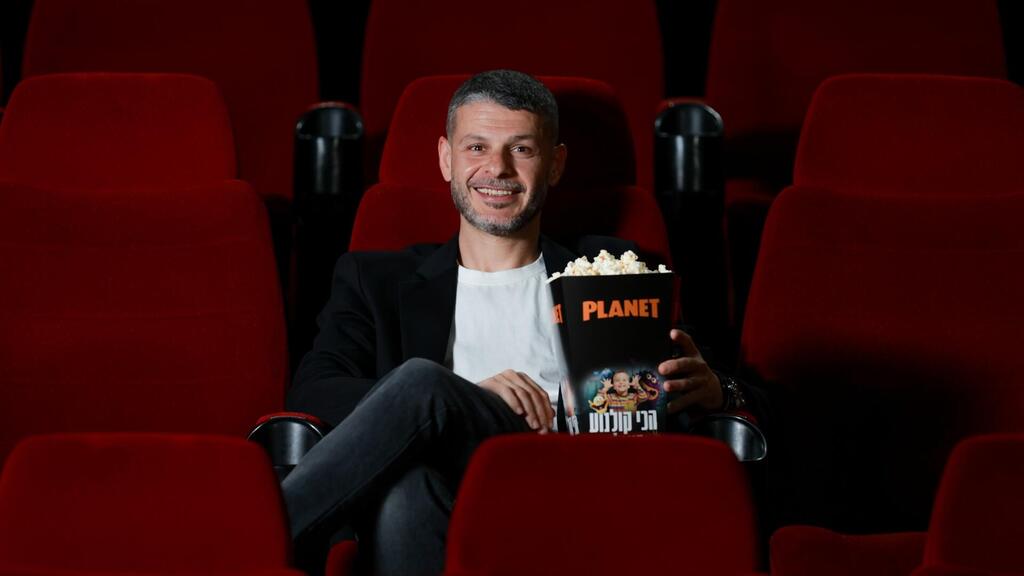
Wearing a tailored jacket over a white T-shirt, Borover meets us at Planet in Rishon LeZion, inside an empty theater opened specially for the interview on a sweltering summer vacation day. Outside, children and parents move between screening rooms, arcade machines and crowded food counters. Borover rejects the idea that cinemas have become mainly a refuge for parents with children escaping the heat, or older audiences taking advantage of discount days. He points to the success of Israeli films such as Saving Shuli San and Kupa Rashit, each of which drew more than a million admissions, alongside blockbusters and premium-format releases.
“People come because they want to sit together, feel the tension, laugh, feel and experience something,” he said. “When DVDs and videotapes arrived, people also asked whether cinema had a future. Cinema keeps changing, but we’re still here, receiving thousands of viewers and giving a lot of people a good time.”
The real challenge, he said, is getting audiences back into theaters after years of disruption. The pandemic, Hollywood writers’ strike and the war in Israel all contributed to shortages of major releases. “When there are lots of good movies, people come in huge numbers,” Borover said. “When there aren’t enough films, it’s like a supermarket without enough products. Why would people come?”
Planet’s answer has been to make the theatrical experience increasingly difficult to replicate at home. Its Israeli complexes include IMAX theaters, 4DX auditoriums with moving seats, scents, water, air, bubbles and fog, and ScreenX theaters that extend the image across three walls for a 270-degree viewing experience. “These are experiences that beat watching at home,” he said. “The audience votes with its feet.”
An industry moving from crisis to crisis
Borover was born in Samarkand and immigrated to Israel with his family in the 1990s, settling in Petah Tikva. He served in the Israeli Navy and, after completing his military service in 2008, returned to work as an usher, this time at Planet in Ayalon Mall. He briefly left the cinema business to work in security at the airport, but quickly realized that movies had become more than a temporary job. He returned as a projectionist at the Seven Stars Mall in Herzliya.
At some point, Borover heard that Planet was part of an international cinema network with operations in Europe and decided that one day he would get there. That opportunity came in 2017, when he was asked to manage the company’s operations in Bulgaria. A year and a half later, he moved to Romania. By his early 30s, he had already successfully managed cinema operations in two countries. Then came the biggest test: overseeing both markets simultaneously as a global pandemic abruptly shut theaters around the world.
“Nothing prepared us, or the world, for COVID,” he said. “We closed all our cinemas across the global network at once. We thought we would reopen within two or three months, and in Romania and Bulgaria we stayed closed for more than half a year.”
The theaters later reopened under restrictions, closed again and struggled through prolonged uncertainty. For Borover, the most difficult challenge was the workforce. At one point, roughly 1,000 employees in Romania were under his responsibility. Financially, the reality was simple: theaters lost money. Operators negotiated with mall owners over rent, governments in some countries offered financial assistance, and employees adapted to the uncertainty.
Borover also found himself establishing Romania’s cinema association because the government would negotiate reopening conditions only with an industry body rather than individual companies. “They said they wanted an association, so I gave them an association,” he said. He brought together the three largest cinema operators in Romania and met with the prime minister as well as the culture and health ministers to work toward reopening theaters. Borover recalls that the Romanian prime minister was particularly surprised that an Israeli was leading the effort.
Eventually, the cinemas reopened with restrictions, even though doing so was not necessarily profitable. “It was important to get the wheels moving again,” Borover said.
The broader international group underwent its own crisis. Planet in Israel had been part of the Cineworld group led by Israeli brothers Mooky and Israel Greidinger, which became the world’s second-largest cinema operator after acquiring U.S. chain Regal for about $3.5 billion in 2018. The pandemic later pushed Cineworld into Chapter 11 bankruptcy proceedings in the United States, the Greidingers left the company and new management took over.
Borover stresses that the U.S. bankruptcy process did not affect Planet’s operations in Israel. He also sought to clear up another source of confusion: businessman Shlomi Nachaisi’s Ami Group bought the Planet Rishon LeZion building from the Greidinger family for NIS 300 million, but not the cinema operation itself. Planet continues to operate independently and rents the property from Ami Group.
The road to Europe ran through Be'er Sheva
One of the most important stops in Borover’s career came at Planet in Ayalon Mall, where he also met his wife, Chen, then a shift manager at the concession stand. When a new executive joined the company, Borover reminded him of his ambition to work in Europe. The response was that he first needed to travel a longer road in Israel. Soon afterward, the company was preparing to open a new cinema in Be'er Sheva.
“The manager called me and said, ‘Listen, the road to Europe goes through Be'er Sheva,’” Borover recalled. He and Chen moved south. They were not yet married and had no children. Borover was 28 and Chen was 25.
A year and a half later, in April 2017, The Fate of the Furious was filling theaters when Borover received another call. The company’s chief operating officer was coming to Be'er Sheva to meet him. For Borover, major moments in his life are still linked to whatever movie happened to be playing at the time. When he took over Israel in the summer of 2025, it was Saving Shuli San. In 2017, it was Fast & Furious.
The executive sat down across from him and said there was a job available in Europe. “I didn’t ask which country, I didn’t ask what the salary was,” Borover said. “I immediately said, ‘I’m interested. Tell me when and I’ll get on a plane.’”

(Photo: Yaron Brenner)
Then came a month of waiting without knowing where he was going. Finally, the call arrived: on June 1, he was expected in Bulgaria. Borover asked to delay the move by a few days to attend a close friend’s wedding, then flew out. Chen remained in Israel preparing for their own wedding that August.
A little over a year later, while Borover was dancing at another friend’s wedding, the phone rang again. This time the company needed him in Romania. The decision was harder. Chen was pregnant, and Borover knew how consuming managing another market would be. For once, he did not answer immediately and said he needed to consult his wife.
Her response, he recalls, was simple: “Yakov, whatever you decide, I’m with you. You want Romania? Romania.”
In February 2019, just 10 days after their daughter Mila was born, Borover flew to Romania. For six months, he traveled back and forth while waiting for Chen and their daughter to receive visas. Then COVID arrived. By the time they finally joined him in Romania, Borover avoided traveling back to Israel because he feared being stranded away from the Bucharest headquarters while decisions about opening and closing cinemas had to be made almost daily.
“The pandemic taught us to reinvent ourselves and that nothing is certain,” he said. “Everything can go from zero to 100, and from 100 to zero.” When theaters reopened, some operated at only 30% capacity, with one occupied seat followed by two empty ones. “You’re operating cinemas in the least profitable way possible,” he said, “but you still know the most important thing is to start moving the wheels again.”
After two years in Romania, Borover was asked to take responsibility for Bulgaria as well while continuing to live in Romania. He agreed. Then, in 2025, another call came from the group president responsible for Europe: he wanted Borover to take over Israel.
Borover had one question: Israel as well, or Israel only? “I said I wasn’t willing to take only Israel. That was too small for me,” he recalled. “I wanted Israel in addition to Romania and Bulgaria.” Since June 2025, that is exactly what he has done.
Between Romania and Israel
Borover lives near Bucharest with Chen and their two children, Mila, 7½, and Leo-Ron, 15 months. He describes a sizeable Israeli community in Romania, including many Israelis working for and managing international companies. His daughter attends a British school, while his son goes to a Chabad kindergarten. Borover does not speak Romanian, but Mila does, along with English, Spanish and Hebrew, and frequently translates for him. She has even appeared in a Romanian film.
“We enjoy it here,” he said. “Life in Romania is calm, people are very warm and they love Israel.” There are still thoughts of returning home eventually, although when reminded that he described Israel alone as “too small” for him, he laughed. “There’s a thought. I didn’t say it was going to happen.”
Across all three markets he manages, Borover sees one particularly strong similarity: audiences love locally produced films. In Israel, he says, that phenomenon is especially powerful and gives the market significant potential for growth.
He also pushes back against the perception that Israeli cinema tickets are especially expensive. According to Borover, the average ticket price in Israel has not risen since 2016, while about 60% of moviegoers do not pay full price because they purchase through clubs and discount programs. The full Israeli ticket price is NIS 49 before discounts, he said, while in Romania it is 50 lei without comparable discount clubs. Planet has also introduced a family package offering 10 admissions for NIS 250, or NIS 25 per ticket. He notes that Israel is also unique among the group’s markets in allowing moviegoers to bring their own popcorn and drinks into theaters.
TikTok changes the box office
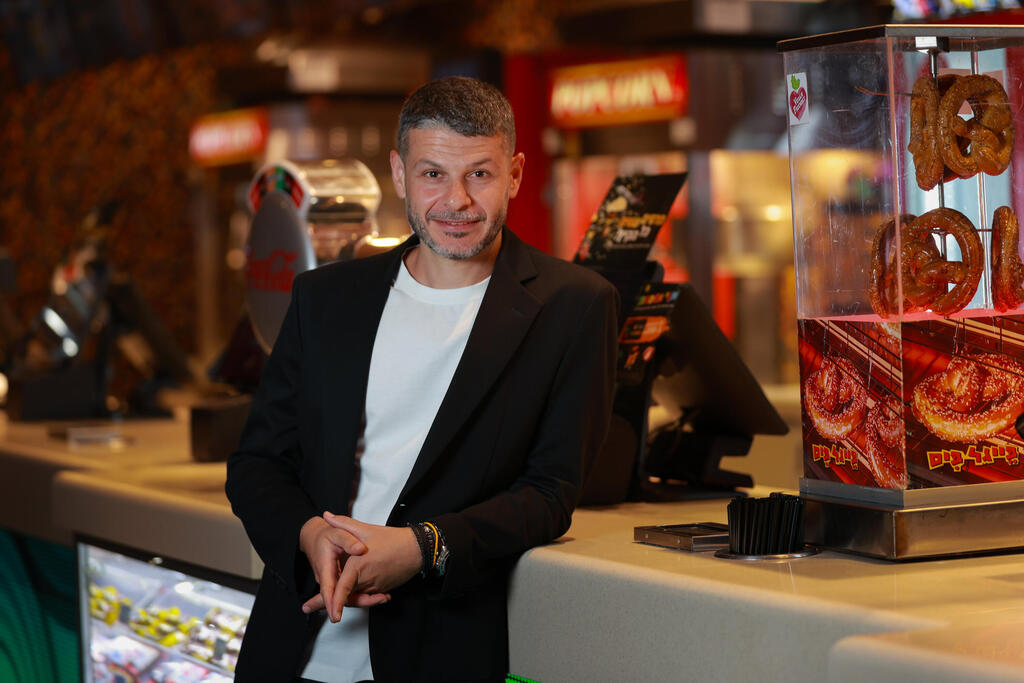
Perhaps the biggest surprise of the past year, Borover said, has been the power of TikTok to determine which films succeed. Every August, the company begins examining the following year’s release slate and estimating audience demand. But this year, three films, The Housemaid, Obsession and Backrooms, dramatically exceeded Planet’s expectations after exploding on TikTok.
“This year something happened that I had never seen in my entire career,” Borover said. “We didn’t expect those three films to blow up the way they did. They simply took off because of TikTok and because people want to be part of the conversation.”
(Photo: Yaron Brenner)
The same social element, he argues, remains central to why people continue going to the cinema rather than watching at home. Borover recently watched The Odyssey in Israel after returning from a family weekend in Eilat. He dropped everyone at home and drove to Planet Rishon LeZion for an 8:30 p.m. screening despite the film’s three-hour runtime.
For a man who says almost every part of his life is managed through his phone, three uninterrupted hours is no small achievement. His daughter jokes that taking away his phone would be like taking away his hand. Yet Borover said an entire theater remained focused on the movie. Some may have occasionally checked their phones, particularly in Israel, where breaking security developments can make it difficult to disconnect completely. The weekend he attended the screening was marked by uncertainty over whether another strike in Iran might occur.
Even so, he says the theater offers something increasingly rare: collective attention. “When you go into a theater and watch Shuli or Kupa Rashit with everyone crying with laughter, they definitely aren’t looking at their phones,” he said. “Cinema is a kind of disconnect from the world outside, especially today.”
The industry has changed dramatically since Million Dollar Baby played during Borover’s first shift in 2005. Planet is now part of a large international group with hundreds of cinemas, while the experience surrounding the film has become almost as important as the movie itself: arcade machines, concessions, merchandise, reclining seats, motion effects, IMAX and screens wrapping around the audience.
For Borover, however, the basic appeal has remained remarkably consistent. His daughter Mila is a major fan of Moana and Toy Story, and the next film on their summer list is Minions. “She loves coming to work with Dad,” he said.
Given how Borover himself got started, perhaps that is hardly surprising.