


Gas stations across the West Bank shut down for 30 minutes Tuesday as part of a coordinated private-sector protest over a worsening cash crisis in the Palestinian banking system.
The protest, held from 11 a.m. to 11:30 a.m., came amid warnings of operational disruptions in parts of the Palestinian banking and business sectors. The crisis centers on a growing surplus of Israeli shekel banknotes that Palestinian banks are struggling to transfer into the Israeli banking system.
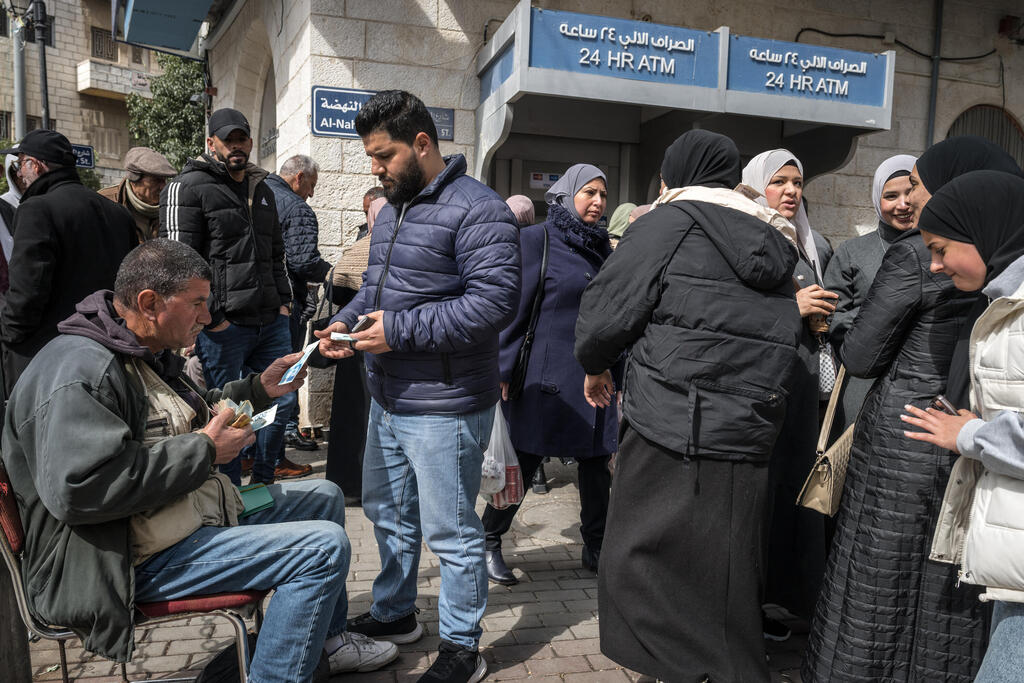
Palestinians exchange money at a bank terminal in Ramallah
(Photo: Sergey Ponomarev/Getty Images)
The buildup has strained bank vault capacity, led to limits on new cash deposits and disrupted businesses that rely heavily on cash.
Nassar Nassar, a Palestinian businessman and chairman of private-sector associations, told ynet that the problem stems from years of cash accumulation, some of which he said has difficulty passing regulatory checks on its source.
“The money simply accumulated in the banks, some of it from regular commerce, but some from more problematic sources such as money laundering, land purchases and services inside the West Bank, or cash transactions without orderly reporting,” Nassar said.
He said tax evasion and undeclared transactions also contributed to the unusually large volume of banknotes in the system.
Palestinian banks must meet international anti-money laundering standards, while Israeli banks demand full transparency about the source of funds before accepting them, Nassar said. The result has been a bottleneck that has worsened in recent years.
“The system is built on cash, and the transition to modern banking has not been completed,” he said. “That creates a situation in which money flows in but does not flow out.”
The Palestinian private-sector coordinating council blamed Israel for the crisis, saying restrictions on transferring surplus shekels into the Israeli banking system are the main cause of the cash buildup. The council said Israel bears overall responsibility for the direct harm to the Palestinian economy and called on the international community to intervene to ensure the rapid removal of surplus currency.
Banking officials in the Palestinian Authority described vaults as nearly full, with banks increasingly limited in their ability to accept new deposits, especially cash. Small and medium-sized businesses reported refusals to accept shekels, delays in deposits and growing difficulty paying suppliers and employees.
The crisis has hit cash-heavy sectors especially hard, including fuel, retail and services.
A Palestinian economic official familiar with the issue said the Israeli shekel is actually the fourth-most important currency in the local economy, challenging the common view that it is the dominant currency in Palestinian economic activity in both Gaza and the West Bank.
The official said the Jordanian dinar is the main currency used for wages, savings and much everyday trade, followed by the U.S. dollar for large transactions and the euro for foreign trade and money transfers. The shekel, the official said, is used mainly in daily commerce between areas of the Palestinian Authority and in cash purchases by Arab citizens of Israel who enter Palestinian areas.
Still, the official said, the shekel remains dominant in terms of banking infrastructure and clearing arrangements with Israel, giving it an economic impact far greater than its formal share of circulation.
Efforts to resolve the crisis are continuing through coordination among Palestinian banks, the Palestinian Authority and Israel’s banking system, but officials familiar with the matter said progress has been slow and gaps remain significant.
Business leaders warned that without a quick solution, the crisis could broaden, causing salary delays, reduced trade activity and deeper uncertainty in the market.
The private sector says the issue is not a temporary disruption but a structural problem that has affected the Palestinian economy for years, erupting whenever the financial system reaches the limits of what it can absorb.