

How do they handle their overdraft, how much did they pay for their home, and what dream did they fulfill amid the war? People from across Israel speak candidly about everyday life, before and during the war. This time: the Peretz-Gorokhod family from Harish.
Pictured: Livnat (44), Maxim (45), Sahar (7), Anna (8), Daniel (13) and their dog, Toy.
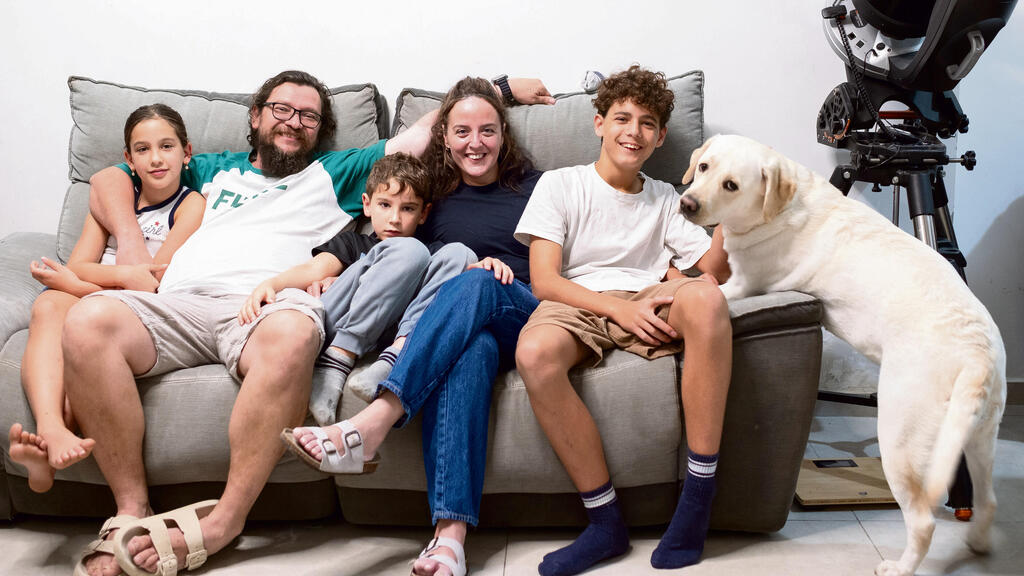
Peretz family, on the couch
(Photo: Assi Haim)
The apartment? A garden apartment purchased about seven years ago for NIS 1.3 million.
Harish? Livnat: "We moved here from Kfar Saba because my parents bought a home here, and that made it financially possible for us too, plus the advantage of living close to them. I don't really want to stay, and we've already started looking elsewhere, but we're still here mainly because of the kids. They don't want to leave. There's no culture here, the education isn't good, there's nothing to do. It's not a lively city, and it has a very strong religious character." Maxim: "What bothers me most is that the education system here just isn't good enough."
How did you meet? Maxim: "We worked together at a pastry shop 16 years ago. I'm originally from Russia. I immigrated to Israel when I was 16, and that's when I started working too. I was making dough, and that was how I supported myself, so I decided to study it. It made me feel good."
Livnat? "I'm originally from Afula, and after my army service I moved to Tel Aviv, knowing I wanted to work in a restaurant. These days, anyone with two eyes and two hands can get a job in a kitchen. Back then, kitchens were sacred territory, reserved for people with experience. Nobody would hire me, so I worked at an eyeglass store until my boss found me a job. He wanted to get rid of the pest who only wanted to work in a kitchen and was just passing the time in his store. I worked there until I left for New Zealand."
New Zealand? Livnat: "I was there for about two years. I visited my sister, traveled around and then stayed in Auckland to work at a restaurant. But I missed my parents, speaking Hebrew, my friends and everything familiar to me so much that I couldn't take it anymore. I hated feeling like a foreigner, so I came back and worked at several restaurants until I met Maxim. After Daniel was born, I was between jobs, and Maxim encouraged me to open my own pastry business. Daniel grew up surrounded by dough, constantly covered in cocoa."
A pastry business? Livnat: "I never had the courage to open a business. The idea really intimidated me, but Maxim pushed me, so I borrowed NIS 20,000 from my father and bought some equipment." Maxim: "We cleared out Daniel's playroom and turned it into a pastry kitchen in our small third-floor apartment in Kfar Saba." Livnat: "I specialized in petits fours and started offering them to catering companies. I'd go door to door with a little cooler, giving people samples to taste, and gradually started building a customer base. Little by little, the business grew. Then Maxim was fired from his job and joined me. We called it 'Libi.'"
Libi? Livnat: "I saw the potential, but I didn't know how to manage a business or set prices. I was charging far too little considering the amount of work I put in and the quality of the ingredients, but there was demand. As the business grew, we moved out of the apartment and rented a kitchen in Hod Hasharon."
Maxim: "That's where I introduced baked goods, and we started supplying cafés. And through it all, I remember so much crying. It was just the two of us running the business. We didn't have enough money to pay employees, and even when we did, they were constantly calling in sick or not showing up. You do everything yourself: orders, preparation, deliveries, cleaning. You're on your feet 24 hours a day and you never see your kids."
Livnat: "That's what makes you cry. You can't manage to balance work and the children, and you're completely on your own. For example, I'd commit to making thousands of sufganiyot, the traditional Hanukkah doughnuts, and then, on the morning we were supposed to start preparing them, I'd get a call from an employee saying, 'I can't get out of bed.' Suddenly, you're all alone, and you start crying because you know you have no choice. Hanukkah is our nightmare. But I always knew it was a period we had to get through. I'd tell myself, 'OK, just hang in there a little longer. Don't break down.' And eventually, it happens."
It happens? Livnat: "Suddenly, you can afford to hire more employees, get someone to handle the bookkeeping, maybe even bring in a delivery driver once or twice a week. The first time I told myself, 'It's happening without me,' was this past Hanukkah. I was in bed when, in the middle of the night, an employee sent me a photo of beautifully risen doughnuts. That was when I realized I'd made it. By then, we were already operating out of the production facility we'd opened in Yokneam."
Yokneam? Livnat: "It's a 280-square-meter production facility we moved into five years ago, with a factory store next door selling bread, sandwiches, pastries and coffee. We had to develop that side of the business too, finding places willing to buy premium, handmade baked goods and pay a little more for them. And the customers came."
How are you doing financially? Maxim: "The business provides us with a very good living. We're doing just fine. No complaints."
What's next? Livnat: "We're always thinking about the next step. We've just opened a new place, a bakery at the Mul HaHof mall in Hadera."
Maxim: "After we'd finally managed to build ourselves a normal, comfortable life, we basically said, 'We're bored. Let's open another store.' And suddenly, we were back where we started 15 years ago."
Livnat: "The store next to the factory in Yokneam was a success, so we said, 'Why stop there?' Let's invest NIS 2 million in a beautifully designed, high-end bakery. It's a major investment and a huge risk, and nobody knows us in Hadera. But I keep telling myself, 'Hold on, give it a chance.' We're there all the time, and luckily, the Yokneam operation runs without us. There are 30 employees and a factory manager there, and I'm learning to let go."
The new bakery? Livnat: "We thought we'd just take what worked in Yokneam and copy and paste it, but it doesn't work that way. The peak hours are completely different. I feel like people are a little hesitant to come inside because they don't quite understand what this place is that has suddenly appeared. Everything is ultra-modern and meticulously designed. We even created a sourdough bread cabinet like something you'd find in your grandmother's house, but people still don't dare go near it. I think we intimidate them a little. It's unfamiliar, but I'm sure it'll happen. Little by little, people will discover us."
How do you like to spend your free time? Maxim: "Going out to eat." Livnat: "Mostly in Pardes Hanna and Haifa. There isn't even one decent restaurant in Harish."