


A New York court ruled over the weekend that a painting valued at an estimated $25 million, looted by the Nazis during World War II, will be returned to the heirs of a Jewish art dealer.
The decision by Supreme Court Justice Joel M. Cohen effectively ends a complex, cross-continental legal battle that lasted more than 11 years. At the center of the case was an unusual dispute between the grandson of the original owner and the Nahmad family, a prominent Jewish dynasty of art dealers considered among the most influential players in the global art market.
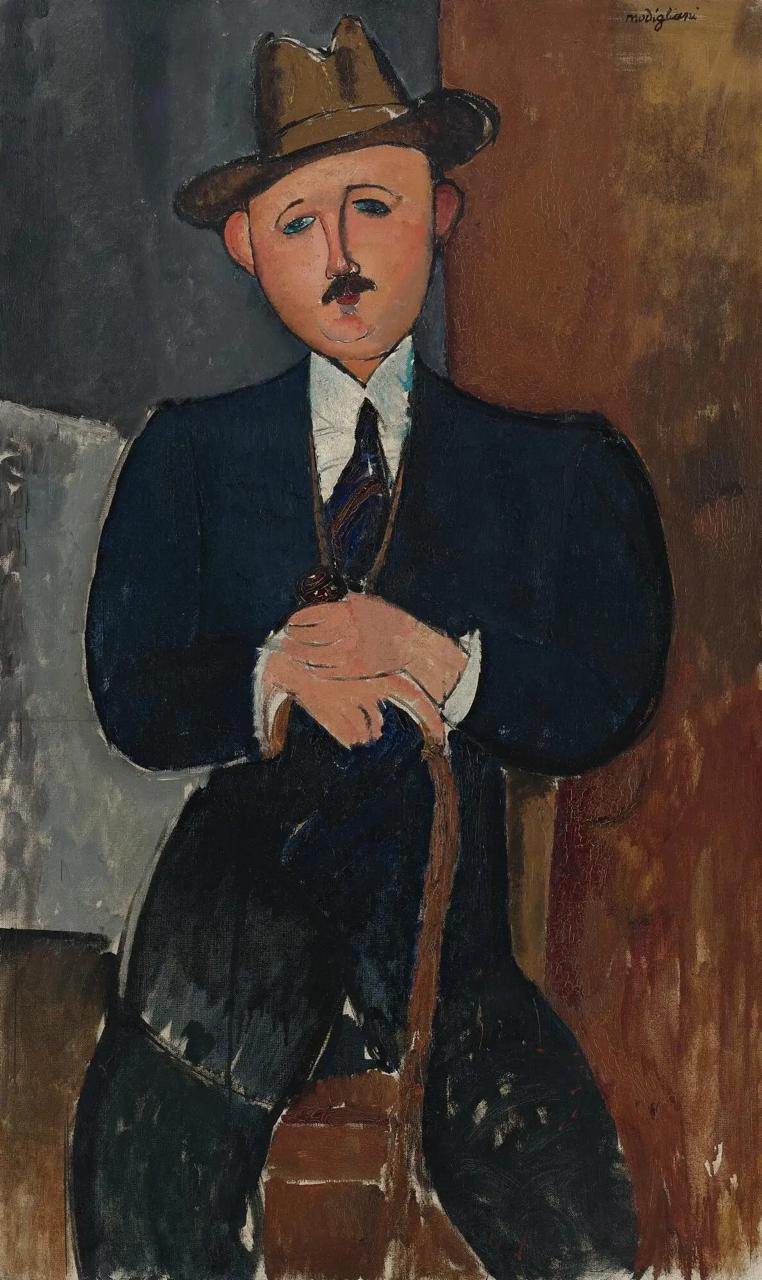
The artwork at the heart of the dispute is “Seated Man with a Cane,” painted in 1918 by Jewish-Italian artist Amedeo Modigliani. Modigliani’s works are among the most sought-after in the world, often fetching tens of millions of dollars at auction.
The painting was purchased in 1996 by a holding company linked to the Nahmad family at a Christie’s auction in London for £2 million. Since then, it had been stored in a secure, tax-free storage facility in Geneva, known as a “freeport,” where billionaires often keep valuable art away from public scrutiny.
In 2008, the Nahmad family attempted to sell the painting at Sotheby’s in New York, but it failed to attract buyers.
A trail back to Nazi looting
The painting’s history reflects the broader mechanisms of Nazi-era looting.
Oscar Stettiner, a Jewish antiquities and art dealer with British citizenship who ran a gallery in Paris, fled the city in 1939 ahead of the German occupation, leaving his assets behind. Nazi authorities seized the painting, and a French collaborator, Marcel Philippon, sold it on their behalf.
After the war, Stettiner sought to recover his property. A French court ruled in his favor in 1946, but by then the painting had already changed hands, and the buyer claimed it was no longer in his possession. Stettiner died in France in 1948 without ever recovering the work.
Offshore ownership and legal battle
When Stettiner’s grandson, Philippe Maestracci, launched legal action to reclaim the painting, the Nahmad family fought the claim with a team of lawyers.
For years, representatives of Monaco-based billionaire David Nahmad argued that he did not personally own the painting. Instead, they said it belonged to a Panamanian holding company, International Art Center.

David Nahmad with an Arman artwork at his Monaco home
(Photo: AP/John Leicester)
The use of offshore companies in tax havens is common in the art world, often allowing collectors to obscure ownership and gain tax advantages.
That defense collapsed in 2016 following the Panama Papers leak, which revealed that Nahmad was the sole owner of the company. Swiss authorities subsequently raided the Geneva storage facility and seized the painting.
Nahmad later acknowledged ownership but maintained that he had purchased the painting “in good faith.” As evidence, he noted that the work had been loaned to an exhibition at the Jewish Museum in New York in 2004.
“Would someone who had doubts about stolen art dare to lend it to a Jewish museum?” Nahmad said at the time.
His legal team also argued there was uncertainty over whether the painting in question was the same one that had belonged to Stettiner.
Court rejects defense
Judge Cohen rejected the Nahmad family’s arguments outright.
He ruled that the defense failed to present any evidence that another party had owned the painting prior to its looting, and emphasized that Stettiner never relinquished his property voluntarily.
The ruling relied in part on the 1946 French court decision and documentation showing the painting had been exhibited in Venice in 1930 under Stettiner’s name.
A photograph of the painting from 1950 further reinforced the claim, showing the words “stolen” and “Stettiner family” clearly written on the back. The family name still appears on a label affixed to the painting.
Despite the ruling, Cohen said he did not accuse Nahmad of concealing the artwork or misleading the Stettiner family over the decades. He noted that Nahmad was not involved during the period when the painting was hidden and only entered the picture when it was purchased in 1996.
Instead, the judge directed criticism at Christie’s auction house, saying it had provided an inaccurate and misleading provenance in its 1996 sales catalog, whether intentionally or not. That failure, he said, enabled the painting’s sale to the Nahmad family.
Christie’s declined to comment on the ruling.
'The journey is complete'
Maestracci said he was “happy and satisfied that my grandfather’s journey has finally been completed.”
His lawyer, Philip Larrigan, accused the Nahmad family of deliberately prolonging the case in an effort to exhaust the heir and force him to give up, despite what he described as clear evidence.
A lawyer for the Nahmad family declined to comment.