

Israeli cybersecurity startup Huskeys has raised $27 million in a Series A funding round led by Blackstone, just five months after emerging from stealth, bringing its total funding to $35 million as it seeks to build security technology for a web increasingly dominated by artificial intelligence agents.
The company said the investment marks the first time Blackstone has led an early-stage investment in a cybersecurity company. The U.S. investment giant is the world’s largest alternative asset manager, with more than $1.3 trillion in assets under management.

The round also included strategic investments from Okta and Zscaler, along with participation from Skinos Ventures, the fund founded by Israeli cybersecurity entrepreneur Shlomo Kramer and Yishai Yuval, as well as Merlin Ventures, Bright Pixel and SV Angel.
Senior executives from companies including Google, Microsoft, Palo Alto Networks, Cloudflare, Check Point, Amazon Web Services and Intel also participated, according to Huskeys. Individual investors included Israeli actor and comedian Assi Cohen and mentalist Lior Suchard, who also advises the company.
Founded in 2025 by CEO Itai Gafni and Chief Technology Officer Roy Weisfeld, both veterans of Unit 8200, the Israeli military’s elite signals intelligence and cyber unit, Huskeys is developing technology to manage and secure internet traffic without requiring companies to replace their existing security infrastructure.
Since emerging from stealth, Huskeys said it has expanded internationally and added major customers, including TikTok, Legoland, digital health company Ro, Blackstone and AI platform Hugging Face.
Securing an internet increasingly run by AI
Huskeys is positioning its technology as the foundation of a new cybersecurity category it calls Network Edge Security Management, or NESM.
The platform integrates with organizations’ existing web application firewalls, or WAFs, and other network security products, providing security teams with a consolidated view of internet traffic. It is designed to identify risks and allow companies to adjust security policies in real time without replacing existing systems.
Huskeys is increasingly focusing on what it calls “agentic traffic” — internet activity generated by AI agents and other autonomous systems rather than directly by humans.
The company says non-human traffic has already surpassed human-generated traffic and cites projections that it will account for 70% of internet traffic by 2027.
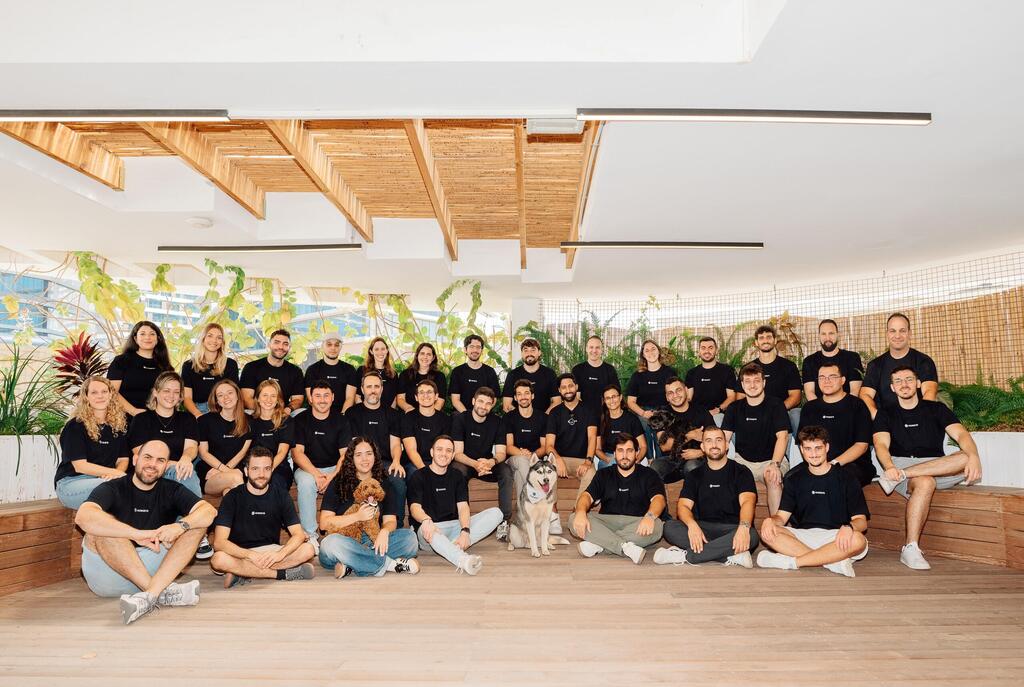
Huskeys team
(Photo: Netanel Tobias)
That shift presents companies with the challenge of distinguishing legitimate autonomous activity from malicious traffic in real time. Blocking legitimate AI agents could disrupt services and cost companies revenue, while allowing malicious agents through could expose their systems to cyberattacks.
“AI transformed the way the internet operates and brought with it new security risks,” Gafni said. “In a future where most identities operating on the web will be autonomous agents, the market already understands the magnitude of this shift and the need for the new category we are building.”
The company's partnerships with Okta and Zscaler are intended to combine identity and network information, allowing customers to analyze the behavior of AI agents across the internet and identify potential threats.
Huskeys said the integrations are based on its view that cybersecurity will increasingly require companies to understand not only network traffic but also the digital identities behind autonomous activity.
From web firewalls to AI agents
Kramer and Eran Reshef, both prominent figures in the development of web application firewall technology, have backed Huskeys. The company said their involvement reflects a belief that its technology represents an evolution of traditional WAF security rather than a replacement for it.
Huskeys also offers what it calls “virtual patching,” designed to protect organizations against newly discovered vulnerabilities before developers can repair the underlying software.
As AI tools make it possible for attackers to discover and exploit vulnerabilities more quickly, Huskeys says its technology can block attempts to exploit them at the network edge within minutes, giving development teams additional time to fix the underlying code.
“Five months ago, we exited stealth with a clear vision: to build a new network security category for the AI era, whose momentum we could already see accelerating,” Gafni said.
“Artificial intelligence has changed the way the internet operates, bringing enormous opportunities alongside new security risks and the potential for lost revenue,” he added. “We believe that in the near future, most identities operating on the web will be autonomous agents, and organizations will need a new infrastructure capable of identifying, securing and managing them.”
Gafni said the new investments and partnerships demonstrated growing industry recognition of the shift toward autonomous internet traffic.
Adam Fletcher, Blackstone’s chief information security officer, said AI-generated traffic and increasingly fragmented network environments were changing how companies protect internet-facing applications.
“The way organizations secure internet-facing applications is undergoing a fundamental transformation,” Fletcher said. “AI-driven traffic and increasingly complex and fragmented edge environments require a new approach to security management.”
He said Huskeys had developed a platform capable of operating across enterprise networks ranging from relatively simple systems to large and complex environments.
“We believe the company is well positioned to redefine how organizations manage network security,” Fletcher said.