


The timing, coincidentally just before the war with Iran and the Iranian strikes on energy facilities in Qatar, saw another unexpected regional player enter the global race to search for helium, a gas now in short supply: Jordan, Israel’s eastern neighbor.
On February 2, reports in Jordan said that the Ministry of Energy and Mineral Resources signed a memorandum of understanding with the British company Hotspur Helium to begin exploration and drilling for helium in the Dead Sea region over a period of two years. The agreement was signed on the Jordanian side by Energy Minister Saleh Ali Al-Kharabsheh.
ya alla 18.05.20226
(Source: Lior Sharon)


Al-Kharabsheh said this is the first agreement of its kind dedicated to helium exploration and that the project represents a unique opportunity to open new horizons. “We seek to utilize Jordan’s natural resources in line with the vision of economic modernization and the need to focus on high value-added sectors,” he said, adding that the company submitted a work plan to be carried out over two years and that if results are positive, the process would expand into a concession agreement for helium exploration.
According to the memorandum, the company is committed to conducting surveys and field studies, including the preparation of geological maps of gas reservoirs and an assessment of the economic feasibility of the expected quantities. The company will also share knowledge and train national personnel in the field. Although it is too early to place hopes on the project, the Jordanian Al-Mamlaka channel noted in February that it could contribute to the national economy and position Jordan as a global producer of rare gases. The signing was preceded by government approval in November 2025.
In the months since, including the weeks of war with Iran, the global need to find helium has become even more critical. Disruptions to QatarEnergy facilities in Ras Laffan have also affected helium production, with the site considered one of the world’s most important helium production hubs.
As recalled, on March 2, in the midst of the war, QatarEnergy announced the suspension of liquefied natural gas production and related products due to an Iranian strike targeting facilities in Ras Laffan and Mesaieed. Qatar’s defense ministry said Iran had attacked using two drones: one targeting a water tank belonging to power stations in Mesaieed and the other targeting an energy facility in Ras Laffan owned by Qatar’s energy company. On March 4, Qatar declared force majeure, temporarily suspending its contractual obligations due to the events. Later that month, additional Iranian strikes on Ras Laffan were reported. QatarEnergy said the industrial city had sustained significant damage.
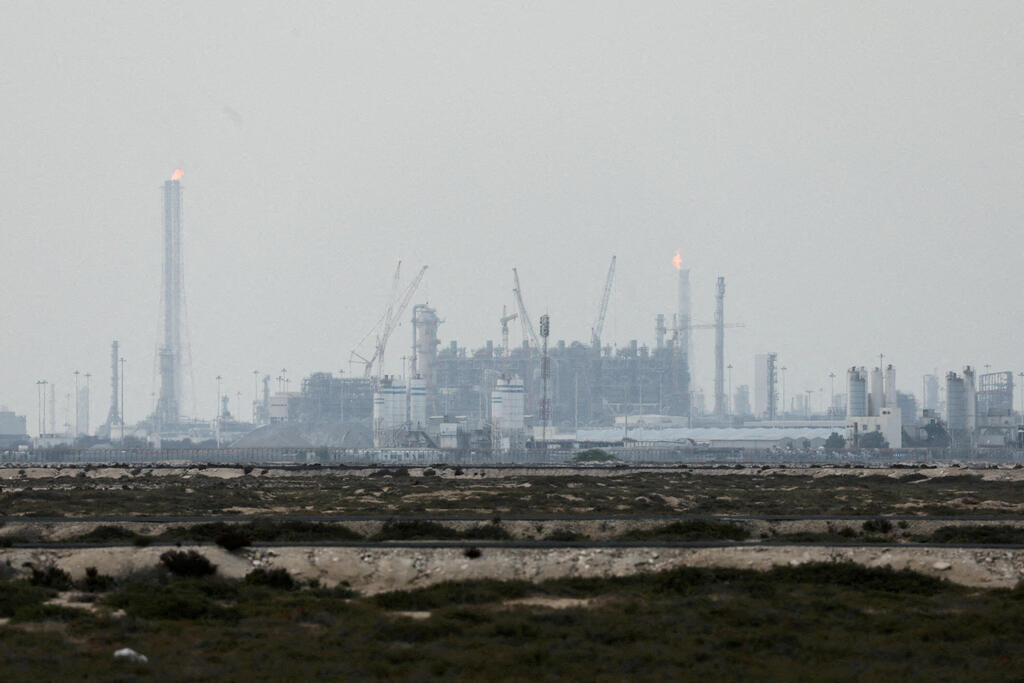
QatarEnergy's natural gas facilities
(Photo: REUTERS/Stringer/File Photo)
Helium is used in a wide range of industries, including deep cooling, MRI machines, semiconductor manufacturing and fiber optics, as well as scientific research, aviation and space. A report in the Qatari newspaper Al-Araby Al-Jadeed in April noted that Qatar had developed over more than a decade into a dominant force in the global helium market, reaching about 35% of global production, largely thanks to the same facilities Iran targeted in Ras Laffan, which produced about 2.6 billion cubic feet of helium annually.
Al-Araby Al-Jadeed added that the first global impact of Qatar’s production halt was a spike in prices. Economic reports indicated that helium prices have doubled since the war with Iran began and warned that further increases are expected if disruptions continue.
QatarEnergy extended the force majeure period on May 4, allowing it to continue temporarily suspending its contractual obligations. The company has not issued an official statement, and it remains unclear when full operations can resume due to ongoing damage and continued regional tensions.
However, Qatar is not the only Arab country already positioned among the world’s leading helium producers. The United States is the largest producer, followed by Qatar, Russia in third place and Algeria in fourth. Geographically, Algeria in Africa is far from shipping routes threatened by Iran and from the attacks. It produces 5.8% of global output. While this is not comparable to Qatar’s pre-war levels, competition for remaining supplies in the US and Algeria is increasing, and there is no doubt this is a timely moment for new discoveries.
Could Israel also have potential for commercially viable helium discoveries, like its eastern neighbor? “The Ministry of Energy and Infrastructure is monitoring developments in the field of energy exploration and natural resources in the region,” the ministry said in response to an inquiry by ynet. “At present, no dedicated exploration or drilling for helium gas is being conducted in Israel in the Dead Sea area, and no exploration licenses have been issued for this purpose in the region.”
First published: 03:35, 05.19.26