

Dario Amodei, CEO of AI giant Anthropic and one of the most influential figures in technology, is leading a company that only this week reported an annualized revenue run rate of $65 billion ahead of an IPO expected to break records. But a Wall Street Journal investigation last week highlighted another figure whose influence on Amodei and the company’s strategy may be unusually significant: his wife, Cami Clark.
Clark has already been dubbed the “first lady of AI,” despite holding no official position at Anthropic, OpenAI’s direct rival. She has generally tried to maintain a low public profile, but can often be seen sitting in the front row at high-profile events attended by Amodei, including the World Economic Forum in Davos. She also accompanied him to a February meeting with Indian Prime Minister Narendra Modi.
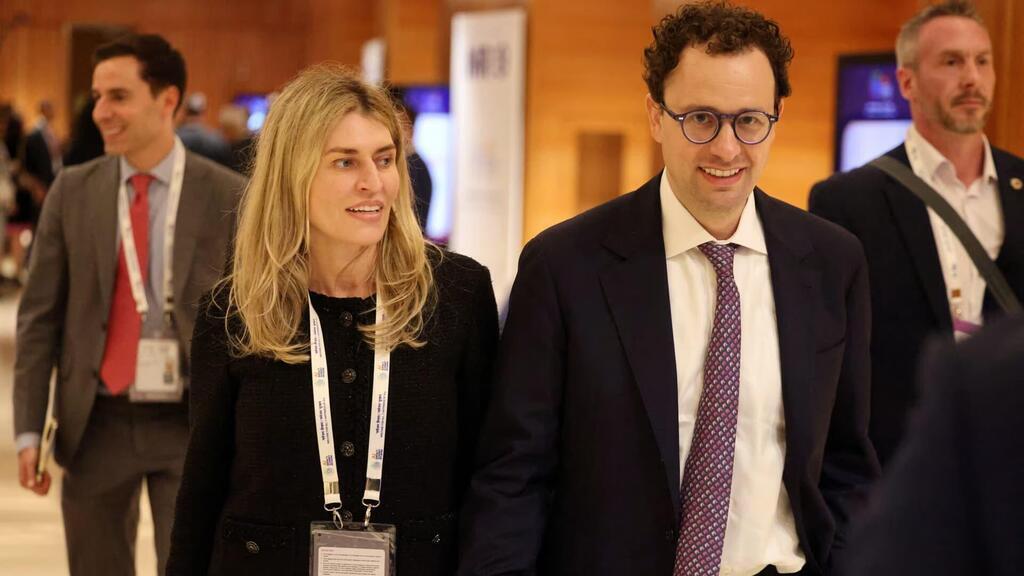
Anthropic CEO Dario Amodei and his wife, Cami Clark
(Photo: Ludovic Marin/Getty)
The couple kept even their marriage relatively quiet. Amodei’s Wikipedia page only began listing him as married this year, while Anthropic’s own Claude chatbot has responded to questions about the subject by saying that his marital status “is not clearly verified.”
Part of that discretion may be connected to Clark’s unconventional background, which is far removed from the standard image of a Silicon Valley executive’s spouse.
Born in Reno in 1979, Clark began studying architecture but dropped out of university. She experienced bankruptcy when she was young and, at age 20, married architect Mulder Eckloff III, who was then 64. The marriage ended after three years.
In 2010, Clark founded Addys, described as a “revolutionary porn company for women,” intended to bring a sex-positive approach to an industry overwhelmingly aimed at men. Its slogan was “intellectually promiscuous.”
According to reports, Clark also tried to persuade convicted sex offender Jeffrey Epstein to invest in the venture. Epstein did not invest, but documents released by the U.S. Justice Department indicate that the two continued communicating for two years. Clark invited him to her housewarming party and connected with him on LinkedIn.
The exposure of those communications may help explain why she has preferred to remain outside the spotlight, particularly amid renewed scrutiny of Epstein-related documents and as Anthropic moves closer to a highly anticipated public offering.
Clark also launched other projects in health and dieting, though little information about them remains publicly available today. At the same time, she steadily built a broad network of connections with senior Silicon Valley figures and political power brokers.
Her relationship with Amodei began in 2014, when he was still an academic working as a postdoctoral researcher at Stanford University’s medical school. They married in Italy in 2022.
Amodei’s personal fortune is now estimated at about $15.5 billion and could rise sharply if Anthropic goes public. But according to acquaintances and people close to the couple, Clark played an important role in building the career that produced that fortune.
She helped ensure that Amodei’s ideas received attention in an intensely competitive industry and introduced him to influential figures and major investors. One of those was former Google CEO Eric Schmidt, with whom Clark reportedly had a romantic relationship for three years beginning in 2011.
Schmidt told Bloomberg that in 2018 he visited Amodei and Clark at their San Francisco apartment and came away impressed by their ideas.
Clark was also the person who introduced Mira Murati, one of her close friends from their time working together at Leap Motion, to OpenAI President Greg Brockman. Murati later became OpenAI’s chief technology officer before leaving last year to establish her own AI startup.
The Information has described Clark as a “major behind-the-scenes player at Anthropic.” People familiar with the company have also characterized her as an emotional anchor for Amodei who offered advice throughout Anthropic’s creation and development.
Yet despite that influence, Clark still has no formal role at the company.
“She is probably the most significant person inside Anthropic’s inner circle who does not have an official role at the startup,” The Information reported.
According to reports, Clark sought company shares and proposed investment ideas that would have formalized her position, but those efforts were rejected by Anthropic’s other founders, including Amodei’s sister and co-founder, Daniela Amodei.
Clark nevertheless continues to use her personal network on Anthropic’s behalf.
Amid Anthropic’s confrontation with the Pentagon over the company’s demand for restrictions on how Claude can be used, Clark reportedly told people in political circles that Anthropic’s aim was to protect the United States and that the company was not “woke,” a term that has become politically toxic under the Trump administration.
Her interventions illustrate the unusual nature of her position. She is neither an executive nor an employee, but reportedly remains involved in some of the relationships and discussions surrounding one of the world’s most important AI companies.
As Clark’s influence appears to grow, however, her online presence has moved in the opposite direction. According to the Wall Street Journal’s review, much of her personal history has effectively disappeared from the internet.
That contrast may be the clearest description of her role: increasingly important inside the orbit of one of the most powerful companies in artificial intelligence, while becoming increasingly difficult to see from outside it.