

At 6:30 a.m., when most Israelis are still dozing in bed or getting ready to make their first cup of coffee, Nati Badash of Tel Mond is already deep in the sea. A 52-year-old high-tech executive and father of three, he refuses to start his day before catching a few waves.
“It’s a feeling an outsider can’t understand,” he says. “I come out of the water after two hours full of energy. It’s much cheaper than a psychologist.”
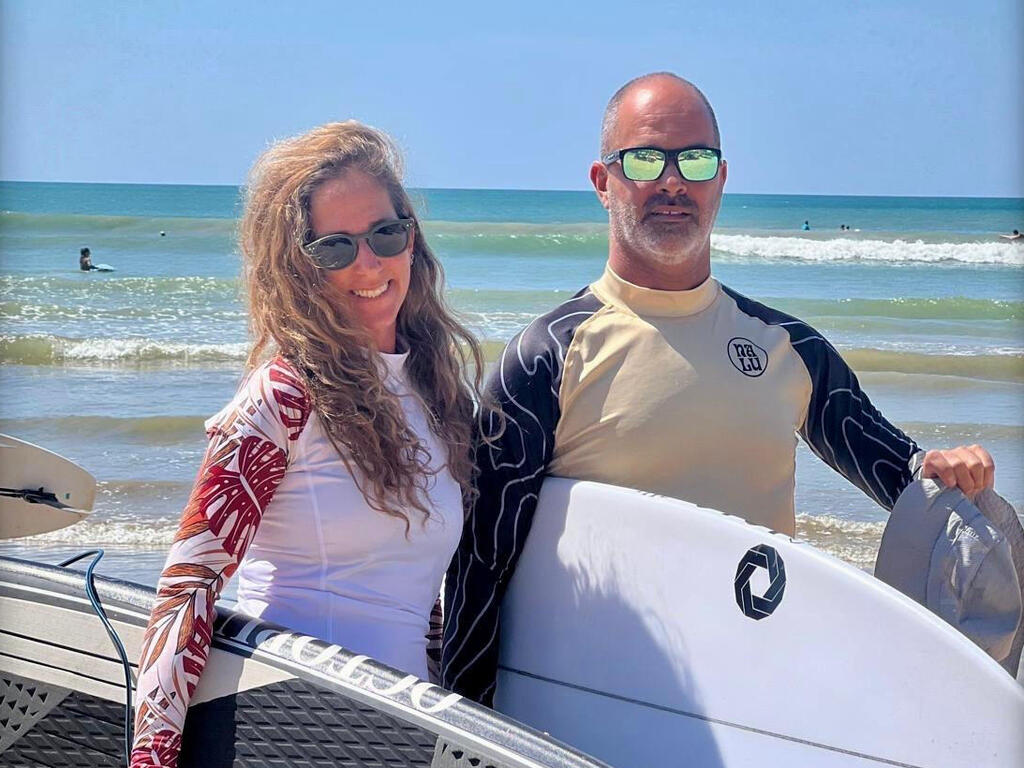
Badash is just one of tens of thousands of Israelis who have fallen in love with surfing in recent years. Once saddled with the image of a pastime for teenagers who skipped school to head to the beach, surfing has become a way of life and, since October 7, a powerful tool for healing and coping with trauma.
Surfers come from across the spectrum, from 4-year-old children to retirees in their 80s, from senior executives and doctors to combat soldiers suffering from post-traumatic stress. Between the waves, they find not only sport and enjoyment but also community, healing and peace of mind. Along the way, dozens of surf clubs have sprung up from north to south, Israel’s first artificial wave park has opened, surf tourism has flourished and a multimillion-shekel industry has emerged.
‘It’s never too late to start’
“It’s an addiction,” Badash admits. “My best friends today are from surfing. I even met my partner between the waves and, coincidentally, her name is Gal,” the Hebrew word for wave. “We surf together and make sure to fly every year for our dream vacation in Sri Lanka. Surfing is life.”
Like Badash, Shira Firstenberg, 37, of Jaffa, who holds a doctorate in education, also starts her mornings in the sea. For her, it is the way to arrive at the office focused.
She began surfing eight years ago. “The inspiration came from a film I saw about surfers in Iceland,” she says. “I took a few lessons, bought a surfboard and since then I’ve been in the sea every morning. If the sea is flat, I swim or dive, and if there are waves, I surf. Only afterward do I go to work. For me, surfing is much more than a hobby. It’s how I start my day and arrive at work sharp and energized.”
Do you surf abroad as well?
“Of course. Over the past eight years, I’ve surfed in Indonesia, El Salvador and Sri Lanka, places I doubt I would have reached if not for surfing. I also surfed at a wave pool in Bristol, England, before the surf park opened here in Tel Aviv.”
As it turns out, the sport has no age limit. Surf clubs today have students in their 70s and surfers over 80.
“The holistic nature of surfing makes it possible to enjoy it well into old age,” says Amit Vizel, a longtime surfer who now runs overseas surf trips with her husband, Dor Damari. She says their passion for the sport was quickly passed on to their baby daughter, who is already beginning her own journey in surfing.
“It’s never too late to start and apparently it’s never too early either. There are babies who get on a surfboard as soon as they can stand. The sport supports fitness, health, mental well-being, a connection with nature, self-confidence and social ties, and gives surfers a full life in every sense.”
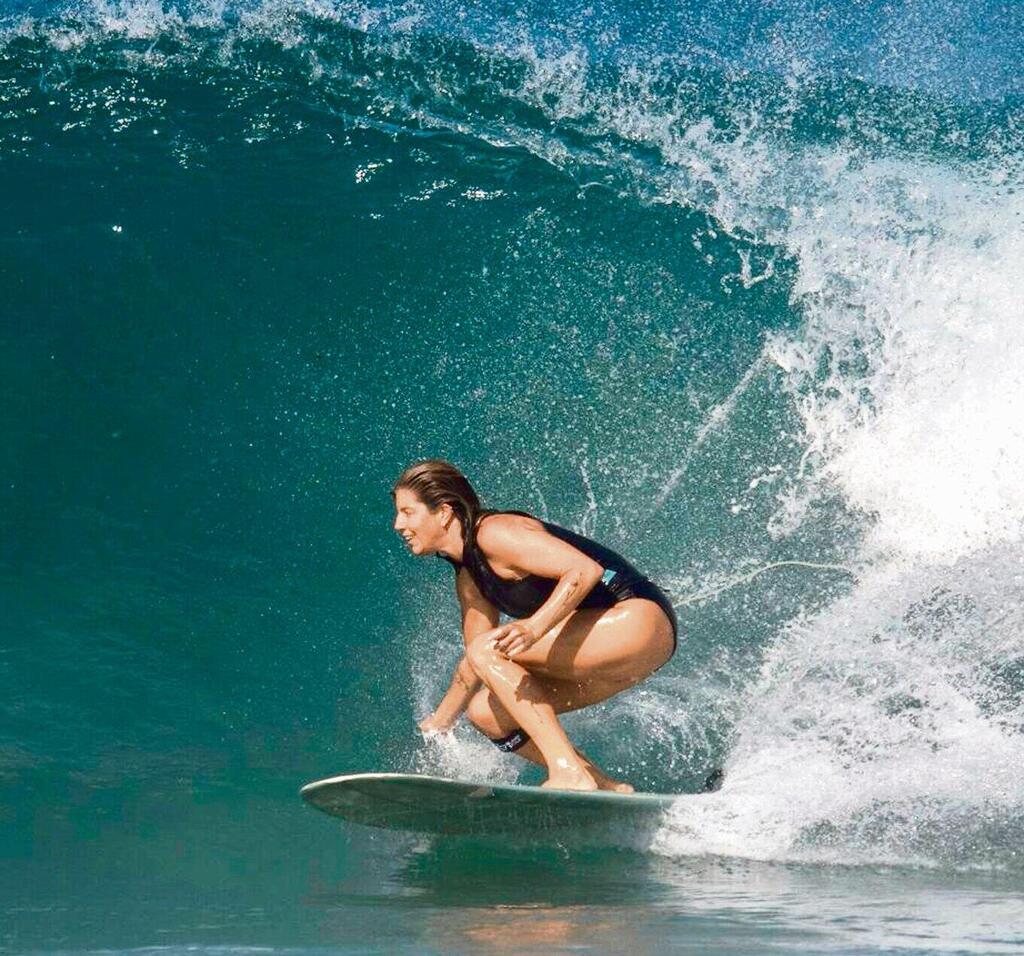
Shira Firstenberg
(Photo: Yuval Shlomo)
Surfing in Israel has grown over the past decade from a niche pursuit into one of the country’s most popular sports. In recent years, the number of participants has continued to rise. Estimates put the number of active surfers at around 30,000 to 50,000, while as many as 80,000 people surf occasionally. A previous ynet report similarly described Israel’s surfing community as numbering around 80,000.
And why not? Israel has about 190 kilometers of Mediterranean coastline and surfing conditions are suitable during much of the year, particularly in the fall and winter.
The main surfing hubs are in Tel Aviv, including Hilton Beach, the Dolphinarium beach area and HaTzuk Beach. Major surfing schools also operate along the beaches of Herzliya and Netanya, at Bat Galim Beach in Haifa and in Ashdod and Ashkelon, which are popular surfing centers in the south.
Alongside them is SRF Park TLV, which opened in Tel Aviv a little over a year ago and has given the sport a major boost. The facility offers artificial waves for surfers of different skill levels and was designed to make surfing accessible even when natural conditions are poor.
Dozens of surf schools now operate along Israel’s coastline, from Nahariya to Ashkelon. From a very young age, thousands of children and teenagers take part in surfing classes and summer and holiday camps. Industry figures say this summer has been the strongest yet in terms of registration for children’s and teen surf camps.
Israel has also established itself on the competitive surfing scene. Surfer Anat Lelior represented Israel at two Olympic Games, Tokyo 2020 and Paris 2024, and a number of Israeli surfers compete internationally in World Surf League events. Lelior has also recorded major results on the international circuit.
Kobe Shafrir, a married father of three from the Tel Aviv area, has been surfing for more than 40 years and works as a private surfing instructor through his business, Kobe. He stresses that wave surfing demands persistence, a genuine love of the sea and nature and considerable physical ability.
“To understand and speak the language, you need to train for at least a year, both independently and through surfing lessons,” he says. “For me, teaching surfing is no less than teaching an approach to life that has something in common with Zen or other Eastern philosophies rooted in a deep connection with nature. I give one-on-one private surfing lessons or lessons in small groups, usually just two or three students.”
Shafrir combines surfing instruction with teaching mathematics and serving as a 10th-grade homeroom teacher at Herzliya Hebrew Gymnasium.
“At the end of the day, teaching surfing isn’t enough to make a living,” he explains. “After all, it’s a seasonal business and there aren’t always good waves in the sea.”
Still, with demand for the sport growing, it looks like a business where you can make decent money.
“It looks glamorous, but it’s a business with heavy expenses, and anyone looking to make money has chosen the wrong field. Seasonality and wars make the day-to-day operation complicated. It’s physically and mentally demanding. Many hours in the sea and sun. It’s not easy.”
Shafrir spoke from Sri Lanka, where he had flown, he says, to surf alone and in peace.
“No students, no obligations. A vacation before the start of another school year,” he says.
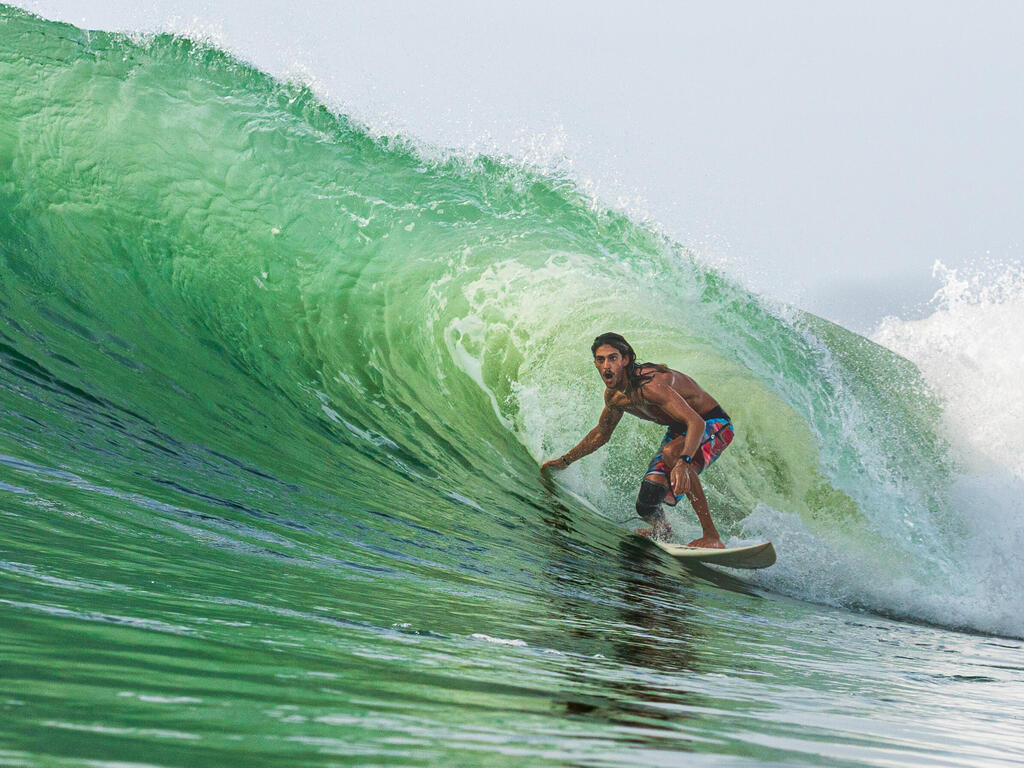
(Photo: Stav Kadosh)
What kind of people come to learn from you?
“There’s a huge variety. The surfing trend is drawing men and women of every age. I’m approaching 60 myself and I train surfers older than me who handle the sport very well. It’s a sport that makes you feel forever young, at any age.”
And what does it cost?
“I charge 280 shekels for a private lesson. That barely covers the major expenses involved in running a surfing business, including insurance, equipment and everything else. I’d be happy to charge 450 shekels a lesson, like a session with a psychologist. The results from surfing are no less effective.”
Surfing is not a cheap hobby. A new longboard costs between 3,000 and 8,000 shekels. A good winter wetsuit costs about 2,000 shekels and becoming a proficient surfer requires consistent training through courses and lessons.
Surfboards costing thousands of shekels
There is hardly a surfer in Israel who does not know the studio of Hani Ovadia, a handmade surfboard shaper in south Tel Aviv. Beginners and experienced surfers alike make their way there. Part of the surfing trend is the experience of buying a board made specifically to fit the surfer, tailored to height, body type, weight, the kind of waves they usually ride and other factors.
“There’s also the gimmick factor, like with any accessory, in surfing too,” Ovadia says. “Customers come to me wanting to dedicate a board to a friend, a girlfriend or boyfriend, or a child celebrating a bar mitzvah, with a special inscription and an original design.”
At Ovadia’s studio, we met Ben Sarfati, 51, of Tel Aviv, a competitive surfing coach for Israel’s national team. He has been surfing since he was 13.
“I was a hyperactive kid and I found my peace in the sea,” he says. “But back then, we surfers were nonconformists. Our parents didn’t exactly support this hobby and saw us as kids who went surfing because we had dropped out of school. Today, surfing is already embedded in kindergartens and elementary schools and has become a trend among children, teenagers, adults, women and men alike. It is no longer associated only with the wild teenagers in the crowd.”
Ovadia, who is in his 50s, builds surfboards for some of the top surfers in Israel and abroad.
“I make surfboards from the initial stage using materials such as polyurethane foam and expanded polystyrene, entirely by hand from start to finish. Making a surfboard is a lot of work. Above all, it requires professional shaping and sanding to achieve the best possible result, customized to each individual surfer. That sanding stage alone takes several days, unlike a branded product that comes off a production line.
“I have models that I build individually, so they can take months. There is no mass production here. I also have an entire line of unique boards that I make for use in the wave pool at the surf park, because the material has to be adapted for wave-pool use, including to the force generated by the wave. The boards are obviously not cheap. They are carefully handcrafted, so we’re talking about several thousand shekels per board.”
Is it a good living?
“Financially, what I do honestly isn’t very worthwhile. But it gives me enormous pleasure and tremendous satisfaction every time I create a unique board with my own hands. I’ve also been surfing since I was very young. For me, surfing is peace and detachment, beyond the physical exercise involved. It’s an experience that engages a whole range of senses, spiritually and physically.”
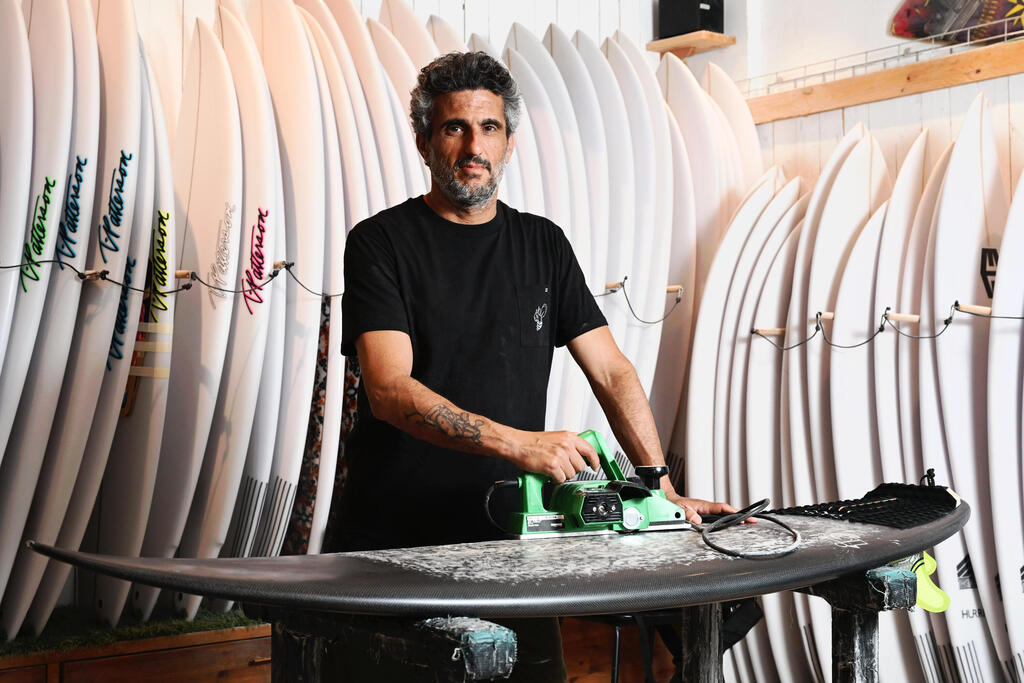
Hani Ovadia
(Photo: Kobi Koanks)
How did you get into the field?
“I was drawn to the profession after being exposed to it while working in California when I was young, with professional shapers such as Tom Curren. I very quickly realized that this was what we were missing in Israel. There are plenty of factory-made boards with brand labels, but handmade surfboards are a different story. I came back to Israel and opened my studio here.”
Did you ever think the hobby would become so widespread?
“There’s no question that the change in parents’ attitudes makes a difference. Today, parents support their children and sign them up for surfing courses and surf camps. In the past, surfers like us were seen as slackers. I’m glad that has changed.”
Give us an example of some of the special orders you receive.
“On a day-to-day basis, I get orders for boards dedicated to a friend who is getting married, a board with a portrait of the owner’s dog that died, or a board dedicated to a commander whose soldiers want to surprise him. I was also asked to make a board for a bride whose hobby is surfing, engraved with a message from her new husband and an illustration featuring their pet names for each other.
“There are endless requests and I take them on every day. That’s part of the excitement of my profession, giving whoever gets on the board the best possible experience. The sky’s the limit.”
Israel’s first wave pool: ‘No jellyfish, no crowds’
More than a year ago, an artificial surfing complex, SRF Park TLV, opened in Tel Aviv at an investment of about 180 million shekels. Surfers call it the “Lagoon of Happiness.”
The surf pool offers waves that would not look out of place in Sri Lanka: 30 types of waves, different surfing styles and 40 dunams, or about 10 acres, of what surfers describe as paradise. The facility contains about 29,000 cubic meters of water. Its wave machine consists of 56 modules capable of generating up to 700 waves an hour. The range of waves is suitable for beginners and veteran surfers alike. The water is turquoise, the waves resemble those in Sri Lanka and even the temperature feels familiar to experienced surfers.
“Considering that Israel has close to 70 days a year with good surfing waves at sea, the wave pool completely fills the gap,” says Dor, an avid surfer. “There are surfing conditions here that are hard for us to find even in the Mediterranean.”
Entrepreneur and owner Simon Tal Doyev, a former Israeli surfing champion, adds: “Israel’s surfing beaches are becoming very crowded, and there are also jellyfish in the sea, so there’s no doubt this is a game changer.”
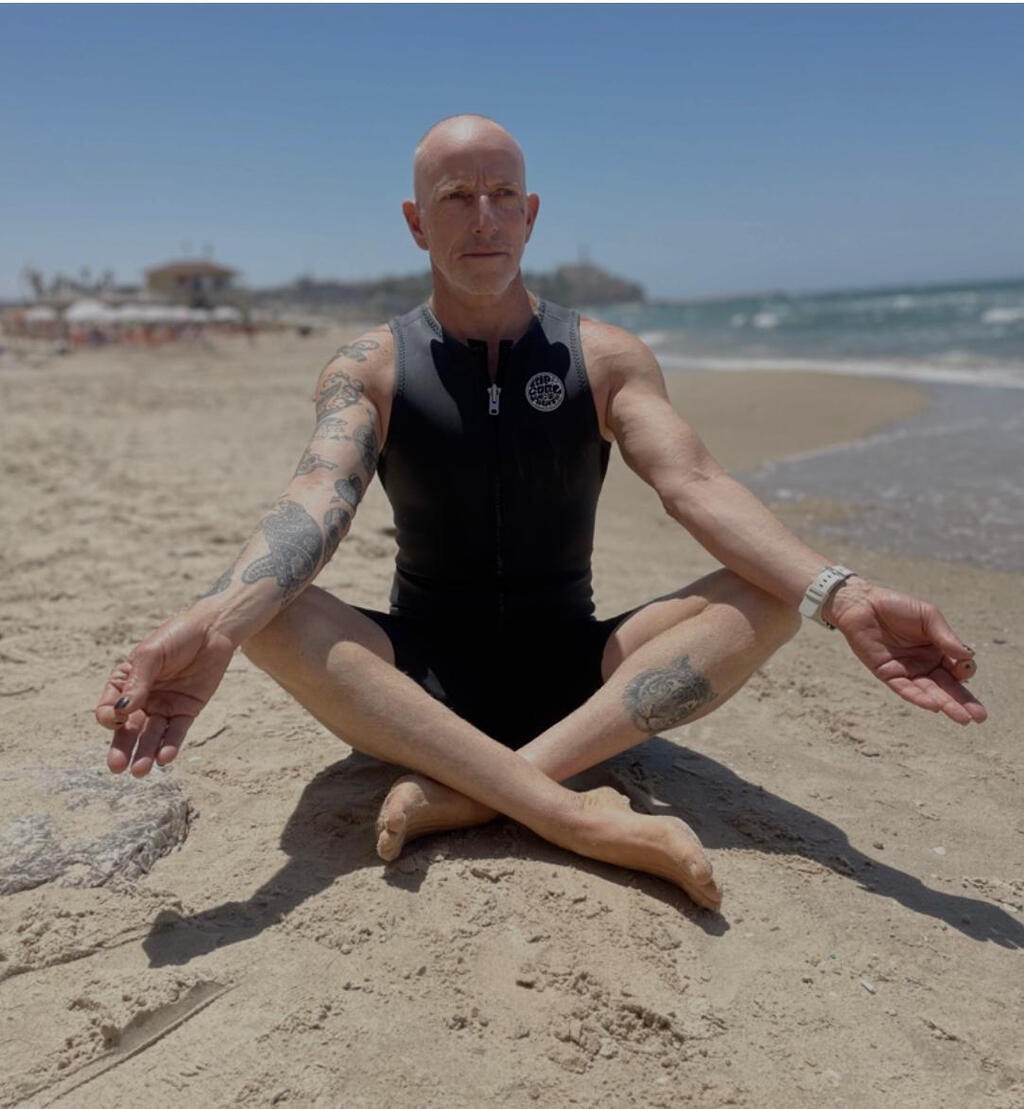
Kobe Shafrir
(Photo: Naama Piritz)
After winning the Israeli surfing championship in 1984, Tal Doyev founded the country’s surfing organization a year later and was among the founders of Gazoz, a surfing-equipment company.
“It’s a way of life for me,” he says. “And today, finally, after a journey of more than 15 years, there is a real solution to Israel’s wave problem. A surfing lagoon covering 22 dunams is a dream that became reality. The municipality gave us a 40-dunam site for 20 years, and we managed to create a paradise for surfers here, from beginners to professionals.
“Everyone takes their turn, with no fighting and no stealing waves. The basic premise is that there simply aren’t always good waves in the sea.”
According to Tal Doyev, the road to realizing the dream was far from simple.
“First, it was difficult to get the project off the ground and find a plot with the proper land registration suitable for a park like this. Raising the money was also challenging. Most of the investment came from us, the entrepreneurs. Fortunately, the municipality and the Ganei Yehoshua company gave us tremendous support. They helped us with permits, planning and even engineering.
“In addition, the company responsible for the technological equipment is a Spanish pro-Palestinian company that refused to come here to assemble the equipment after October 7. We found ourselves stuck without a solution, until one of the project partners, a water expert, stepped in himself and got us out of the bind. The installation involved 21,000 bolts.”
And what about recouping an investment of more than 180 million shekels?
Yoav Laor, CEO of the surf park, says: “In a country like ours, after the coronavirus crisis and amid the reality of war, it was clear to us that the expected return on investment would take longer than usual. We employ more than 200 people at the park, working around the clock in three shifts a day.”
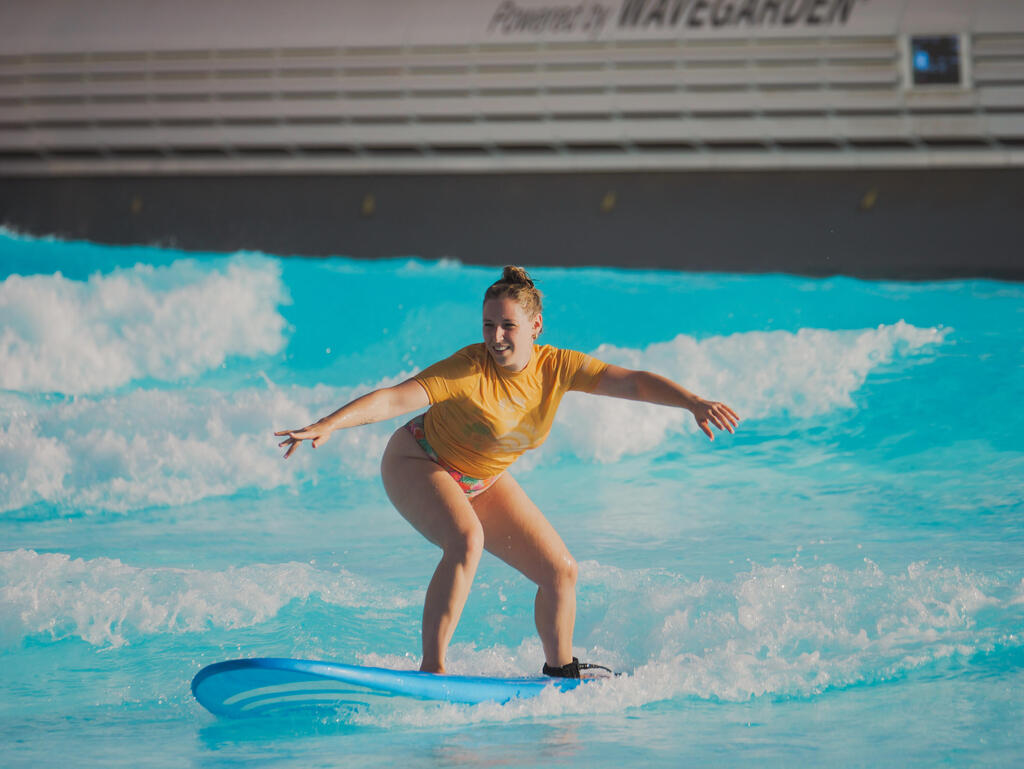
A surfer at SRF Park TLV
(Photo: Noam Eshel)
Lior Zamir, the park’s marketing and surfing director, came to the sport from the high-tech industry and says he is proof that anyone can do it.
“Come and give it a try,” he says. “Anyone can surf, from children to adults. In recent years, more and more women have joined the sport and they are excellent surfers. Our goal is to make surfing accessible to everyone, to a wide range of people.
“You don’t need any prior knowledge. You can come with zero preparation. Within the first few minutes in the water, you’re already standing on the board, whether you’re a child, a teenager or an adult. You don’t need a background or experience, just passion and a love of the water.”
The technology has been in use around the world for nearly a decade. Similar wave pools operate in South Korea, Australia, Brazil, England and Spain.
“The wave-pool industry is growing at a crazy pace. We were the ninth park to open,” says Tal Doyev. “We saw enormous potential in it. Israel has a surfing community of about 80,000 surfers, plus another 100,000 sea enthusiasts, including people who used to surf.
“The number of good surfing days in Israel is low, the beaches are crowded, the wind picks up by 10 in the morning, there are jellyfish and even sharks. Many companies tried to find a solution, and I’m glad we managed to bring one here.”
How does it work in practice?
Zamir says: “On our website, you can choose one of six surfing levels. You reserve a spot, receive an RFID wristband, enter the complex through the ramp, meet an instructor and head to the lagoon, either to the right or left.
“Each set includes five waves, with one wave every four seconds, and everything is organized: no shouting, no pressure. It’s like the sea, but on steroids.”
What is the main difference between surfing in the sea and surfing in a pool?
“The wave here is consistent. You can work on the same maneuver over and over again, like in professional training. This is the place for anyone who wants to improve.
“I’ve surfed in many places around the world, but here there’s a sense of belonging. You wait for a wave that is yours alone. No pushing, no fighting. You simply know it will come.”
Waves against trauma
Surfing lessons are offered at several locations in Israel, both at beaches and at SRF Park TLV, as a means of rehabilitation and trauma treatment. Since October 7, demand for surf-based therapy has soared, particularly among discharged combat soldiers dealing with PTSD.
HaGal Sheli, a nationwide nonprofit, works with at-risk populations, people dealing with trauma and people with disabilities, helping them cope with personal, community and national crises.
Since the war began, the organization’s teams have established emergency centers staffed by leading treatment professionals, using the sea and waves to assist residents of northern and southern Israel, soldiers, bereaved families, survivors of the Nova music festival, medical teams and security forces. Among other initiatives, the nonprofit opened a HaGal Sheli trauma treatment center at Zikim Beach in cooperation with the Defense Ministry’s Rehabilitation Department. HaGal Sheli has expanded its surf-therapy work significantly since October 7, including programs for war survivors, veterans and bereaved families.
“It is active meditation, an ongoing mystical and energetic dance between the surfer and the wave,” says Oran Weiss, who also leads the “Voice of Nova” surfing workshop at SRF Park TLV.
Weiss is a seven-time Israeli surfing champion who ranked third in Europe and 21st in the world. He is also a certified hydrotherapy practitioner, owns Oran Surf School and teaches surfing to people with special needs.
“I’m a great believer in the healing power of water, in healing the mind and treating post-trauma,” Weiss says. “The project grew out of my personal story. I started surfing in 1980 at Tel Baruch Beach, within walking distance of my home. The atmosphere at home was bad, my parents were going through a divorce and the sea became my refuge.
“At the time, I didn’t understand that the sea was helping me emerge from that whole situation with my sanity intact. I experienced post-traumatic symptoms from events in my childhood and surfing kept me whole. Years later, I chose to study therapy professionally and combine the experience I had gained in the sea to help people going through something I know so well from the inside.”
That led to what Weiss describes as an almost cosmic connection with the Nova Tribe Community Association. For months, Weiss and Omri Kochavi built a professional surfing program together, complete with the required approvals and insurance.
“I turned my surf school into a place for treating post-trauma, using exactly the same method I had instinctively used myself since I was a child.
“In 1990, friends who returned from India brought back their experiences from parties in Goa and new music that was still unfamiliar here. Nature parties became another escape for me, until I crashed. I had a psychotic episode, and the road back and the rehabilitation process were very long. Surfing played a major role in my recovery, and this time I understood that surfing was an extraordinary therapeutic tool.
“Today, when I’m not doing well, I always know that even if it’s hard, I’ll drag myself into the water because it will make me feel better. It has proved itself time and again.”
Weiss studied hydrotherapy and completed his internship at the rehabilitation pool at Sheba Medical Center in Tel Hashomer.
“On October 7, when the whole country came to a halt, I had the idea of connecting surfing with rehabilitation. I approached friends who were active in the association, Alon Dotan and Zion Makenzi, who are also surfers, and offered to treat survivors on a volunteer basis.”
The first pilot was conducted with Omri Kochavi, and the results, Weiss says, came quickly. His smile returned.
“After a year, I began a process with the association to build a therapeutic surfing group that would become a supportive, embracing family and allow us to keep surfing together. We already have a strong core group and we’re flying with it. There’s no chance we’ll stop dancing and no chance we’ll stop surfing. The feedback we receive from the treatment groups is incredibly fulfilling.”
How does it actually work physiologically?
“From a neurocognitive perspective, increased adrenaline release creates the natural high experienced while riding a wave. After surfing, a feeling of euphoria and satisfaction takes over, driven by the increased release of endorphins after strenuous physical activity, as well as dopamine.”
The surfing trend goes global
Surfing has in recent years become a global culture in its own right. Tens of thousands of surf schools operate around the world, millions of people learn to surf through organized instruction, the sport has entered the Olympic Games and in countries such as Australia it is regarded almost as a national sport.
An entire tourism industry has developed around surfing, offering vacations that combine surf training, accommodations, excursions and a sense of community.
Israelis have ridden that wave as well. While surfers once traveled independently in search of waves, companies now specialize in organized surf trips for individuals, couples, families and groups.
The most popular destinations include Sri Lanka, the Philippines, the Maldives and Morocco, which offer warm water, ideal surfing conditions and a sense of freedom that is hard to find in the Mediterranean.
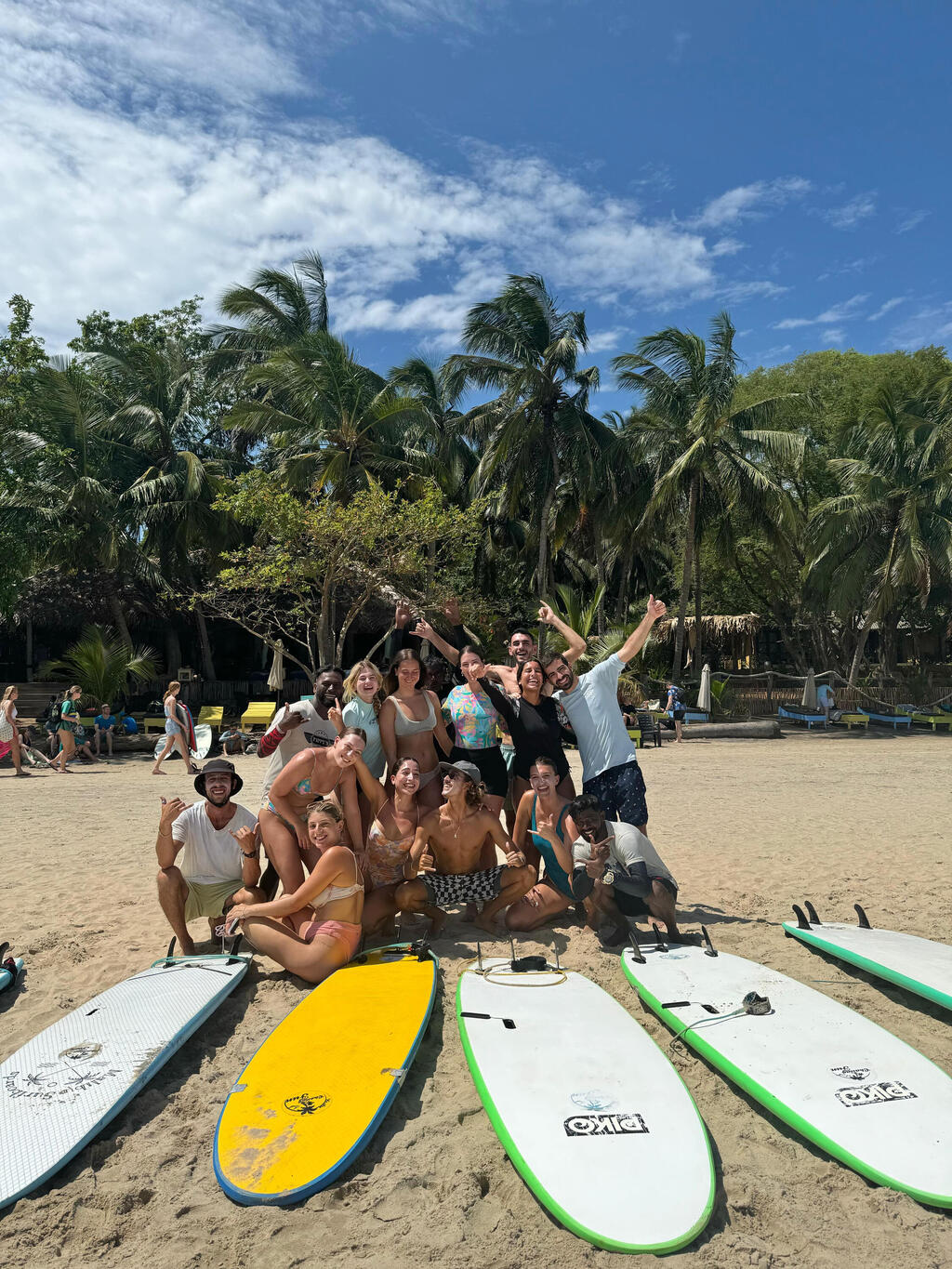
Amit Vizel and Dor Damari's surfing group
(Photo: Courtesy of Amit Vizel)
Amit Vizel and her husband Dor Damari, founders of the Chasing Fun company, are among the pioneers of the field in Israel. Dor began teaching surfing as a child, while Amit caught the surfing bug during a stay in California. The two even met on a surfing trip to Sri Lanka, which later became the beginning of their love story.
Since 2015, they have taken surfing groups to destinations around the world. Today they offer programs for beginners and advanced surfers, young Israelis after military service and adults 27 and older.
They say the clientele has also changed in recent years.
“In the past, it was mostly young people after the army. Today, we see couples, families, fathers and children, women traveling alone and groups of friends. A surf trip has become a tourism product in its own right, much like a ski vacation.”
The trend continues to expand. The company will soon launch dedicated surf trips for families with young children, combining surfing lessons for the parents with the toddlers’ first introduction to the sea.
“More than 10 couples have already met on our surf trips, gotten married and become parents,” Vizel says. “Now they’re coming back on trips with us, this time with their children.”
Surf trips generally cost between 10,000 and 13,000 shekels per person, depending on the destination and time of year. A typical package includes around 11 nights in Sri Lanka or 13 nights in the Philippines, along with professional instruction, accommodations and additional activities.