


The collapse of Bank Ayandeh in October 2025 offers a clear postmortem of a regime that long prioritized ideological expansion and regional proxies over fiscal stability. The failure was not an isolated case of banking mismanagement but a structural rupture in a financial system weakened by corruption and international isolation.
When Bank Ayandeh folded after nearly $5 billion in losses, Iranian authorities moved the liabilities into the state-run Bank Melli in an attempt to contain panic. The decision shifted a private banking failure directly onto the national balance sheet, exposing the limits of the Central Bank’s ability to manage systemic risk.
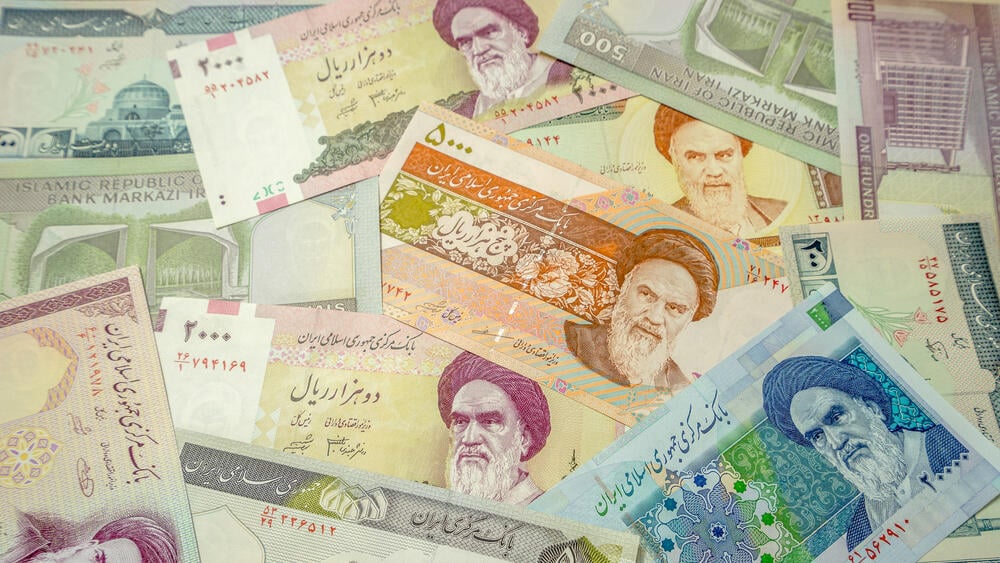
Iranian Rial
(Photo: Shutterstock)
To cover the deficit, authorities turned to large-scale money printing. Intended to prevent a bank run, the move instead accelerated inflation and erased middle-class savings. The impact became visible on December 28, 2025, when the rial fell to a record 1,432,000 to the U.S. dollar. The plunge triggered protests led by merchants in Tehran’s Grand Bazaar, a group historically associated with economic stability and regime support.
As 2026 began, Iran’s economic outlook deteriorated further. The World Bank projected continued contraction, with inflation potentially approaching 60%. At the same time, Iran’s external financial channels narrowed sharply. The January 3, 2026 capture of Venezuelan President Nicolás Maduro by U.S. forces disrupted the Caracas-Tehran trade route that Iran had used to bypass sanctions. Days later, the interception of the vessel Bella 1, accused of carrying sanctioned oil, further restricted access to hard currency.
With oil and drone trade routes disrupted, Iran lost one of its remaining external lifelines. The pressure was reflected in the actions of its own leadership. In mid-January, intelligence reports indicated that Iranian officials moved roughly $1.5 billion in foreign currency out of the country within 48 hours, even as protests continued under an internet blackout.
 Amine Ayoub
Publicly, the government projected defiance and deployed the Islamic Revolutionary Guard Corps to secure major cities, including Tehran and Esfahan. Privately, the capital flight suggested a leadership hedging against the collapse of its own financial system. The offshore transfers appeared aimed at safeguarding elite assets while inflation continued to erode household incomes.
This protest wave differs from earlier cycles driven by political or social demands. The unrest of 2026 is rooted in economic survival. As currency value collapses and state resources are siphoned out of the country, traditional tools of repression lose effectiveness.
The $5 billion loss from Bank Ayandeh was never resolved. It was absorbed, expanded and passed on to the public through inflation. As the regime relies on monetary expansion to finance security forces, it is dismantling the economic foundations that sustained it for decades. The Islamic Republic is no longer managing a functioning economy, but attempting to prolong control as the system itself comes apart.