

The panel examined recent comments by U.S. Vice President JD Vance during a podcast interview, debating what they described as an increasingly critical tone toward Israel within parts of the American political landscape. The hosts also discussed New York Mayor Zohran Mamdani's remarks suggesting he would seek legal avenues to arrest Prime Minister Benjamin Netanyahu should he visit the city, arguing that such statements distract from pressing domestic issues while contributing to growing anxiety among New York's Jewish community.
ALL CAPS ep. 19


Another topic focused on reports of an alleged assassination attempt targeting a member of Prime Minister Netanyahu's family while in the United States. While noting that many details remain unconfirmed, the panel said the incident highlights broader concerns about Hezbollah-linked activity on American soil and the security challenges facing Israeli officials and their families abroad.
The conversation also touched on the FIFA Club World Cup, where political remarks made around the tournament reignited debate over the intersection of sports and international politics. Panelists criticized the growing tendency to use major sporting events as platforms for political messaging and reflected on Argentina's strong public support for Israel under President Javier Milei.
The centerpiece of the episode was an extensive interview with Shira Ruderman, Executive Director of the Ruderman Family Foundation, who discussed the changing relationship between Israel and Jewish communities around the world following the October 7 attacks.

Ruderman argued that October 7 served as a defining moment for Jewish identity, particularly among American Jews. Rather than simply strengthening ties to Israel, she said the attacks prompted many Jews to reconsider what being Jewish means and how identity extends beyond religious practice to include peoplehood, shared values and responsibility toward one another.
Addressing the political divide within American Jewry, Ruderman suggested that many voting decisions stem primarily from domestic American political identities rather than attitudes toward Israel itself. She acknowledged the growing ideological polarization in the United States while stressing that Jewish identity cannot rely solely on political affiliation.
The discussion then shifted to philanthropy, where Ruderman described charitable giving not simply as writing checks but as a strategic investment in creating measurable social change. She explained that effective philanthropy requires partnerships across governments, nonprofits and the private sector, emphasizing that long-term impact comes from collaboration rather than isolated initiatives.
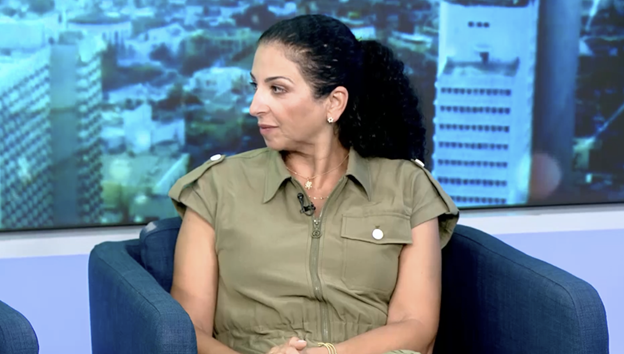
Shira Ruderman
Ruderman also spoke about the rise in antisemitism on American campuses, explaining that her foundation has increasingly focused on addressing the mental health impact of antisemitism on Jewish students and faculty. Rather than concentrating exclusively on combating antisemitism, she argued that strengthening Jewish identity and confidence among young people is equally essential.
Reflecting on her own identity, Ruderman described herself first and foremost as Jewish, while acknowledging the dual identity experienced by many American-Israelis. She emphasized that Israel remains central to Jewish identity regardless of where Jews choose to live.
Asked why Jewish philanthropy often becomes the subject of conspiracy theories, Ruderman rejected the notion that charitable involvement reflects a desire for control. Instead, she argued that Jews have historically invested deeply in strengthening the societies in which they live, seeing philanthropy as both a responsibility and an expression of civic commitment.

Titi Aynaw and Sarai Givaty
When asked which world leader had most influenced her personally, Ruderman pointed to the late Rabbi Lord Jonathan Sacks, praising his humility, intellectual depth and ability to unite diverse segments of the Jewish world. She expressed hope that a new generation of Jewish leaders would emerge with a similarly unifying vision.
The episode concluded with host Nitsana Darshan-Leitner outlining legal action by Shurat HaDin against Mamdani's comments regarding Netanyahu, arguing that any attempt by local authorities to cooperate with International Criminal Court arrest efforts would conflict with U.S. federal law.
Ending on a more uplifting note, the panel highlighted the Maccabiah Games, celebrating thousands of Jewish athletes from around the world who gathered in Israel. A viral video shared by social media personality Montana Tucker was showcased as a symbol of unity, resilience and hope amid a challenging period for Jewish communities worldwide.
Watch the full episode of ALL CAPS featuring Nitsana Darshan-Leitner, Sarai Givaty and India Naftali for more unfiltered conversations, exclusive interviews and analysis of the stories shaping Israel and the Jewish world.
To learn more about Shurat HaDin's efforts to fight terrorism and defend Israel through legal action, visit Shurat HaDin – Israel Law Center
First published: 15:00, 07.26.26