

Israel may be losing part of the battle for public opinion not because it lacks facts, but because it is too often delivering them to people who already agree.
That is the argument at the center of Episode 23 of “ALL CAPS,” where basketball trainer turned Israel advocate Barak Swarttz challenges one of the most familiar assumptions surrounding Israeli public diplomacy: that better explanations will necessarily produce better results.
Watch ALL CAPS episode 23


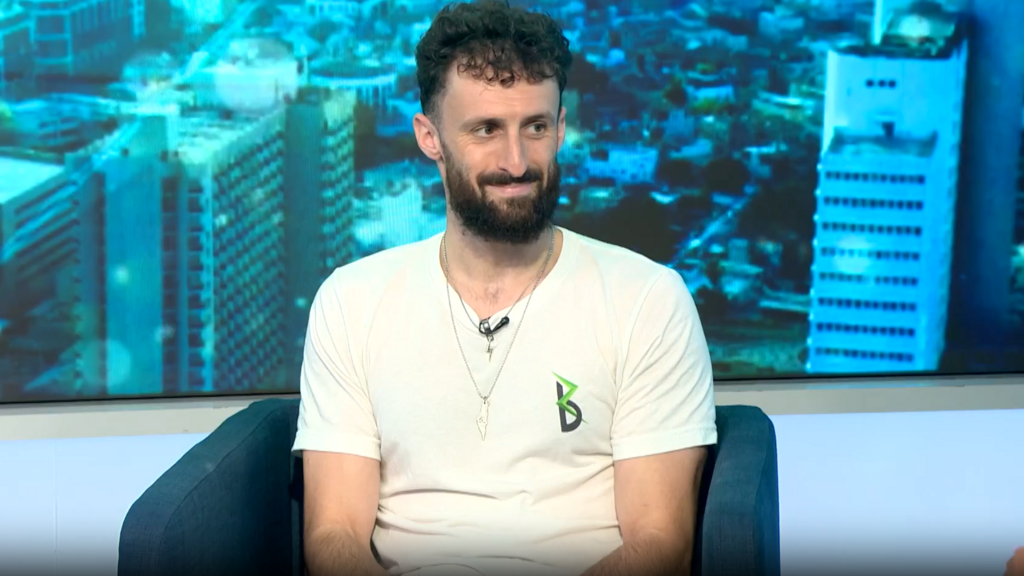
Swarttz, who has trained NBA and WNBA players and built a career around basketball before shifting heavily into Israel advocacy after Oct. 7, argues that much of what is commonly called hasbara has become an echo chamber.
“If you want to explain something, it’s typically going to somebody who needs to receive the explanation,” Swarttz tells the panel. But much of the audience consuming pro-Israel advocacy content, he says, already supports Israel. “What you are doing is you are not explaining, you’re reaffirming. It’s an echo chamber. It is a massive echo chamber.”
His alternative begins somewhere seemingly far removed from geopolitics: basketball.
Swarttz grew up outside Boston in a family of rabbis and spent part of his childhood in Israel during the Second Intifada. After returning to the United States, he immersed himself in basketball, first hoping to become a professional player before injuries pushed him toward training. Years later, after making Aliyah, he found himself unable to serve in the IDF while friends were being called into combat.
Following Oct. 7, that frustration became a turning point. A friend was killed at the Nova music festival, and Swarttz said he felt unable to remain on the sidelines. “I can’t put on a uniform. What I can do is use my words,” he says. Basketball, he discovered, gave him access to audiences political messaging often could not.
For Swarttz, the key is not beginning a conversation with Israel, Zionism or the IDF. It is beginning with something both sides already share. “The only reason you trust somebody is because you have common ground,” he says, describing conversations with athletes from different backgrounds. “The common ground that I’ve built with people is basketball.”
That distinction becomes the episode’s most provocative idea. Swarttz separates advocacy, which he sees as strengthening people already sympathetic to Israel, from the much harder task of reaching those outside that circle. Culture, he argues, can sometimes do what another infographic, speech or factual rebuttal cannot.
Basketball, food, fashion, music and travel all offer entry points because they establish a human relationship before demanding a political conclusion. The goal, Swarttz says, should also be more realistic.

The ALL CAPS panel with Barak Swarttz
He recounts entering a large anti-Israel protest in Washington in 2024 dressed simply in basketball shorts, a Nike shirt and Converse sneakers. Rather than presenting himself immediately through political symbols, he approached protesters as someone they might actually speak with.
One encounter lasted close to an hour. Swarttz says the young man initially confronted him angrily but eventually removed his face covering, shook his hand and told him: “You’re the first and only Israeli I’ll ever respect.”
Swarttz does not present that as a miraculous conversion. “To think that he was gonna go home and change his mind would be delusional,” he says. The achievement, in his view, was getting someone who had been hostile minutes earlier to listen and engage. “Our KPI should not be, did we change his or her mind.”
That philosophy also shapes where Swarttz believes Israel should concentrate its resources. Instead of obsessing over the loudest anti-Israel activists, he urges advocates to look beyond the protest encampment to the far larger number of people simply going about their lives.
“The silent majority in the middle is where I’ve found a lot of success,” he says.He even proposes a distinctly American model for Israeli outreach: find 50 immigrants to Israel, one from each U.S. state, and use their knowledge of local language, culture and communities to communicate with the places they came from.
A Bostonian, he argues, instinctively understands Boston. A Texan understands Texas. Israel should use that familiarity rather than assuming a single centralized message will resonate everywhere.
Swarttz also warns against treating nuance as disloyalty. Asked whether Israeli advocates sometimes dismiss criticism too quickly, he points to civilian deaths in Gaza as an example of an issue where acknowledging painful realities can make a conversation more credible rather than less supportive of Israel. “Two things can be true at once,” he says.
The conversation fits a wider theme running through Episode 23: how ideas travel, and what happens when narratives survive far beyond the events that created them.
The panel revisits the 1972 Lod Airport massacre following the funeral of Kozo Okamoto, the Japanese Red Army terrorist who participated in the attack that killed 27 people. The discussion focuses on the unusual international network behind the massacre and on the glorification of Okamoto at his funeral decades later.
Later, the hosts examine the Democratic Socialists of America’s foreign policy platform and its treatment of Israel, arguing over how anti-Israel ideas move from activist politics into the American mainstream.
The episode closes on a very different expression of Israeli resilience: the rapid rise of Base44, the AI platform created by Israeli reservist and entrepreneur Maor Shlomo and acquired by Wix for $80 million after only months of development.
But Swarttz’s argument provides the episode’s clearest thread. Israel, he suggests, does not necessarily need to shout louder. It may need to decide more carefully who it is trying to reach, what that audience actually cares about and whether the conversation should begin with Israel at all.
Watch the full episode of ALL CAPS featuring Nitsana Darshan-Leitner, Sarai Givaty, Titi Ayanaw and India Naftali for more unfiltered conversations, exclusive interviews and analysis of the stories shaping Israel and the Jewish world.
To learn more about Shurat HaDin's efforts to fight terrorism and defend Israel through legal action, visit Shurat HaDin – Israel Law Center.
First published: 14:59, 08.23.26