

Five years ago, Noga Erez sang that she had no idea what would happen at the end of the road, but that the trip there would be wild. Even so, the journey to perform at the Coachella festival seemed like an especially extreme challenge.
In a series of videos she posted on the way to the long-awaited event last night, she and her partner and musical collaborator, Ori Rousso, appeared caught in a surreal, almost unbelievable situation, in which preparations for one of the most important shows of her career turned into a logistical and bureaucratic nightmare against the backdrop of the war with Iran. The list included canceled flights, a stranded crew, soaring costs and even one incident involving fava beans.
Gallery

Noga Erez performs at the Coachella festival
(Photo: Emma McIntyre/Getty Images for Coachella)
On the other hand, there is nothing like truly slogging through hardship to further cement the element of grit and struggle in Erez’s music, a key component of her persona. And given that her career has absorbed blow after blow due to entirely external circumstances — from the coronavirus pandemic to the war in Gaza and now the Iran saga — Erez no longer has to work very hard to convince anyone that it is not simple to be a highly talented, remarkably charismatic and very beautiful artist. “It’s the Wild West,” she sang in the closing number, “but I’m from the Middle East.” That more or less sums it up.
As a daughter of this unhinged region who needed “strength I didn’t know I had,” as she said at the end, Erez did not appear offended by her arguably unjust placement on a relatively minor daytime stage. It was neither personal nor political: later that evening, Geese, a fast-rising indie band that is boycotting Israel, also performed there. On the contrary, it was clear that she, the band and the dancers attacked every song with the understanding that if there was an audience at that hour, it was likely the best and most loyal one at a festival that has become an influencer-driven spectacle.
The set opened with a new song warning of “duck season,” but Erez herself was a black swan, in her familiar oversized suit and with the gaze of an assassin locking onto a target. From there she moved into “End of the Road,” which, as noted, sounded like an apt summary of the via dolorosa known as being an international artist from Israel. Strong performances of “Vandalist” and “Dumb” pushed the adrenaline higher, even through the screen.
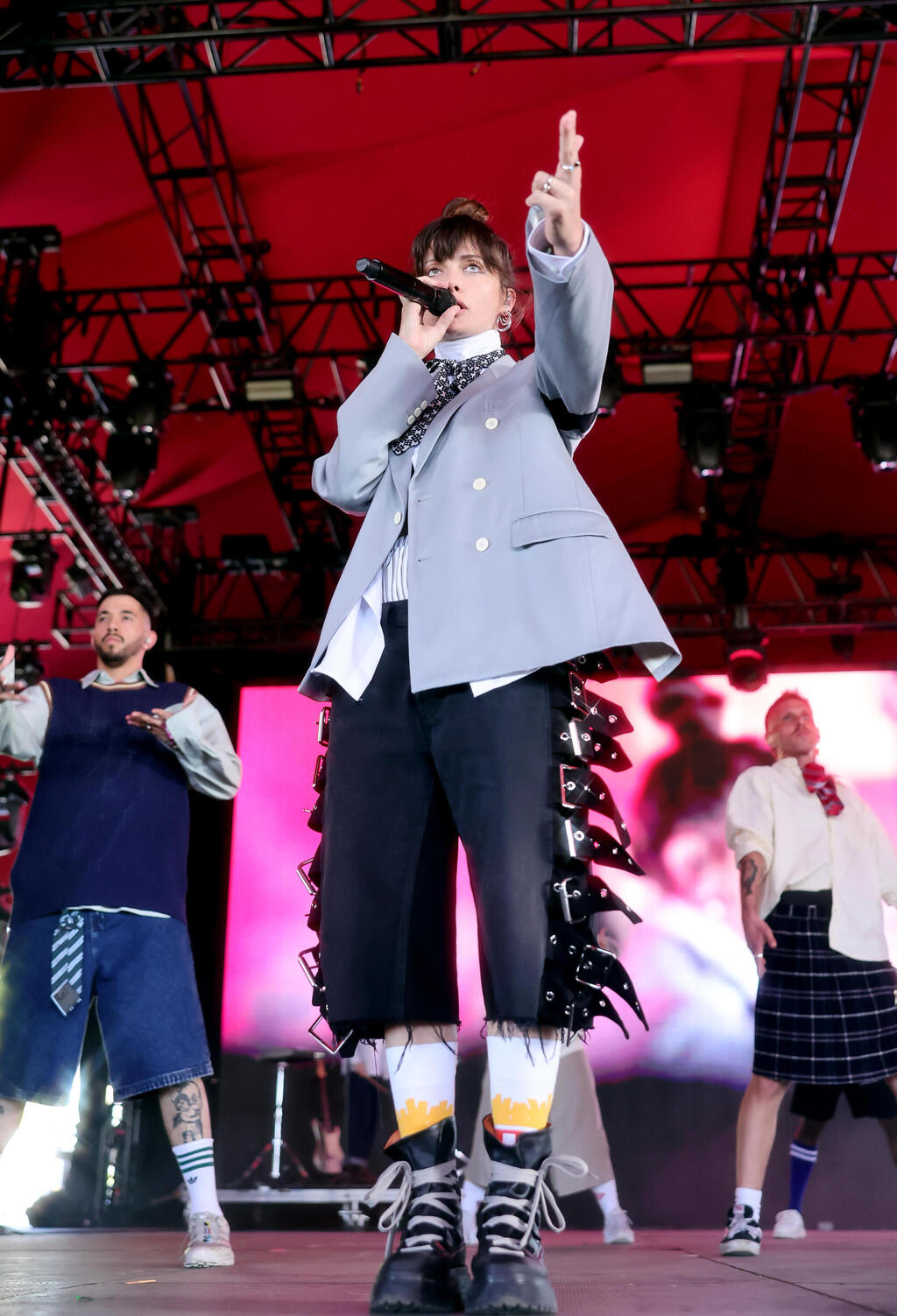
(Photo: Emma McIntyre/Getty Images for Coachella)
By contrast, the guest appearance by rapper Armani White carried less musical weight and more symbolic significance: these days, finding someone willing to collaborate with an Israeli artist is not exactly a walk in the park, and his being Black is also not insignificant given the growing ties between anti-racism protest movements and pro-Palestinian organizations. Even if his segment was not the peak of the set, it gave Erez another point of connection with the American audience and some much-needed breathing room in a highly demanding performance. Indeed, the performance of “Views,” a song with, well, a lot of words, felt smooth and effortless.
Just before the final song, which was new like the one that opened the set, Erez stepped briefly to the side of the stage and applied something that made her nose appear slightly bloodied. She then spoke emotionally about how complicated it had been to reach this moment and how far from obvious it was. The embrace at the end with her daughter, alongside the bloodied look, created a fitting image of toughness and tenderness for a performance that seemed like a mission even Tom Cruise might have declined. Who says there are no more victory images in wartime?