


After weeks of war during which cinemas were closed, theaters have finally reopened — albeit partially — and a fitting way to mark the occasion is with one of the most anticipated and talked-about films of the moment: the sci-fi adventure “Project Hail Mary.”
Set against the threat of Earth’s destruction, the film is defined by themes of courage, friendship and sacrifice. That is its strength as potential “family-friendly” entertainment, but also its weakness. Despite evident investment and strong performances and direction, the film struggles to balance light comic adventure with cosmic-scale ambition. It may not be the great sci-fi epic its creators — Phil Lord and Christopher Miller — hoped for, but it can be seen as a middle ground (and a lesser one) between family sci-fi like Steven Spielberg’s “E.T. the Extra-Terrestrial” and philosophical space journeys such as Christopher Nolan’s “Interstellar.”
The film is based on Andy Weir’s 2021 novel. Weir also wrote “The Martian” (2011), adapted into Ridley Scott’s “The Martian” (2015), and there are clear similarities in their blend of “hard” sci-fi elements and survival stories centered on isolated protagonists. Unlike the earlier book, “Hail Mary” introduces alien life forms, and the film adaptation further softens the novel’s hard sci-fi aspects.
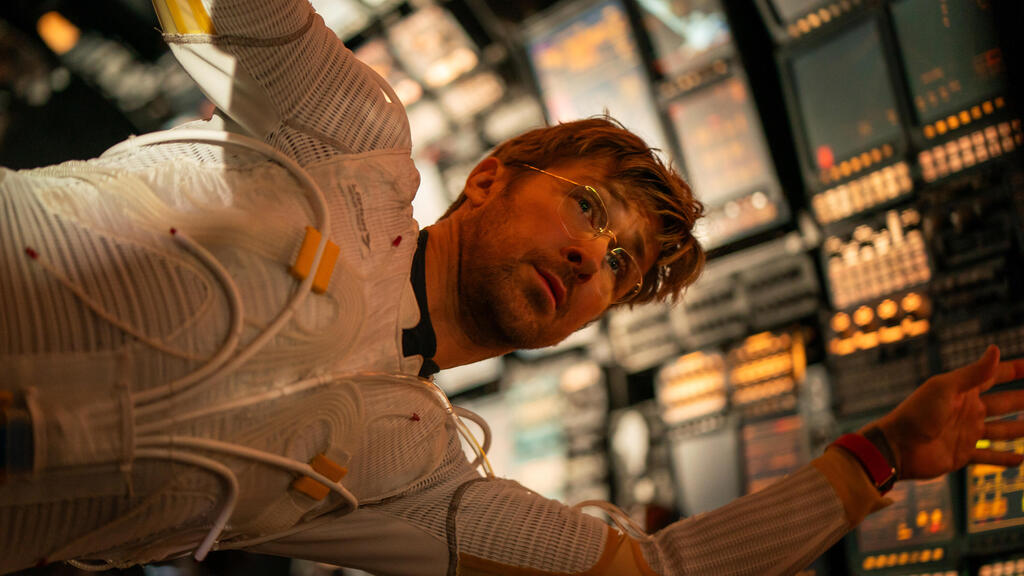
The story opens with Dr. Ryland Grace (Ryan Gosling) awakening from a medically induced coma aboard a spacecraft en route to an unknown destination, with no memory of how or why he got there. He discovers that his two crewmates — Captain Yao Li-Jie (Ken Leung) and astronaut Olesya Ilyukhina (Milana Vayntrub) — are dead. As his memory gradually returns, the film flashes back to the events that led him to the mission.
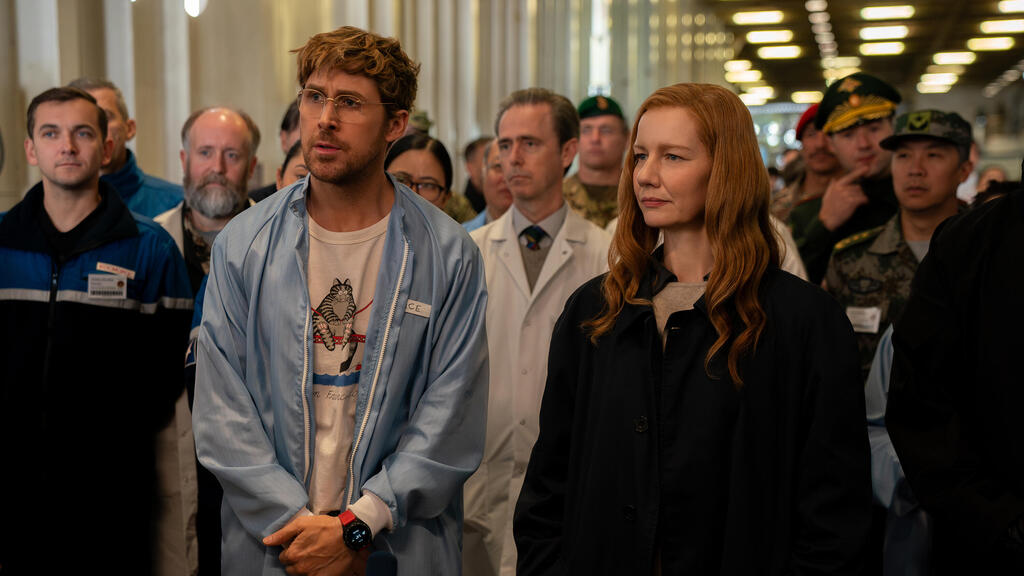
We first meet him as a high school science teacher. During class, a curious student questions him about a cosmic phenomenon that has sparked alarming rumors: an infrared line stretching from the sun to Venus, known as the “Petrova line.” For reasons not fully understood, Grace explains, it is cooling the sun and could lead to catastrophic temperature drops on Earth. Soon after, he is recruited by Eva Stratt (Sandra Hüller, “Anatomy of a Fall”), who heads an international scientific effort to address the existential threat.

From ‘Project Hail Mary’
(Photo: Courtesy of Forum Film)
Grace, a molecular biologist whose academic career was derailed after a contentious doctoral thesis, is given a chance to study “astrophage” — an alien life form that feeds on solar energy. This cosmic microorganism spreads by consuming stellar energy. Ironically, its ability to store vast amounts of energy also enables the “Hail Mary” mission: astrophage will power a spacecraft sent to the star Tau Ceti, which appears resistant to the organism. The hope is to find a solution there and transmit it back to Earth via probes. For the astronauts, however, it is a one-way journey. The term “Hail Mary” refers not only to the Christian prayer but also to a last-ditch, long-shot pass in American football.
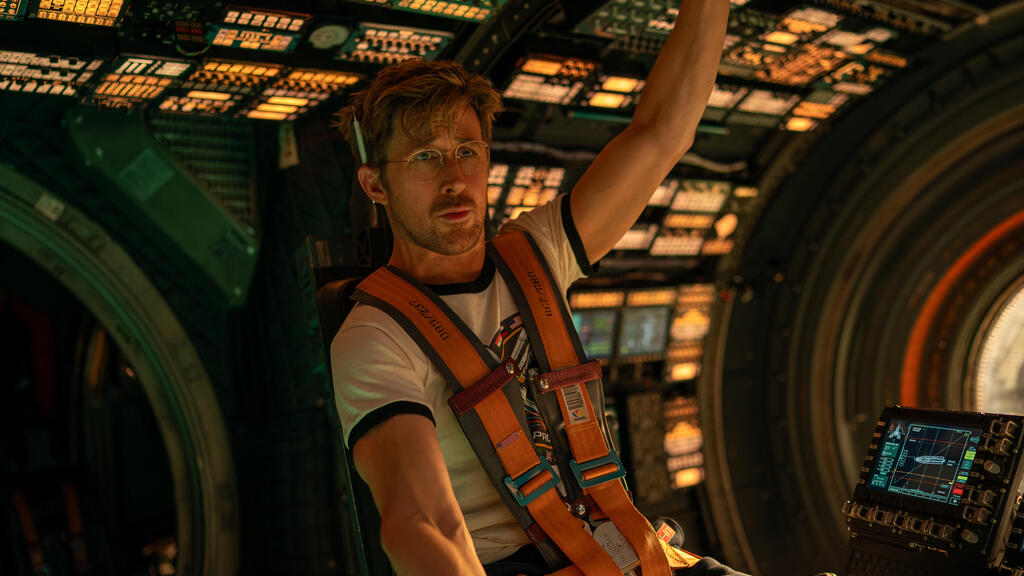
Alongside the relative gravity of the past timeline, the present-day storyline aboard the spacecraft is marked by Grace’s confusion. While his initial situation is threatening, the film injects levity, with comedic music accompanying his attempts to navigate the ship. The Grace of the past appears hesitant and overwhelmed, while his present self quickly evolves into a resourceful, Gosling-style hero. Directors Lord and Miller, known for comedies such as “21 Jump Street” and “The Lego Movie,” and screenwriter Drew Goddard clearly aim for a lighter tone, but the stitching together of a “serious” past and a “comic” present feels somewhat forced.
From ‘Project Hail Mary’
(Photo: Courtesy of Forum Film)
Even viewers unfamiliar with the book will know from the trailer that Grace will not remain alone. He encounters an alien who becomes central to the story. Without revealing spoilers, it can be said that Grace names him “Rocky,” portrayed through puppetry by James Ortiz. The use of practical effects is a major strength, with Ortiz imbuing the non-humanoid alien with expressive life. The film focuses on the evolving relationship between two beings from different worlds, united by a shared mission to save their respective planets. It explores uncertainty, fear of the other and the absence of a shared language, ultimately developing into a cosmic buddy movie infused with human values.
As audience engagement with this relationship grows, the value of the flashbacks diminishes, despite Hüller’s strong performance. The flashbacks do lead to a late payoff, but it may not justify the time devoted to them in a relatively long, 154-minute film aimed at broad audiences. By contrast, the bond between Grace and Rocky forms the emotional core, providing both humor and moments that may move viewers to tears.
From ‘Project Hail Mary’
(Photo: Courtesy of Forum Film)
Gosling carries the film, much of which features him interacting with an unusual companion, recalling Tom Hanks’ dynamic with “Wilson” in “Cast Away.” Internal monologues from the novel are translated into spoken dialogue, sometimes with a forced lightness — as in a scene where Grace delivers a eulogy during a space burial. The comedic tone works better once his exchanges with Rocky begin.
Beyond the puppetry, the film’s technical and visual elements are impressive. There is clear inspiration from “Interstellar,” particularly in its depiction of space maneuvers, though “Hail Mary” relies less on practical effects overall. While not shot on film, it was captured with IMAX cameras, transferred to film and then digitized again. Cinematographer Greig Fraser delivers another striking sci-fi effort, following “Rogue One” and Denis Villeneuve’s “Dune” films, for which he won an Oscar.
This is a film designed for the IMAX screen, though current circumstances in Israel mean it cannot be experienced that way. Still, the enjoyment and comfort it offers translate well even to a smaller screen.