

In 2007, The Band’s Visit was released and quickly became a defining moment in Israeli cinema. Directed by Eran Kolirin and starring Ronit Elkabetz and Sasson Gabay, the film won eight Ophir Awards, including best film, and went on an especially impressive international run. In 2016, it was adapted into a musical that opened on Broadway, where it won 10 Tony Awards, including best musical, and earned a Grammy for best musical theater album. The production later moved to the West End, where it led its stars, Miri Mesika and Alon Abutbul, to nominations for the prestigious Olivier Awards.
This past weekend, the musical was staged locally for the first time, in a blue-and-white production created in collaboration with Kolirin himself. Running for a limited number of performances, it finally allowed Israeli audiences to encounter up close the greatest Israeli success ever recorded in the global musical theater arena.

The musical follows the Alexandria Police Orchestra, which arrives in Israel for a performance. A small pronunciation mix-up, between a “b” and a “p,” sends the musicians instead to a forgotten desert town called Beit Hatikva, rather than Petah Tikva. Led by conductor Tawfiq (Gabay, returning to the role he previously played on screen and on Broadway), the orchestra members are forced to spend the night in the unfamiliar place, beginning at the diner run by Dina (Mesika, also reprising her West End role). From there, they split off into four small stories unfolding around the town — modest but meaningful human encounters that conclude at dawn.
The cultural meeting between the Egyptian group and their Israeli hosts may sound like a recipe for political confrontation, but in Kolirin’s hands it remains entirely human. The language on stage shifts organically between Hebrew, English and Arabic, with some passages translated into Hebrew for this production. Tawfiq connects with Dina; Khaled (Amir Khoury) spends time with two young locals, one of them played by Adam Gabay, the conductor’s son; and two other orchestra members stay with a young couple struggling with their first steps into parenthood. There is not a single conversation about politics. Instead, the characters discover shared cultural ground, culminating in a moment when Dina and Tawfiq bond over Arab films they both love — and Dina sings the musical’s most beautiful ballad, ‘Omar Sharif,’ which Mesika dedicated to Abutbul at his memorial ceremony.
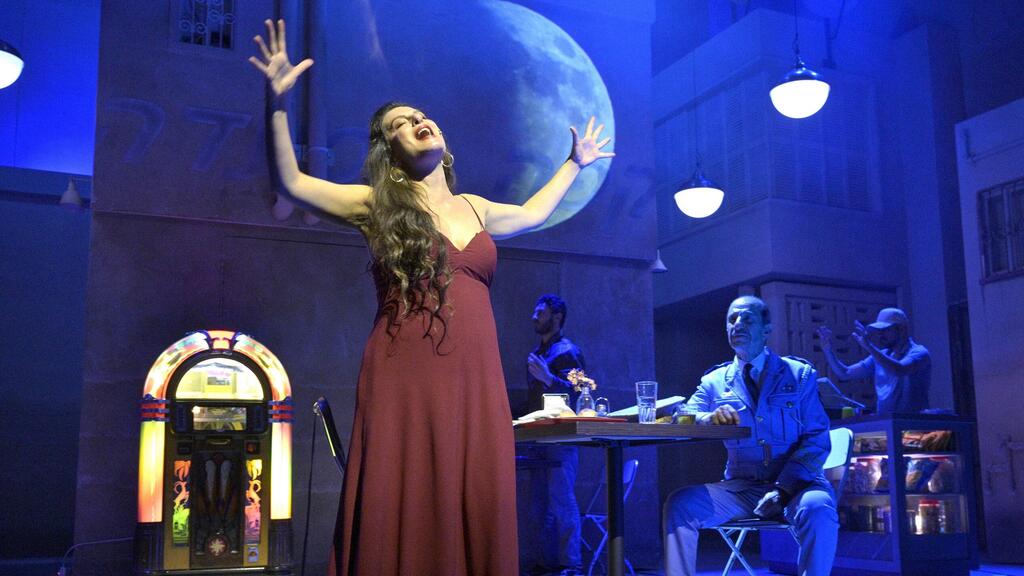
From The Band’s Visit
(Photo: Yossi Zwecker)
At the Heichal Shlomo Theater, where the production is staged, however, the basic conditions do the material few favors. The seats, much discussed already, are ill-suited to a theater venue. The lighting is not always flattering, and the sound is often uneven. Although the production includes several strong numbers, among them ‘Welcome to Nowhere’ and ‘Papi Hears the Ocean,’ it is hard not to judge them harshly when it is unclear whether the issue lies with the sound system, with singers of uneven ability or with a combination of the two.
Most of the songs are performed by Mesika’s character, a sensible choice given that she is the strongest singer on stage, but one that at times creates a sense of imbalance, with other characters fading into her shadow. Still, Mesika manages to step into the very large shoes — to put it mildly — left by Elkabetz, offering a Dina who is at once a simple woman from a small town and a larger-than-life presence. Khoury and Gabay are also excellent, even if their roles receive less stage time than their characters seem to warrant.
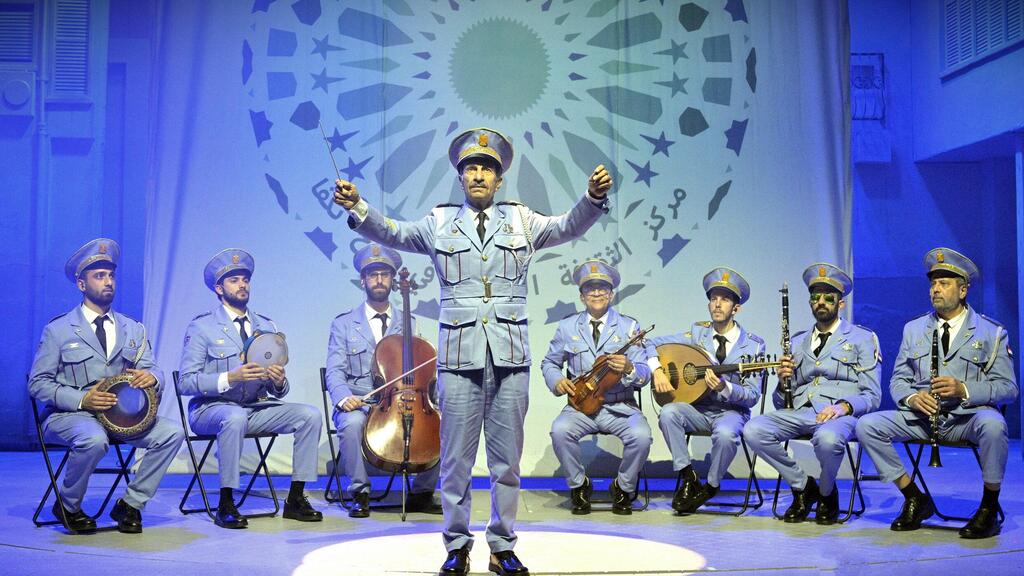
From The Band’s Visit
(Photo: Yossi Zwecker)
“You probably don’t remember it, it wasn’t that important,” the musical says near its conclusion — a beautiful and precise line. One could almost argue that the plot is “boring,” but that was precisely the source of its magic on screen: a small, sensitive story about people in a desert landscape. Their lives do not change completely as a result of that night, but they gain a new perspective, perhaps a small one, yet a meaningful one. On stage, by contrast, that same “boring” quality is felt more acutely. As attractive as the housing-block set may be, without close-ups and sweeping landscapes, something is lost in the transition from cinema to theater.