

In the months leading up to the war, Israeli society was deeply polarized. Public protests intensified, political discourse hardened, and many Israelis warned that the country’s internal divisions posed a long-term threat to its resilience.
Then the war began.
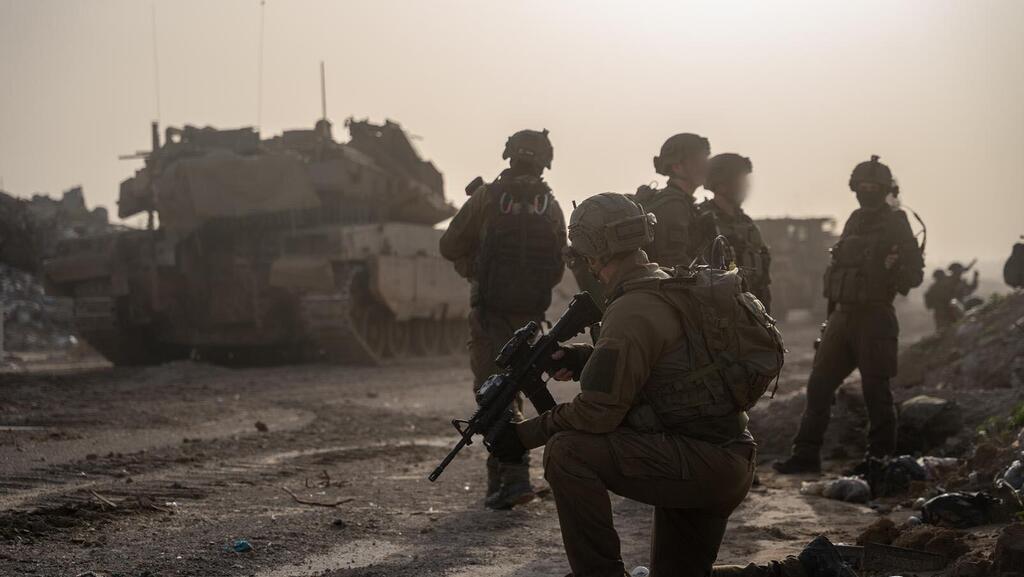
Men and women from across the country — religious and secular, right and left, from the geographic and socioeconomic periphery to the center — were mobilized together. In the intensity of combat service, political identities became secondary to shared responsibility. What emerged was not uniformity of opinion, but a renewed sense of common purpose.
“We realized that our greatest long-term danger is not only external threats,” said David Solomon, founder and CEO of Nifgashim, a civic initiative focused on strengthening social cohesion. “It is our inability to sustain disagreement without losing our sense of mutual responsibility.”
A different model of partnership
Within reserve units, tens of thousands of Israelis who might never have chosen to spend time together found themselves living, operating and making life-and-death decisions side by side.
The contrast with civilian life was stark. Outside the military framework, national discourse often remained tense and hostile. Inside the reserve units, cooperation was nonnegotiable.
Reservists describe the experience as a kind of “parallel reality” — one in which disagreements did not disappear, but were managed within the structure of a shared mission.
When many reservists returned home after months of service, the transition proved jarring. The cohesion they had experienced in uniform did not automatically translate into civilian life. “The gap was almost unbearable,” said Ilan Zarfati, a reservist involved in the initiative. “We understood that if we didn’t actively bring this model back into society, it would fade as a temporary byproduct of war.”
The ‘Iron Duo’ initiative
Tzemed Barzel — Hebrew for “Iron Duo” — is a grassroots project of the Nifgashim movement designed to translate battlefield partnership into civilian leadership.
Under the program’s model, two reservists with differing worldviews who served together visit schools, community groups and companies as a pair. They share their personal stories, discuss how they navigated disagreement during military service and model respectful dialogue in real time.
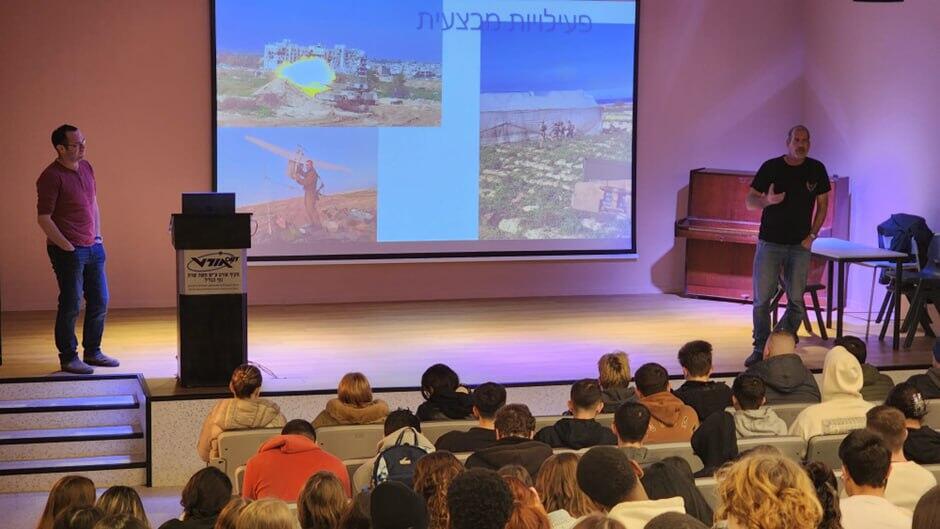
The ‘Iron Duo’ initiative
(Photo: Erez Gonen)
The goal, organizers say, is not to blur ideological differences but to demonstrate that shared responsibility can coexist with sharp disagreement.
Beyond security
Iron Duo positions reservists not only as defenders of Israel’s physical security, but as ambassadors of civic resilience.
By bringing their experience into classrooms and community forums in Israel and the Diaspora, participants hope to help shape a generation that understands disagreement is inevitable, mutual responsibility is a choice and unity does not require uniformity.
Organizers say those interested in supporting the project can do so through an online donation platform. Schools, companies and community groups in Israel and abroad can also request to host an Iron Duo session through the initiative’s website.