

In the late 1990s, singer Eviatar Banai moved to Mitzpe Ramon after traveling through India, the Himalayas and Tel Aviv’s decadence, hoping the desert quiet would offer him rest and inspiration. There, with his band, he created his second and acclaimed album Shir Tiyul (Travel Song). Years later, he wrote on Instagram: “For a year we lived together in Mitzpe Ramon. A group of people who wanted to dismantle the world and rebuild it.”
A quarter of a century has passed since that album. Since then, many winds of music have swept through the desert, and the once sleepy southern town has changed its face. In recent years, a fascinating cultural and culinary scene has flourished there: festivals, concerts, a cinematheque, arts schools, galleries and a range of independent initiatives. “There are always several things happening in Mitzpe at the same time,” says Noa Bar, the town librarian. “The culture is very diverse, just like the population.”
The Desert Reggae Coalition holds a reggae festival every few months. Another notable initiative is Shton, an event in which about 60 artists gather for one day in the artists’ quarter and create a festival that combines high-level art with genuine passion. “The diversity is what keeps Mitzpe sane,” says Ran Livne, a producer and musician.
One reason for the town’s recent boom is that it has become a kind of protected and safe haven, where people have found refuge during turbulent times, from COVID-19 to wars with Iran. During Operation Roaring Lion, only one siren was heard there, and waves of civilians fled south in search of calm and shelter.
According to Uria Reich, one of the driving forces behind the town’s cultural life: “What’s special is that we are very far from everything else. Extreme periphery. The past years have been marked by trauma, and because Mitzpe Ramon is small, remote and very safe, it has created creative activity.”
But Mitzpe’s cultural bloom is not only tied to crises. “There are three real music scenes in Israel where things are constantly bubbling: Jerusalem, Tel Aviv and Mitzpe, where only 6,000 people live,” declares Livne, who together with sound producer Itamar Kashri founded Frequency South. Together they run a studio and produce festivals such as Desert Rock, which will take place at the end of the month. “Part of the magic here is that the culture is usually guerrilla and underground.”
On a recent Thursday night visit through Mitzpe Ramon, mainly in the artists’ quarter (Spice Route area), it was hard not to be impressed. The offering would not be out of place in much larger cities.
Haberech: The bar that became an institution
Haberech, run by Uria Reich and Dan Levi, is the town’s central institution. Reich, who originally came to Mitzpe to dance, opened the place 11 years ago. It started as a local bar and gradually grew into a cultural hub. Its audience is diverse, stylish and lively, ranging from mustached gay men to religious women in head coverings, from longtime residents to Tel Aviv hipsters.
At Haberech, you can also eat and drink well, including creative cocktails and vegan dishes. On weekends, there are special menus. On the night of the visit, chef Itai Be’eri hosted a Thai pop-up. The menu featured dishes from Thailand’s Isaan region: spicy papaya salad, crispy meat salad, excellent spring rolls stuffed with vegetables and noodles, banana-coconut pudding and pad thai.
Be’eri learned these flavors from Kamok and Bunlat, a married couple who worked on his father’s farm in Paran in the Arabah. “I loved Kamok’s food so much that when I came back from school I would go straight to her house,” he says. “That’s where the best food in the world was waiting for me.”
Be’eri lived in Mitzpe for several years and worked there as a metalworker. He eventually returned to his childhood region in the Arabah, but still comes back occasionally to visit friends and share his food. “Something special happens in Mitzpe. A different energy flows here,” he says.
Desert Wine Bar: Negev wines and sunset shows
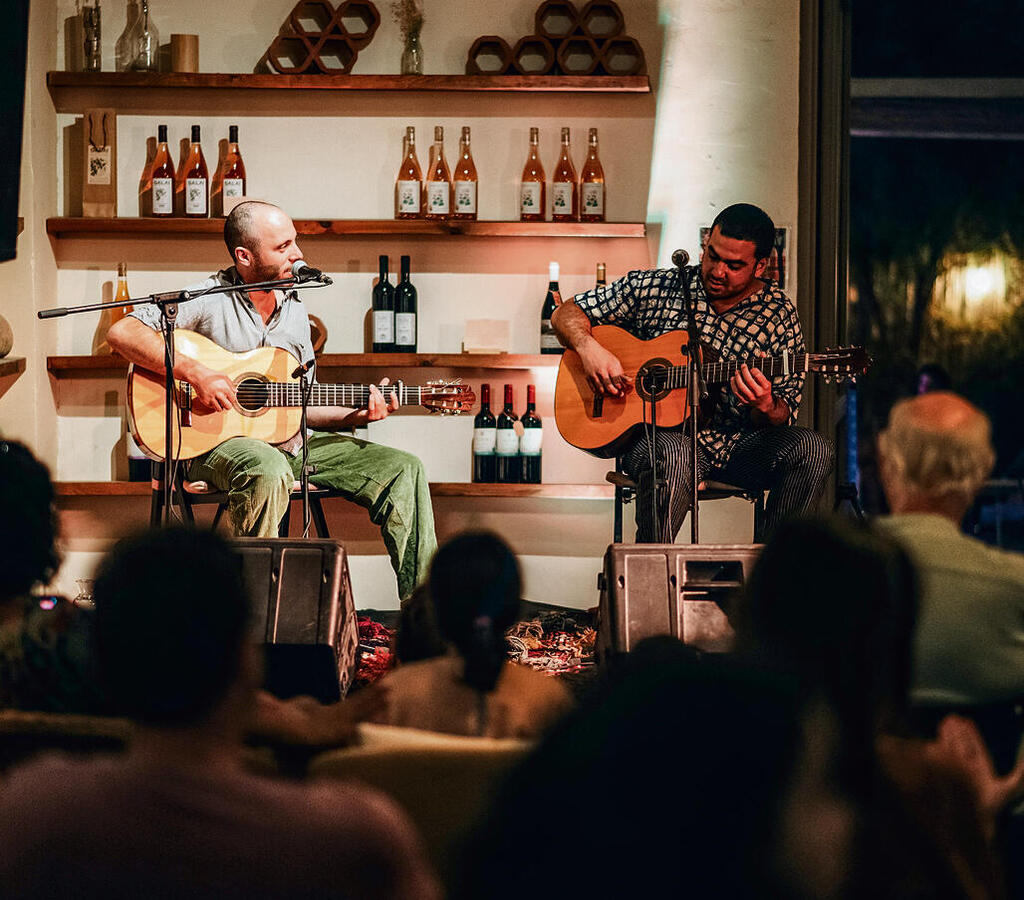
“I feel exposed,” says Dvori, a singer-songwriter and music student at the local music school, during her performance at Desert Wine Bar. She introduces her next song: “I wrote it at the beginning of my pregnancy, while I was in Vietnam.” The performance is tip-based, and as is common today, the audience can contribute via Bit in appreciation.
Desert Wine Bar is a pleasant venue run by a charming couple—Gabriel Tene, who immigrated alone from Costa Rica at 19, and his partner Hadari—along with Yinon Biton. “Our concept is Negev wines. All the wines you see on the shelves are from the desert, including the olive oil,” Gabriel says proudly.
The wine bar has gradually become a cultural center. “Every Friday we have a sunset performance. People sit on the terrace and watch music against the sunset,” Hadari says. “Word about us spreads, and not only people from Mitzpe come to perform. Because of demand, we now also host shows on Thursday evenings. We look for artists who fit our vibe—jazz musicians or acoustic singers who sound good with a glass of wine. We prefer things that don’t bring people down. No crying or too much noise. Sometimes we also hold tastings and lectures.”
HaSifriya: The beating heart of Mitzpe
At the entrance to HaSifriya (The Library), a space devoted to books and reading, a notice board is packed with activity announcements: story hour, master classes, children’s events, performances, used book sales, film screenings and discussions with directors.
“The Library is the beating heart of Mitzpe,” declares librarian Noa Bar. “It’s also a place where people come to read and where students study. It’s quiet and pleasant here. The Library serves as a meeting point for all the diverse communities in Mitzpe. It is neutral, in the best sense of the word—there is room for everyone. There are no political matters here. There is an energy in the Library that is hard to put into words. It allows everyone to be who they are. Something very alive.”
So it is no surprise that artists are happy to perform there. On the day of the visit, veteran singer-songwriter Amir Lev performed. His story-driven songs sound especially fitting among the bookshelves—a perfect backdrop.
The Library is managed by Ronen Stern, a former musician who used to be a gothic club-goer in Tel Aviv’s legendary Penguin Club in the 1980s, “back when Rami Fortis still had long hair,” and today wears a large kippah. Stern prefers action over words, so Livne describes it in his place: “The Library is a well-maintained cultural space. It’s beautiful here,” and indeed it is. Aquariums scattered throughout the Library add to its character and charm.
Rehem: An Israeli indie club
During the war with Iran, it was hard to squeeze into Rehem (Womb), next to Haberech, because it was so packed. On the current visit, two performances were held: Omri Sharif, a talented 19-year-old singer from Kibbutz Gesher HaZiv in the Western Galilee, whose “songs are like paintings,” as her partner describes them. “My music is what comes out of my body and soul,” she says. “Alternative indie rock, influenced by Sonic Youth. First time performing in Mitzpe. Expanding boundaries.”
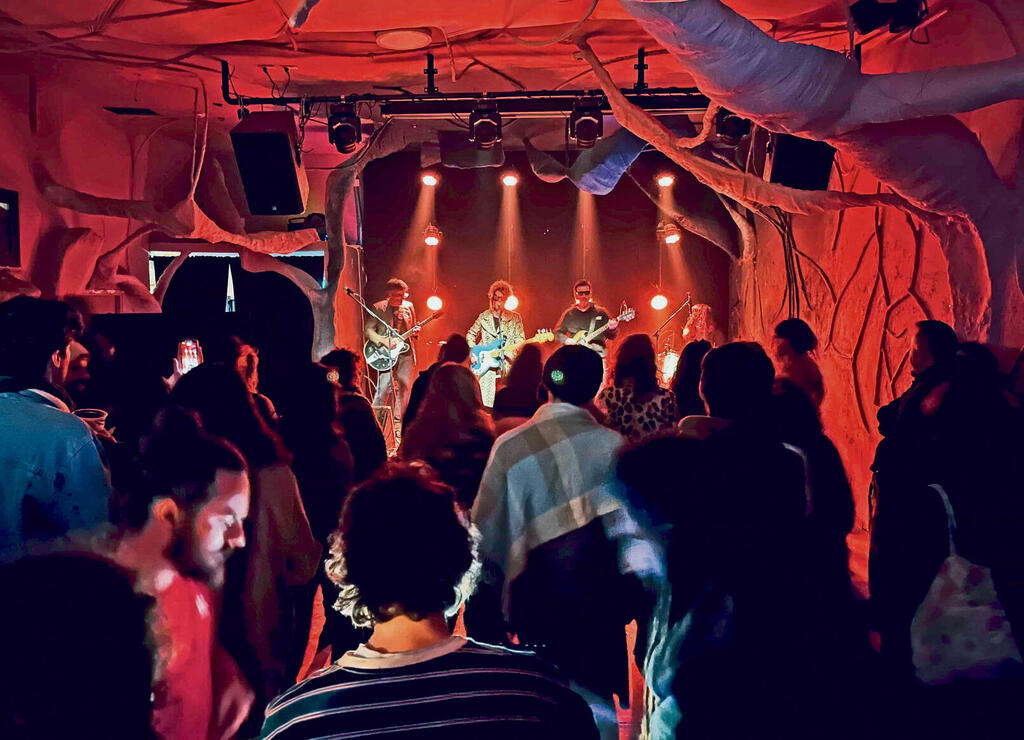
Rehem club
(Photo: Dorel Sivan)
Next was Omer Haliva, a promising 27-year-old singer-songwriter with strong personal charisma. Haliva, son of chefs, is also a sous-chef at the much-talked-about restaurant BOTZ, recently opened in Mitzpe Ramon.
“Four and a half years ago, I moved here to work on my first album,” he says. “I make Israeli indie—not Mizrahi, not hip-hop, not mainstream. Mitzpe Ramon is very much not mainstream. Something about the desert, the silence, the detachment from norms and from the center creates a different rhythm, and it produces different music.”
“You feel loneliness here. Real, intense loneliness, and it’s a recurring theme in my songs and experience. The loneliness is not necessarily about romantic relationships. You are alone, and you have to deal with it. I’d rather live in the desert completely disconnected than in the chaos of Tel Aviv. I lived there, and I don’t like it much.”
Forest party: bonfires and tents
The night journey ends at a party in one of the groves outside town. It is a spontaneous, almost familial, community gathering. We drive along desert paths until we reach the meeting point. Moonlight and strings of colored lights illuminate the darkness. Despite the desert cold, families and groups sleep in tents. A few arrive in caravans. Bonfires help keep warm. Music overpowers the sounds of animals in the surrounding wilderness.
A power outage interrupts the performance of the band Bnei Esrim (Twenty-Year-Olds) after just two songs, but the crowd waits for it to be fixed. “The band describes themselves as hippies. They are young and beautiful,” say two women. “Don’t judge the crowd based on meeting us. We’re the only grandmothers here.” The grandmothers soon leave, but the rest of the crowd continues dancing into the weekend.
Festival: Desert Rock
At the end of the month, the Desert Rock festival will take place for the fifth time, founded by music figures Ran Livne and Itamar Kashri. The upcoming edition will be held at Khan Shitim in the southern Negev, about 40 minutes south of Mitzpe Ramon.
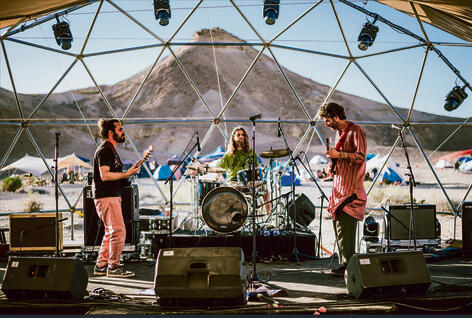
Desert Rock Festival
(Photo: Aviran Moyal)
The duo promises “28 hours of local rock and roll from Israel’s contemporary indie scene: hard rock alongside folk, alternative culture outside of time and space.”
The festival has grown each year, with attendees aged from 6 to 60, including families. This year’s lineup includes 28 artists and bands such as HaZeevot, GayaGaya, Shen and Matate Hashmed. There will also be workshops and art events. Accommodation is camping, with additional options for rooms and glamping tents.