

Several World Cup matches will be played this summer in Kansas City, but when it comes to the way the world will watch the matches - to take a page out of "The Wizard of Oz" - soccer is no longer in Kansas, Toto.
This will be the most technologically advanced World Cup in history, and it may serve almost as a guidebook for how global events will be staged in the future. It will also be the first tournament in the era of artificial intelligence’s rapid rise, and the World Cup could set a new standard for data mining in sports.
The answer to whether all these gadgets will help fans enjoy the reason everyone is gathering — soccer — or will simply disrupt and distract from it, will come soon.
Gallery

Converting football fields to soccer. 170 different experiments to find the optimal grass for World Cup soccer
(Photo: Tony Gutierrez/AP)
According to Sebastian Runge, FIFA’s head of football technology and data, upgrades will be seen in three specific areas: the semi-automated offside technology, known as SAOT, which will be even faster and include new player scans; football artificial intelligence; and body cameras for referees.
SAOT is designed to help make faster and more accurate offside decisions by identifying the location of players and the ball. It cuts review time by about 30 seconds on average compared with a manual check. SAOT was already used at the World Cup in Qatar, the 2023 Women’s World Cup and top European leagues, “but until now,” Runge said, “the system was available only to VAR (Video Assistant Referee) officials. At the World Cup, we will take it to the next level.”
Now assistant referees on the field will receive an audio signal telling them whether an offside has occurred. “When such a ping arrives, it indicates that the artificial intelligence system is very confident in the decision,” Runge said. “The system constantly checks whether the data is good enough and whether there is no confusion between players. If all those checks are positive, the signal is sent to the referees. All of this happens within milliseconds.”
The goal is to reduce the time the game is stopped because of officiating situations. “These delays are not good for the game,” Runge said. “Our philosophy is always to make the referees’ work easier. We will give them a tool that allows them to raise their flags immediately.”
The SAOT graphics seen by television viewers and VAR officials depict the players involved as the same figure. That level of uniformity could affect the AI’s judgment when assessing a marginal offside. Now FIFA will scan every player to create a figure closer to his actual appearance, based on precise height and other unique features. According to Runge, before the tournament each player will enter a 3D scanner for 30 to 90 seconds. “We will have the real faces, hair and dimensions of the players,” he said.
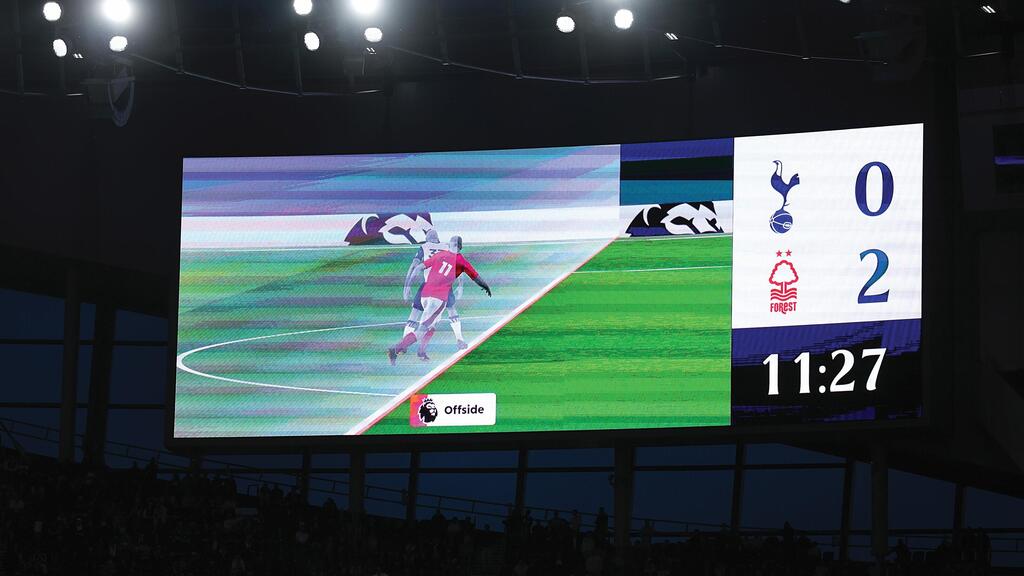
Stadium screens: AI identifies an offside
(Photo: Danehouse- Herry Murphy/ Getty Images)
Another innovation is Football AI Pro, FIFA’s version of Claude and Gemini, which will analyze the game, the players and team performance. According to Runge, teams around the world that can afford it have already begun accessing AI Pro data, and the technology will now be available to every national team at the World Cup.
Perhaps the most enjoyable upgrade will be body cameras — mounted on the ears, not the chest — for all 104 match officials. The technology already exists in leagues from the English Premier League to MLS in the United States, and it makes for exciting social media content. Of course, there will be strict editorial oversight of the footage FIFA approves for distribution. Runge said the concern is mainly coarse language, less so controversial refereeing calls.
This World Cup will also be a peak moment for all kinds of AV technology, from fan engagement and stadium experiences to remote viewing. Stadiums will feature massive LED walls, 360° sound systems and digital elements that will immerse fans in the game as never before. The 8K cameras will place viewers right on the pitch, and fans can expect replays from angles they did not know existed.
170 grass experiments
But ultimately, soccer will have to be played, and in that respect what matters is not a giant LED screen but excellent, durable grass. Last year’s Club World Cup exposed a problem with the quality of the grass in most U.S. stadiums, which are usually used for football games.
To solve it, John Sorochan, a professor at the University of Tennessee, was brought in. For eight years, he led a team of experts researching the search for the perfect grass. They fed, watered and cultivated different blends of grass varieties, measuring blades of grass millimeter by millimeter to find their optimal length.
The accumulated result of more than 170 different experiments conducted by Sorochan and his colleagues will be tested when the fields they developed are trampled over the course of 104 matches.
“That’s a lot of pressure,” Sorochan told the BBC, after being recruited to help oversee the growing, installation and maintenance of the grass at all 16 World Cup stadiums, including four indoor venues. “Those are the ones that really worry me,” he said. “The sun will rise, but it won’t rise indoors. Plants need light, ideally sunlight, to grow.”
The geographic spread of the stadiums also means the pitches must thrive in dramatically different climate zones — from the humid heat of Mexico City and Miami to the cooler conditions of Vancouver and Seattle.
To deal with that, the researchers developed root systems, irrigation methods and maintenance schedules specific to each location, and selected different grass species according to the conditions. They did everything necessary and, still, anything can happen.