


In 2015, Catalan playwright and director Cesc Gay brought “The People Upstairs” to the stage in Spain, a well-written and moderately provocative play. Gay adapted it in 2020 into the successful film “Sentimental,” which was released in Israel in August 2022 under the title of the original play, “The People Upstairs.” In 2022, the play was adapted again in Italy, followed by Switzerland in 2023, France in 2024 and South Korea in 2025. That spread of adaptations is beginning to recall “Perfect Strangers” (2016), by Italian filmmaker Paolo Genovese, the Guinness World Record holder with some 25 remakes.
The dramatic-comic conflict at the center of “The People Upstairs” has a subject capable of fully capturing viewers’ attention, especially those who have already been married for a decade or two. It is easy to take the marital and inter-couple dynamic it presents and translate it, with minor changes, into different languages, cultures and countries.
Although I have seen only the original film adaptation, I do not think I would be taking too much of a risk in assuming that the sixth film version, made this year in the United States, will become the best known. “The Invite” was directed by Olivia Wilde, who also plays one of its four characters. The adaptation was written by Rashida Jones and Will McCormack, two actors who occasionally dabble in screenwriting. This is their second collaboration after working together on “Toy Story 4” (2019). The situation will be familiar to anyone who saw the Spanish version, and in any case, it is impossible to say too much about how the plot develops. As those who saw “The People Upstairs” four years ago know, the dynamic among the characters includes several twists best left unknown before watching.

“The Invite” opens with a quote from Oscar Wilde: “One should always be in love. That is the reason one should never marry.” The film will certainly raise questions about whether love can survive in a long marriage, but as a motto for the film, Wilde’s witticism would have been more precise had “being in love” been replaced with “having sex.”
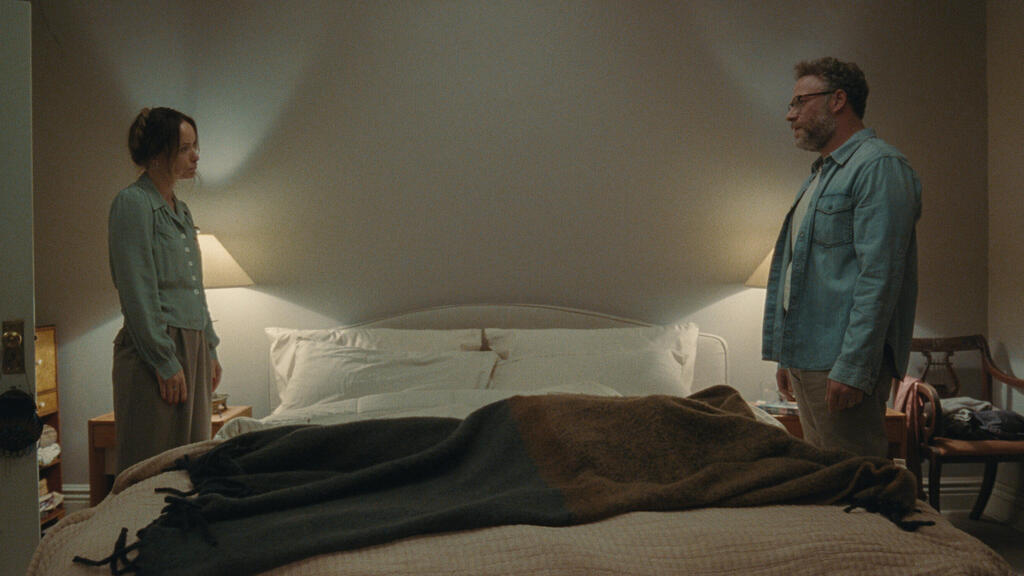
The basic situation is similar. Joe (Seth Rogen) and Angela (Olivia Wilde) are a couple whose marriage is in crisis, even as they recoil from the sharp self-examination it demands. Joe was once a member of a band, but that has long since faded. He now earns a living as a music teacher, a job that serves as a constant reminder of what he sees as his failure in life. Angela is a homemaker who channels all of her creative energy into designing the apartment where they live, a place once inhabited by Joe’s parents and where he himself grew up. This allows the film to place the couple in a very attractive apartment while also turning that positive element into another component of Joe’s low self-esteem.
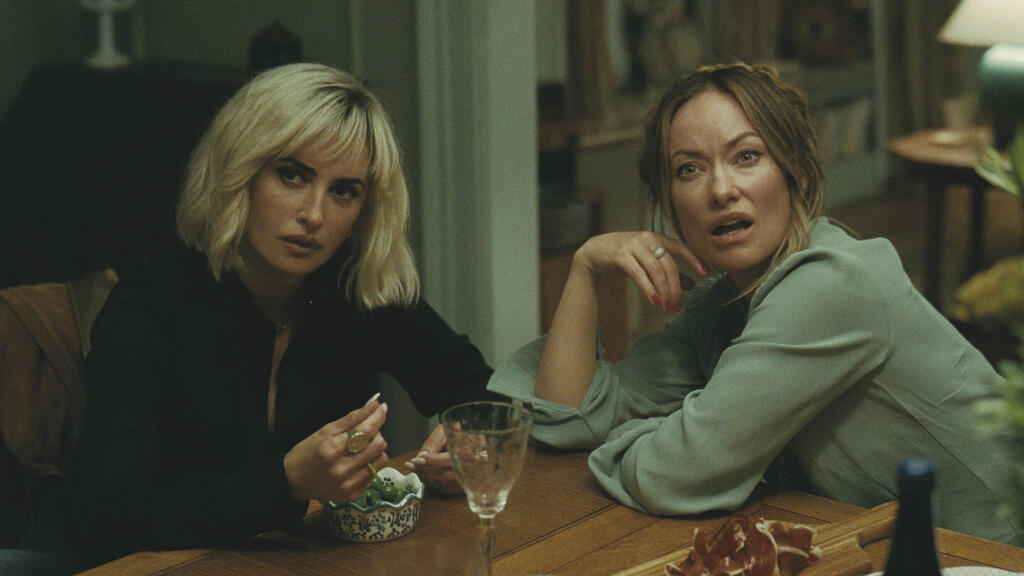
Their relationship has become a routine of barbs, silences and small frustrations. In the film’s opening montage, he comes home from work exhausted after pedaling his bicycle up San Francisco’s hills. She has spent the day buying delicacies to host a neighboring couple — an event Joe did not know was happening. The argument that follows contains more than a few signs of the depth of their problems. For Angela, the dinner seems to carry a special excitement, while Joe threatens to sabotage the gathering by making a crude reference to the acoustic nuisance created by the neighbors as they indulge in wild sex.
From 'The Invite'
(Photo: Courtesy of Lev Cinemas)
The other couple consists of Pina (Penélope Cruz), a psychotherapist and sexologist, and Hawk (Edward Norton), a firefighter who retired from the profession in favor of more sensual pursuits. They are charismatic, sexually liberated and self-assured, living by a completely different set of rules. As the evening progresses, the dinner turns into an emotional confrontation in which the fears and tensions of the host couple are exposed, along with aspects of the guests’ very different way of life.
The American version has several clear advantages over the Spanish adaptation. First, it should be noted, though it is impossible to elaborate, that despite the similar narrative framework, there are also several significant differences. They cannot be specified here, but having seen the Spanish version is no reason to skip the current one. The changes accumulate into a more meaningful emotional process, one that gives the evening’s upheavals the dimension of couples therapy. The film’s ability to achieve this stems not only from changes to the plot but also from additional upgrades.
The four actors in “The Invite” are well known to international audiences. This is not only a matter of familiar faces but of abundant talent. All of them do fine work, but that is especially evident in the cases of Rogen and Wilde. As the host couple, they are required to convey a fair amount of complex emotion, operating in the constant tension between what is said and what they actually feel. Rogen gives one of his best performances, playing a character with more nuance than he is usually given. Angela, as played by Wilde, is a neurotic display of a sexually frustrated woman hungry for male compliments. The characters of Pina and Hawk are more stable, and far more confident in themselves and in their relationship. Penélope Cruz could play another variation on “Spanish sensuality” in her sleep, but here she is present as an actor who has come to work. Edward Norton manages to give a measure of depth and generate affection for a relatively thin character.
From 'The Invite'
(Photo: Courtesy of Lev Cinemas)
The second advantage stems from both the actors and the script. This is a much funnier film. While the Spanish adaptation gradually moves from comic drama to drama, here the comic tone is stronger and remains present throughout. Of course, the presence of a clearly comic actor like Rogen helps, but Wilde, who in my view has never shown any special ability as a comic actress, also does very successful work. She clearly knew how to direct herself, with a strong understanding of her abilities as an actress. Dev Hynes’ music plays an important role in shaping the film as a comedy. The Spanish adaptation made almost no use of music, certainly not extra-diegetic music, while here it engages in a very present dialogue with what is said and what is done — at times too present.
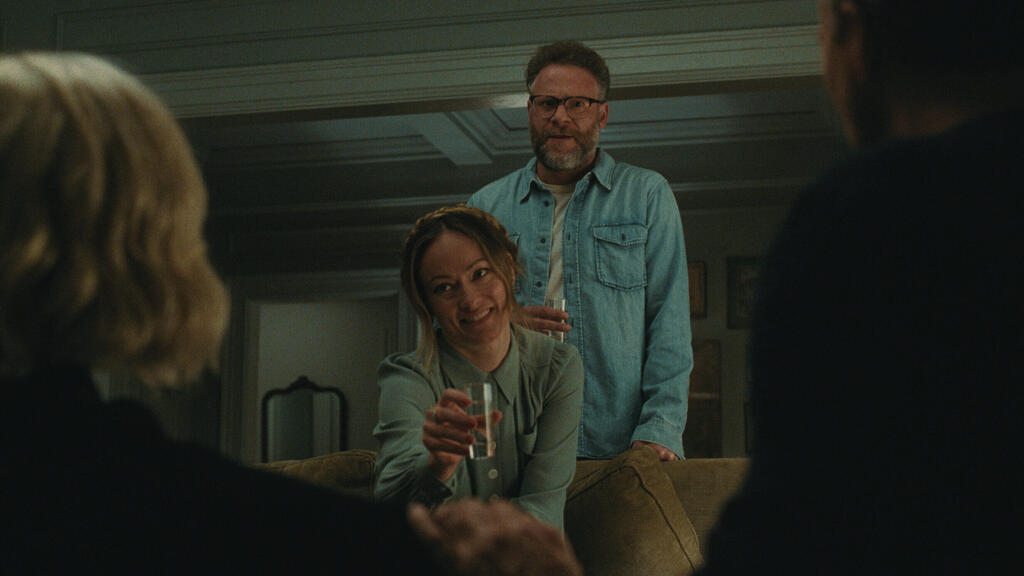
Another clear advantage is that the Spanish adaptation looked like a filmed play, while Wilde directs well within the limits of the space. The film is visually richer in its design, lighting and color; the characters are placed creatively within the space, and the smart editing makes it possible to create the experience of a movie even though the plot takes place almost entirely inside an apartment.
From 'The Invite'
(Photo: Courtesy of Lev Cinemas)
This is Wilde’s third film after “Booksmart” (2019), a kind of progressive female version of “Superbad.” It was a successful debut that American critics praised to an excessive degree. Her second film, “Don’t Worry Darling” (2022), was an attempt to create an anti-patriarchal sci-fi satire in the vein of “The Stepford Wives,” an ambitious effort that resulted in a rather embarrassing film. In “The Invite,” Wilde relies on a strong script and proves that she is indeed a talented director. This is a funny comedy that is also emotionally incisive, aimed at adult viewers — a combination that is almost miraculous in contemporary Hollywood cinema. There is a good chance “The Invite” will have a presence in the next Oscar season.