

Gregory Maguire’s life story, that of the author of Wicked, contains many of the elements of the fairy tale: the loss of his mother at a young age, a weak father and a stepmother who did not rush to take him in, years of wandering marked by alienation, rejection and failure. And, of course, one witch who, in his case, ultimately delivered a happy ending — and above all, wealth.
Yet despite the sweetness of that success, it is hard to ignore the gap between the blockbuster musical and films, which generate millions, and the book’s sluggish sales before it was adapted for stage and screen. There is also a striking divide between the polished imagery, catchy songs and now-obligatory messages about difference, personal empowerment and social justice, and the original story itself, which is very different — almost the opposite.
In contrast to the dazzling color of the films, and even to the more modest palette of L. Frank Baum’s The Wizard of Oz, to which it responds, Maguire presents a world dominated by shades of brown and gray, deliberately so. His Oz is a bleak, fractured land, full of swamps, deserts and, above all, political intrigue and oppression. On the surface, this world is meant to serve as fertile ground for exploring questions of good and evil. In practice, however, that exploration is clumsy and shallow.
Maguire’s writing often reads like fan fiction by an overly enthusiastic teenager, layered with every idealistic concept absorbed in college — or worse, on TikTok. Largely lacking self-criticism, humor or real complexity, the novel bogs itself down in long, tedious stretches of bargain-bin philosophy, offering inflated musings about the supposed ontological emptiness of magic, mirror-gazing identity crises and pseudo-religious explanations for Elphaba’s aversions and rebellious impulses.
The imagery is just as heavy-handed and exaggerated, frequently spoon-feeding meaning to the reader. When the damaged, rejected infant Elphaba destroys a toy bird, another character explicitly frames it as evidence of her attraction to brokenness. Madame Morrible, the scheming antagonist, is painted in similarly blunt strokes, her public smile likened to something sharp and weaponized, as though her presence alone overwhelms the world around her like distant explosions.
The weaknesses extend beyond style to plot construction and character development. From the outset, it is unclear why, in a world populated by dwarfs, talking Animals and people with red skin or blue diamond tattoos, a green-skinned girl would be such a shocking and reviled anomaly — a flaw that undermines the story’s basic motivation. The use of magic is so sparse and sporadic that it raises the question of why Maguire chose the fantasy genre at all.
More broadly, Maguire seems uncommitted to his own ideas, frequently introducing and abandoning them without development or resolution. Everything in his world feels random: the movement of characters through space, their motivations and even their beliefs, all liable to shift abruptly. Elphaba, for example, is initially portrayed as dedicating her life to the struggle for the rights of sentient Animals, yet in the final section of the book, she conducts cruel experiments on monkeys for personal gain.

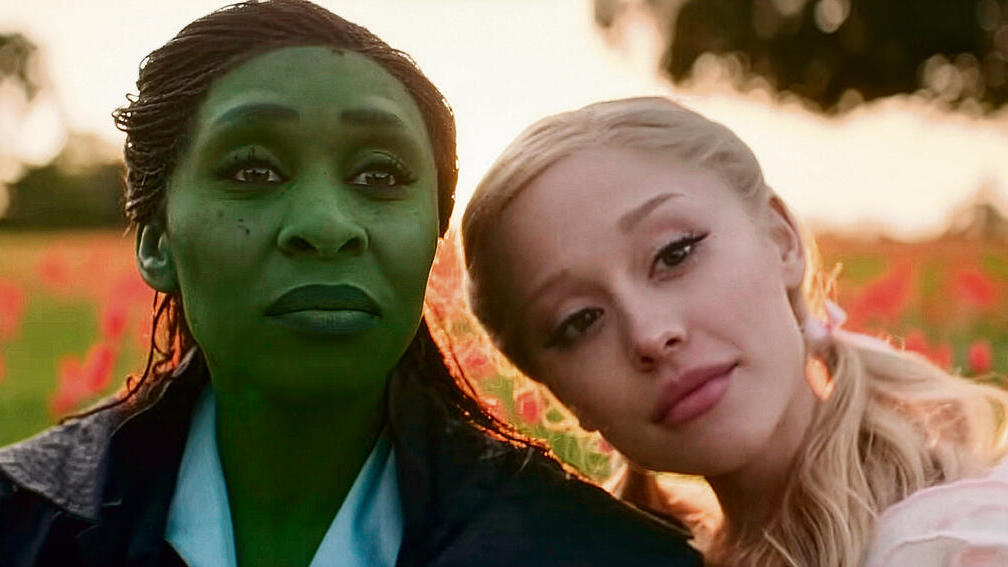
From Wicked: For Good
(Photo: Courtesy of Tulip Entertainment)
Sex, violence and even love, birth and death also appear randomly. Elphaba’s relationship with Fiyero occurs simply because they happen to be in the same place at the same time. Liir is introduced so casually that it takes time to realize he may be Elphaba’s son. Several characters die in abrupt, unsatisfying ways that serve neither the plot nor any discernible theme — if such a theme exists at all.
In Maguire’s defense, it is possible he was attempting to articulate a view of human existence in which there is no absolute good or evil, only squalor and transience, a life driven by base impulses and an endless hunger for power. The fact that the book was written in the early 1990s — amid the collapse of the communist bloc, the sudden shift from the Cold War to diplomatic and economic engagement between former enemies, and ongoing violence such as the Bosnian war and the Rwandan genocide — lends some support to that interpretation.
Still, readers may struggle to reach such conclusions. In the absence of emotionally engaging characters or a coherent plot that can be reasonably followed, many are likely to give up — or simply opt for the films, which offer a glossy, comforting experience without demanding a deep engagement with moral or human complexity. In that sense, Maguire, who has said in interviews that he identifies with his Elphaba, ends up resembling Baum’s original Wizard of Oz: a fundamentally ordinary man, lacking special talent, except for an ability to profit from excessive pyrotechnics and from the talents of others.