

Last summer, when the main front of the war was still Gaza, Gal Gadot found herself at the center of a public and painful storm. When the Venice Film Festival announced that the Hollywood Israeli star’s new film, In the Hand of Dante, would premiere there, pro-Palestinian protests quickly followed.
The controversy peaked as the festival opened in late August. Hundreds of international filmmakers and artists published an open letter urging the festival leadership to take a clear position condemning the ongoing war in Gaza. The group Venice4Palestine also called for the invitations of celebrities who had publicly supported Israel to be revoked, including Gadot and Gerard Butler, who also appears in In the Hand of Dante. Media reports claimed Gadot had canceled her appearance because of the anti-Israel protest and attacks against her, but she later issued an unusual clarification saying she had not planned to attend the festival in the first place.
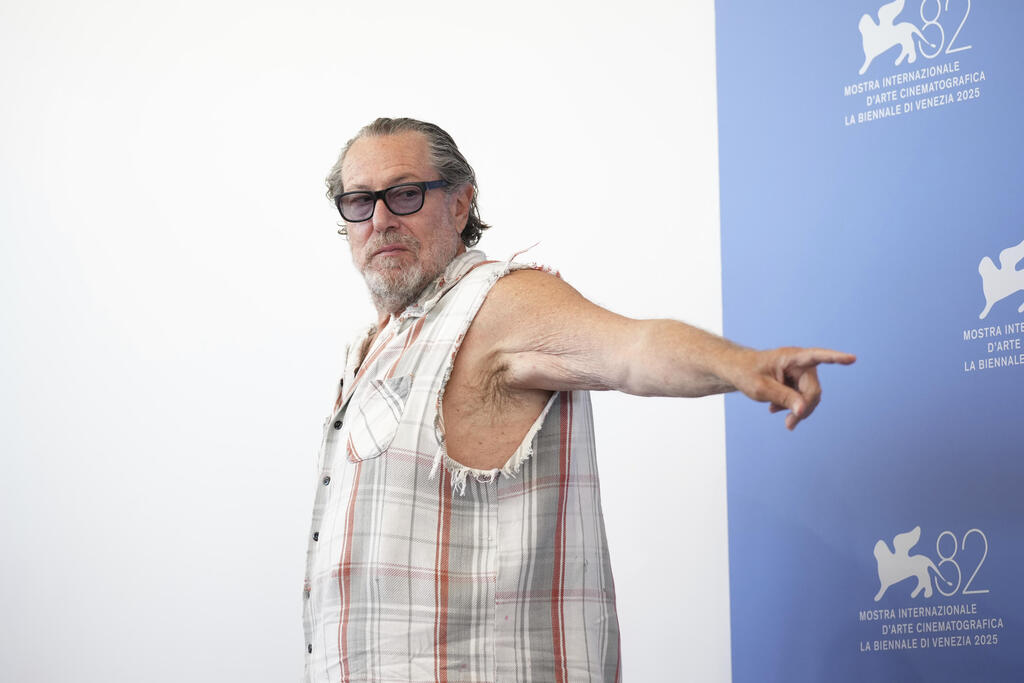
When the film’s director, the celebrated Jewish-American artist Julian Schnabel, appeared in Venice, he was asked at a press conference about Gadot and Butler. “I think there’s no reason to boycott artists,” he said. “I chose those actors because of their merit as actors, and they did an exceptional job in the film, and that’s about it.” Schnabel also declined to weigh in on Gaza, saying the discussion should focus on the film rather than that subject.
In our meeting at a restaurant overlooking the beach on Venice’s Lido, Schnabel again defended Gadot, Butler and his decision to cast them. “What Butler and Gal Gadot did in my movie as actors was amazing, and the rest is not important,” he told ynet. “The casting of Gal created a big mess that has nothing to do with the film. Gal did phenomenal work. Fifteen years ago, I made a film about the Israeli-Palestinian conflict, Miral, and everything I had to say about that conflict, I already said.”
Schnabel continued to reject the calls for a boycott and voiced unequivocal support for Gadot. He noted that at the most recent Jerusalem Film Festival, Gadot received an award honoring her contribution to international cinema and her success, and that in her speech she spoke about peace. “The right in Israel didn’t like it,” he said, adding that it was an Israeli right-wing extremist who assassinated Prime Minister Yitzhak Rabin.

In the Hand of Dante arrives on Netflix next Wednesday. The film is based on the novel of the same name by Nick Tosches and follows a manuscript of Dante Alighieri’s The Divine Comedy. After the ancient text is found in the Vatican Library, it passes from a priest to a senior mobster in New York, where Tosches is asked to authenticate it. Like Dante, he then embarks on a journey of his own.
Schnabel assembled a major cast, including Al Pacino, Jason Momoa, Oscar Isaac and even Martin Scorsese, who appears as an elderly sage who influences Dante as he writes The Divine Comedy. “We’re good friends. I actually painted a portrait of him,” Schnabel said of Scorsese. “Marty has always been very supportive of my work as a filmmaker. He really wanted to play this part, and I thought there was nobody else who could do it. What Marty does in the film is not a cameo. There is depth there.”
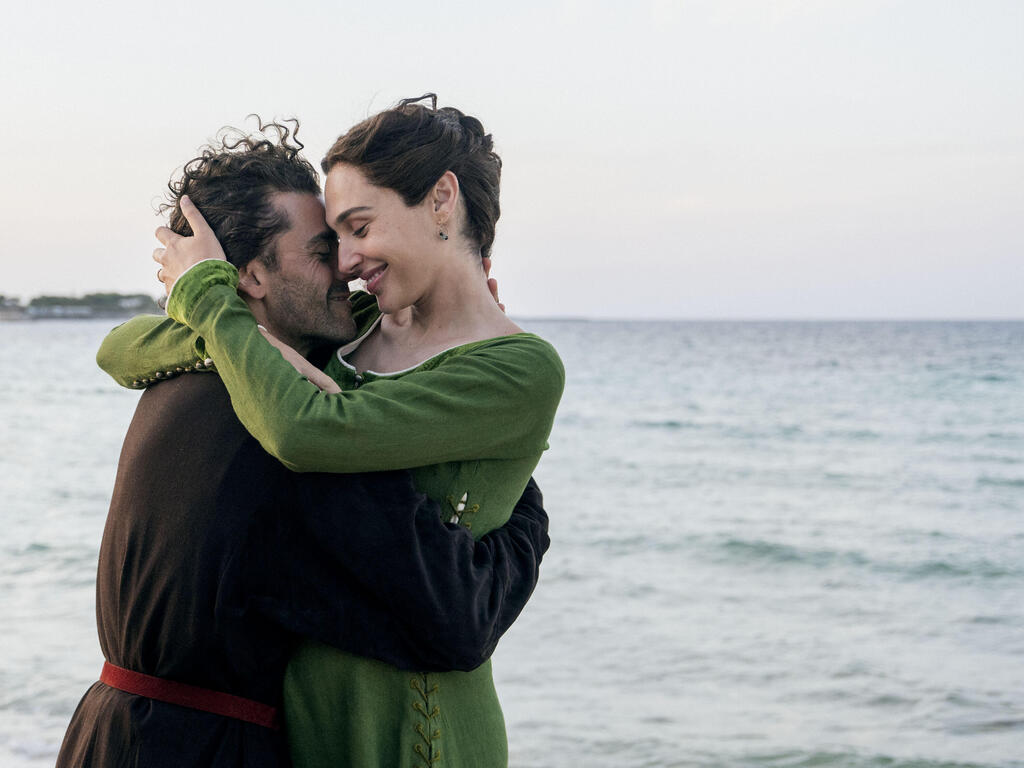
Gadot plays a dual role: Giulietta, the wife of Nick Tosches, and Gemma Donati, Dante Alighieri’s wife in the Middle Ages. Isaac likewise plays both Tosches and Dante. In the film, Gadot appears in suggestive sex scenes with Isaac, including one in which she is filmed like Venus rising from the sea, her long hair covering her groin while her hand covers her chest.
Why did you choose Gadot, and why for a dual role?
“Why did I choose her? I chose her because of what I thought she could bring,” Schnabel said. “I spoke to Gal on the phone, and just from that conversation I knew she could take on the role. In this film she reminds me of Ingrid Bergman.”
(Photo: Netflix)
“When I make a film, I gather people around me who trust me and whom I trust, people I can communicate with, people who know I won’t let them fall,” he added. “They believe that with me, they can explore their inner impulses. They are their own tools. Two heads are on the block: the actor’s, who will be blamed if the work is not good, and the director’s, whose name is on the product and who is responsible for what comes out. Actors who work with me know they will have a clear element of freedom. And that was the case with Gal. She was so warm and kind and so embracing toward Oscar Isaac.”
Are you a romantic person?
“Am I a romantic person? Wow, absolutely,” Schnabel said. “I’m crazy about my wife Louise,” he added, referring to the Swedish interior designer, his third and current wife. She worked with him on this film and on his previous one, At Eternity’s Gate. “At the end of In the Hand of Dante, it says: ‘I have found the God hidden from man, here she is.’ I loved the idea that God would be a woman.”
‘Judaism for me is more a way of life’
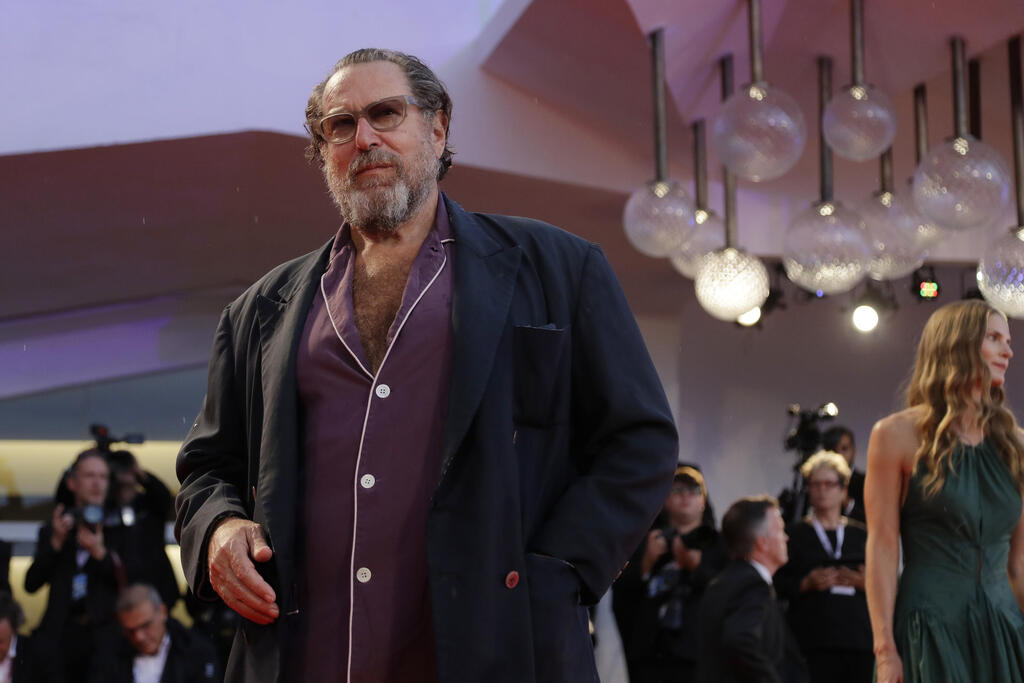
In the Hand of Dante is the seventh film by Schnabel, 74, one of the most important and acclaimed artists of the 20th century. Meeting him is unlike any other interview, starting with the way he dresses. Schnabel can roam festivals in an old checkered shirt stained with paint, sweatpants and sneakers. At the Venice press conference, the provocative and controversial artist arrived in a checkered shirt with the sleeves cut off and a pair of shorts. For the red carpet premiere of In the Hand of Dante, at least, he wore an elegant tuxedo.
Sometimes he can be arrogant, defiant and theatrical; at other moments, warm and curious. It is not always easy to follow the flow of his thoughts, poetic sentences and associations. Sorting through it all can be difficult. But Schnabel is always fascinating and never dull. A conversation with him is enriching, challenging and illuminating.
(Photo: Kirsty Wigglesworth/AP)
Schnabel was born in Brooklyn to a Jewish family. His father immigrated to the U.S. from Czechoslovakia, and his mother was of Romanian descent. “After World War II, the people from Auschwitz and the camps, my mother was finding places for them to live,” he recalled in a previous interview. “So my sister was 11 and a half years old, she said, ‘You know, there are always strangers in our house wearing our mother’s clothes.’ And then they disappeared. And then there were other people over there.”
In 1948, he said, his mother was president of Hadassah in Brooklyn and sold trees to be planted in Israel. “My mother spent her life selling trees, basically getting neighbors to, drove my father crazy because everybody was having to buy trees all the time, and buy a tree in Israel,” he said. His father, he added, was a member of B’nai B’rith.
Did you have a bar mitzvah?
“I had a bar mitzvah,” he said. “And really, on Passover, I used to like to eat pizza.”
When Schnabel was 15, his family moved to a town in Texas near the Mexican border. After university, he returned to New York, began painting and supported himself through odd jobs, including driving a taxi, selling sunglasses and cooking.
In the late 1970s, he broke through with colorful paintings onto which he attached broken plates. His rise was meteoric, and Schnabel was compared to the discovery of a rock star. He was seen as a “noble savage” who returned painting to the gut, to the physical experience, an antidote to the minimalism and conceptualism that then dominated the art world. He exhibited wild, romantic and grandiose works at a dizzying pace, breaking conventions in both subject matter and materials. His critics accused him of pretension, arrogance and audacity, especially after he declared that he was “the closest thing to Picasso.”
In 1988, Schnabel had a solo exhibition at the Israel Museum. “When I was a child, my parents used to tell me, ‘When you go to Israel, you’ll have a special feeling that it’s your country,’” he recalled. “But I never believed that and didn’t bother to go, even though my mother was president of Hadassah.”
When he arrived for the exhibition, he said, the feeling his parents had described suddenly emerged. “When I had the show at the Israel Museum in 1987, when Teddy Kollek was the mayor, I thought I’ll take Arabs and Jews and we’ll go out into the desert and I want to make some paintings on Bedouin tents,” he said. But the First Intifada broke out the day after he arrived, and the project never happened.
“I never really thought about it very much,” he said of his Jewish background and Israel. “My mother wanted me to go to Israel and said, ‘You know, when you go you can have this special feeling.’”
He said he has no connection to formal religion, does not attend synagogue and does not belong to a Jewish community, but feels tied to his Jewishness. Judaism, for him, is “more a way of life, survival, a model for life, how to treat people.” He still wishes artists could have helped bring peace.
The Diving Bell and the Butterfly
(Photo: YES)
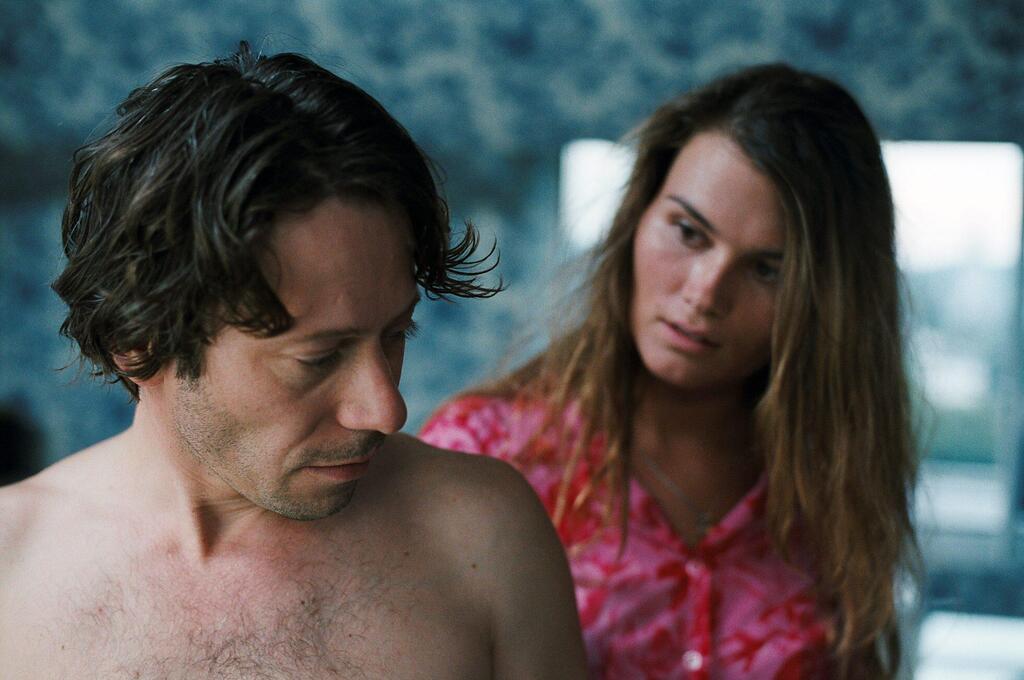
Alongside his painting, Schnabel occasionally directs films. His first feature, Basquiat (1996), reconstructed the tragic story of graffiti artist Jean-Michel Basquiat, who died of a drug overdose at 27. In Before Night Falls (2000), he told the story of gay Cuban writer and poet Reinaldo Arenas, who died of AIDS in exile in New York. In The Diving Bell and the Butterfly (2007), which won him the Best Director award at Cannes and received four Oscar nominations, he adapted the devastating autobiography of Jean-Dominique Bauby, the former editor of French fashion magazine Elle, who suffered a stroke in 1995 that left him almost completely paralyzed. Bauby remained in a state known as locked-in syndrome: unable to speak or move, but still able to understand, think, hear, remember and imagine. He dictated his memoir by blinking his left eye when the desired letter was reached on a chart. In At Eternity’s Gate (2018), Schnabel focused on the period when Vincent van Gogh lived and painted in Arles. Van Gogh died at 37 after struggling with depression.
It seems you like making films about creators who are close to death.
“That’s also what Olatz, my second wife, claimed,” Schnabel said. “She asked me, ‘Why is it important for you to make films about these depressing subjects?’ I’m not sure what my obsession with the subject means. I’ve been terrified of death all my life, even though my father reached the age of 92 without ever really being sick, and my mother died of heart disease at 89. They were happily married for 60 years. During those years, my mother clinically died several times and came back to life. So she was never afraid of death, and even became tired of this world. My father had a lot of energy and was young in spirit, but he changed and aged the moment my mother died. Life is complicated and full of bumps. Acting or creating is a way to defeat death, a way to deal with the fatal disease called ‘life,’ and that is why I feel greatly privileged to be able to create.”
Schnabel remains a sought-after artist and continues to paint. A large exhibition currently on view at Château La Coste in Provence represents five decades of work, alongside new paintings of pine trees inspired by the Provençal landscape.
‘There are more good Israelis than bad, and more good Palestinians than bad’
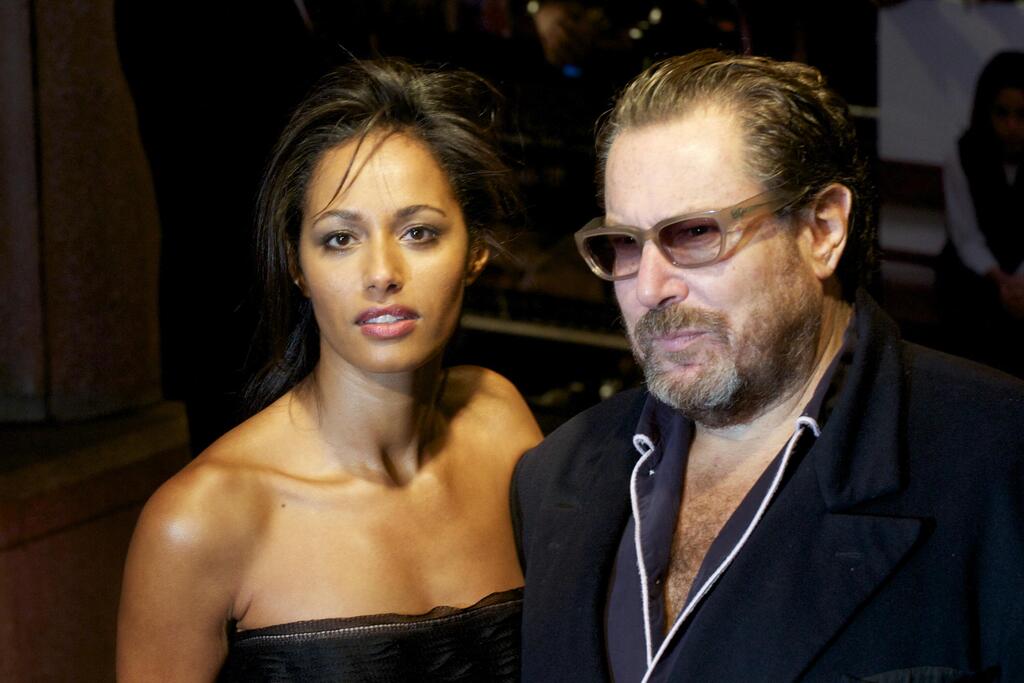
Schnabel’s filmography includes one resounding and embarrassing failure: Miral (2010), a problematic film based on the autobiographical novel by Rula Jebreal, who came from Jerusalem to Italy with nothing and became a journalist, writer, playwright, activist, provocative media figure, tabloid favorite and now one of the prominent voices against Israel over the war in Gaza. Jebreal became Schnabel’s partner, and their relationship lasted from 2007 to 2011. She later had a relationship with Roger Waters, one of the most prominent figures in the boycott movement against Israel.
Julian Schnabel and Rula Jebreal
(Photo: Jorge Herrera/AP)
The melodramatic and cliché-ridden Miral follows several Palestinian women from the Deir Yassin massacre to the signing of the Oslo Accords. “I felt compelled to show aspects of the society that were extremely familiar to people that were outside of that place, to try to make a portrait of the Palestinian community,” Schnabel said in an interview after the film’s 2010 Venice premiere.
“It is a movie about Palestinian people, and by a Palestinian author, and made by a Jewish guy from New York who read the book and thought, okay, well, it’s a good story to tell,” he said. “I don’t think a Palestinian would make a movie like this. You’d never see two girls kissing in a Palestinian film. What the film does is it disassembles the Palestinian society, so you see that there’s a conflict within the Palestinian society. My approach was to look at these people as if they’re people.”
In that context, it should be noted that Israelis are portrayed problematically in Miral, at times almost as caricatures: many are shown as power-drunk and violent, willing to mistreat Palestinian civilians.
“I don’t know if I’m fair or unfair,” Schnabel said in 2010. “We tried to make an honest film. I went there and saw the dynamic and saw things that are just unacceptable. As a Jewish person, I’m ashamed of that kind of treatment. I’m ashamed of a lot of the things that are going on.”
He said the film showed people caught in the middle. “If you’re a soldier, you’re put in a situation over there where you have to do something, or say, protect another soldier that is with you if something’s happening, and you end up having to deal with that your whole life also,” he said. “It’s not about pointing a finger, but I think it’s a very, very realistic portrait of a situation.”
Schnabel said he showed the film to Amalia Dayan, Moshe Dayan’s granddaughter, to Israeli-born filmmaker Oren Moverman and to many other Israelis. The responses, he said, were strong. “Oren said it was a beautiful poem, it was a cry for peace. And Amalia was in tears watching the thing,” he recalled.
He also added a quote by Yitzhak Rabin to the film: “We don’t dream of peace, we make peace.” Rabin originally said “we don’t sing about it,” Schnabel said, but “dreams sounded better,” and the change was poetic license.
“There’s no reason for violence on either side,” Schnabel said. “There’s a lot more similarities between these people than there are differences. I can’t imagine that a state with such intelligent people, I can’t imagine a state of continual war.”
He continued: “I think the Israelis are good, I think there are more good Israelis than bad ones, and more good Palestinians than bad. And I think that these people need to stand up, like in 1982 when they wanted to end the war in Lebanon, 400,000 Israelis went to the street. Beautiful, no? So that’s what has to happen. The civil society can’t be held hostage by fanatics on both sides.”
Miral, which was filmed in Israel with the help and support of Nir Barkat, then mayor of Jerusalem, was screened at the United Nations General Assembly hall despite objections from Israeli diplomats and Jewish organizations, who argued that it was an anti-Israel film promoting the Palestinian agenda. Sean Penn, Steve Buscemi, Robert De Niro and singer Lou Reed, about whom Schnabel made a documentary, attended the screening. Schnabel rejected the objections and described his film as a “cry for peace.”
(Photo: Alessandra Tarantino/Invision/AP)
Fifteen years later, Schnabel still believes that art can alter reality. “When you make art, you change things,” he said. “Even if the subject is tragic, art is always optimistic. There is no such thing as pessimistic art. You can create the perfect work even if your life is in ruins.”
During our conversation about Gadot and violence by extremists, he suddenly recalled the late Juliano Mer-Khamis, who acted in Miral. The film was Mer-Khamis’ last before he was murdered in Jenin in 2011. Schnabel described him as an exemplary Israeli-Palestinian who continued the work of his mother, Arna, by running an acting school in Jenin, before a fundamentalist shot him dead in front of his family.
Why did we have to wait seven years for a new film from you?
“Because I’m not working on films all the time, and cinema is not my job,” Schnabel said. “It took me time to be ready to work on another film, but I do paint all the time, almost every day. Luckily, in painting, that’s possible, unlike cinema. If I had to wait for other people to move themselves so I could make films all the time, I would have to shoot myself in the head.”
“In my film about van Gogh, Dr. Gachet asks van Gogh, ‘Why do you paint?’ and he answers, ‘So I can stop thinking.’ When I paint, I simply stop thinking and merge with what is outside and with what is inside. And that is what happens when I make a film too.”