

In brief:
- Tractor maker JCB set a speed record for a hydrogen-powered vehicle
- With 1,600 hp from two engines and a top speed of 650 kph
- Behind the wheel: a former British Royal Air Force fighter pilot
- With 1,000 hp and F1-style aids: The world’s fastest tractor
- The biggest, most expensive: First drive in the John Deere 9R
Instead of diesel: JCB is best known as a British manufacturer of tractors and construction equipment, but two decades ago it also began developing a diesel engine for use in various machines. With four cylinders and a 4.4-liter displacement, it installed two 750-hp versions of the engine in a purpose-built race car designed for speed records and set a 560-kph speed record in 2006.
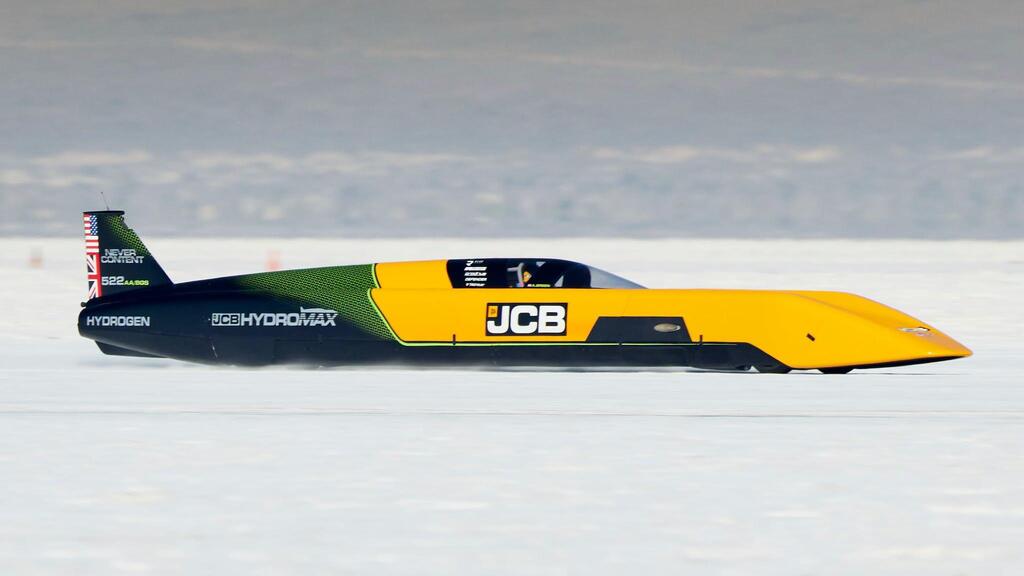
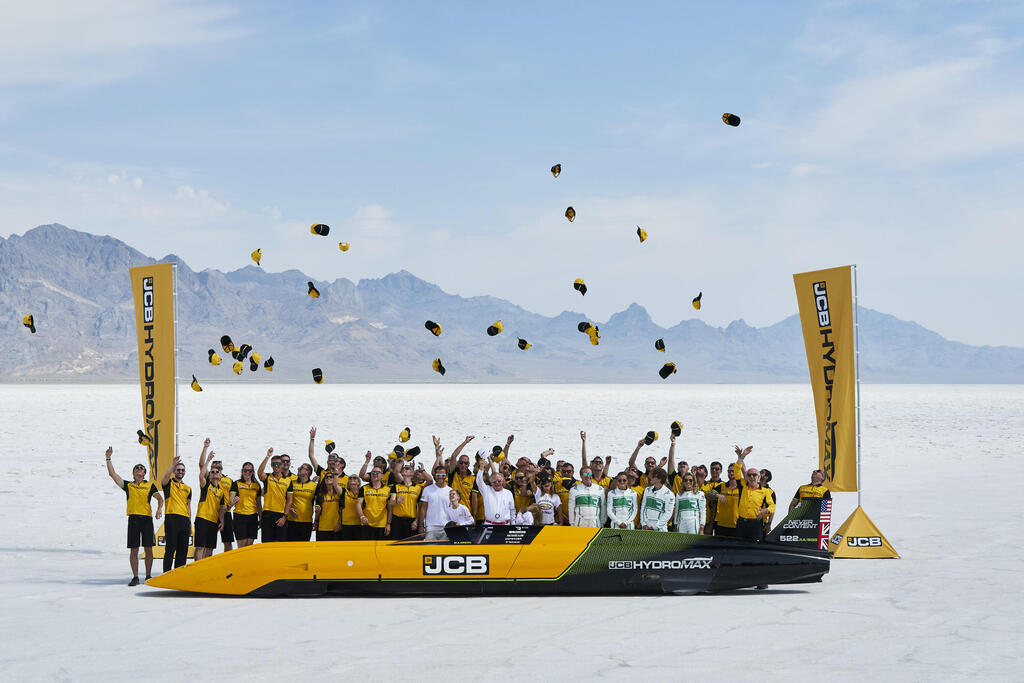
Now it has returned to the famous Bonneville Salt Flats in Utah, this time to break a new record using hydrogen propulsion that it is developing. It reached 650 kph there, calculated as the average speed over two runs in opposite directions, consuming 2 kilograms of hydrogen and producing 18 liters of water as its only exhaust output.
At flying speed: The new race car is powered by a pair of JCB’s production four-cylinder, 4.8-liter engines. They are internal-combustion engines fueled by hydrogen, unlike the fuel-cell technology used by companies such as Toyota and Hyundai. Each engine produces 800 hp thanks to a modified ignition system, an intake manifold with a NACA air inlet that helps reduce drag and a titanium turbocharger capable of more than 150,000 rpm. It can compress, every half-second, an amount of air equivalent to that contained in an average bathtub.
One engine is mounted behind the driver’s cockpit and the other at the front. Each is connected to the wheels nearest to it through a six-speed sequential Xtrac gearbox and a clutch system taken from a JCB backhoe loader, the only system capable of withstanding the load. The cooling system is also complex. Each piston, for example, requires a flow of 1 liter of oil per second to prevent overheating, roughly the same amount used to lubricate all the other engine components combined. Instead of radiators, the cooling system uses two ice tanks, one mounted in the nose and the other in a bulge behind the driver’s canopy. Together they hold 250 kilograms of ice, the amount required for each run.
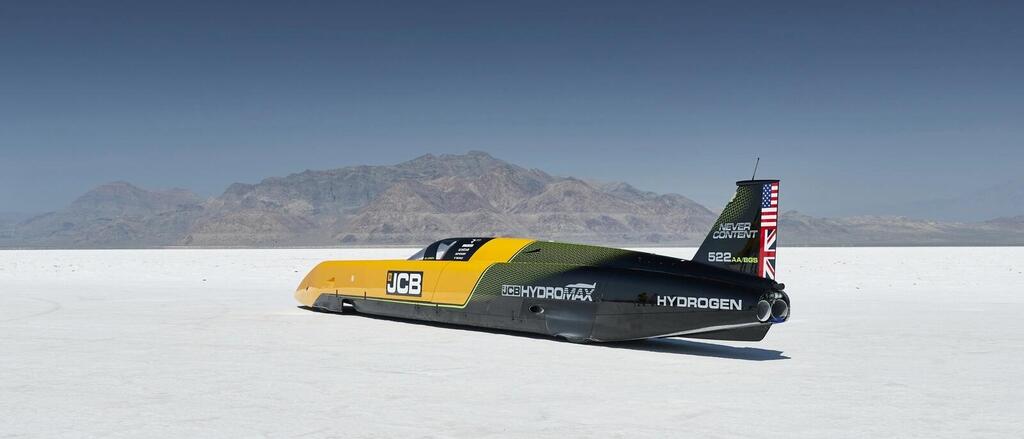
The tubular chassis is made of steel, while the cockpit is mounted on a carbon-fiber subframe with an additional steel roll cage above it. The driver was Andy Green, a former British Royal Air Force fighter pilot who flew Phantoms and Tornados and who was also responsible for JCB’s previous diesel speed record. The speed he achieved this time was not particularly impressive to him: In 1997, he set the world land-speed record of 1,228 kph with the ThrustSSC, a record that still stands. He is also the only person to have broken the sound barrier while traveling on land.