

A blanket of soft white snow is the perfect backdrop for human cruelty. The Coen brothers taught us this in Fargo, highlighting the cold-heartedness of people against a frozen landscape — and now comes Dead of Winter, following in those footsteps, placing Emma Thompson against a pair of murderous hunters you wouldn’t want to encounter even in warmer weather.
The film’s story unfolds in northern Minnesota — though it was actually filmed in Finland — where a recently widowed rural woman (Thompson) visits a remote lake. The reason for her trip is revealed later, though it is hardly compelling. What matters is that near the frozen lake, she encounters a hostile-looking man standing outside a secluded cabin, a suspicious bloodstain marking the snow. She soon discovers a young woman trapped in the basement, along with another woman (Judy Greer) suffering from cancer.
'Dead of Winter' Trailer
(Courtesy of United King Films)


Without revealing too much beyond the opening setup: Thompson has never before played a role demanding physical survival skills, certainly not at 66. But this does little to elevate the film, directed by Brian Kirk (21 Bridges), which is yet another story about rescuing an innocent girl from predatory killers in the snow. Thompson’s character must largely fend for herself, and the frozen lake serves as the central arena for the climactic showdown.
The script, penned by Nicholas Jacobson-Larson and Dalton Leeb, lacks logic. Once the reason for the young woman’s abduction emerges, it is unclear why the perpetrators would need to transport her to a frozen wilderness. Many thrillers have explored similar plots, yet none required a frozen lake as the setting. Flashbacks cut to a loving couple in the 1980s, including the girl, played by Thompson’s real-life daughter Gaia Wise. These scenes — filmed in a far more pleasant climate — fail to add tension or narrative weight, instead creating an unnecessary sentimental counterpoint to the story’s brutality.

What makes Dead of Winter especially problematic is the portrayal of the cancer-stricken woman, who consumes a steady supply of fentanyl and is credited only as “Purple Lady.” Such a monstrous depiction of a dying character strips her of humanity and exposes the story’s weaknesses. Had this character been central or emotionally developed, the film might have explored an unexpected ethical complexity — but as written, she remains a one-dimensional, nameless villain.
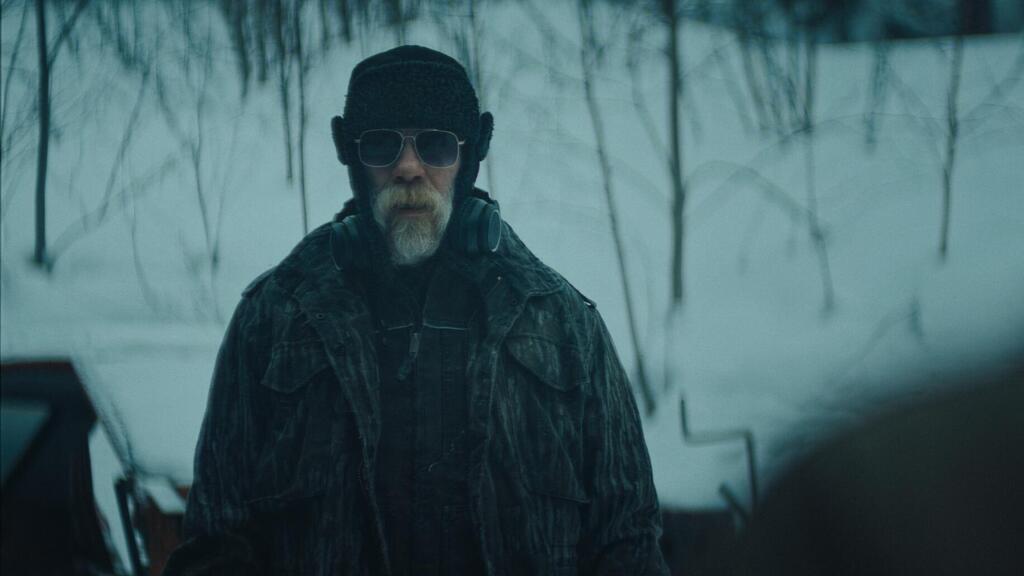
From Dead of Winter
(Photo: Courtesy of United King Films)
This leaves Thompson’s character, a senior version of Frances McDormand’s pregnant detective in Fargo, with little backstory or explanation for her survival skills. A scene in which she stitches her own arm with a fishing hook plays as a standard survival trope, though her competence seems unearned. Nonetheless, Thompson earns her place among actresses like Helen Mirren who have reinvented themselves in action roles. Still, this alone is not enough to make a film otherwise laden with clichés and set in a bleak, snowbound landscape compelling.

Judy Greer, from Dead of Winter
(Photo: Courtesy of United King Films)
The title Dead of Winter has been used for previous films, including a 1987 forgotten gem by Arthur Penn, in which Mary Steenburgen plays a distressed actress auditioning in a remote cabin amid a snowstorm. That film’s chilling psychological drama and craftsmanship make it far more worth watching, a thought that lingered throughout viewing Thompson’s action thriller.