


The heroine of "Wicker" is a lonely woman who decides to order herself a husband. Not a flesh-and-blood man, not a fairy-tale prince and not even a sophisticated sex doll, but a man made of wicker who looks like a walking basket. That hardly sounds promising as a partner for love and sex. But what if I told you he's played by Alexander Skarsgård? Directed by Alex Huston Fischer and Eleanor Wilson, the film is a bawdy, satirical fairy tale that attempts to serve as a parable about love, relationships, jealousy and the human need to be loved. It has considerable charm, but struggles to sustain the momentum of its original premise.
The film is an adaptation of the 2008 short story "The Wicker Husband" by British author Ursula Wills-Jones. The story offers something of an adult version of "Pinocchio": a shunned woman asks the local basketmaker to create a partner for her, and the artificial creation turns out to be an ideal husband. Fischer and Wilson preserve the basic structure and fairy-tale quality of the original story, but expand the social world surrounding it, giving it a more overtly satirical edge.
This is the duo's second feature film collaboration, following "Save Yourselves!" (2020), a science fiction comedy in which a young urban couple heads off on a vacation disconnected from the outside world, just as Earth comes under alien attack. That film also demonstrated the directors' interest in examining social conventions through fantastical premises, using humor to expose the gap between their characters' self-image and reality. In "Wicker," however, they turn to the past, or at least an imagined version of it, replacing an alien apocalypse with a folk tale about the institution of marriage.
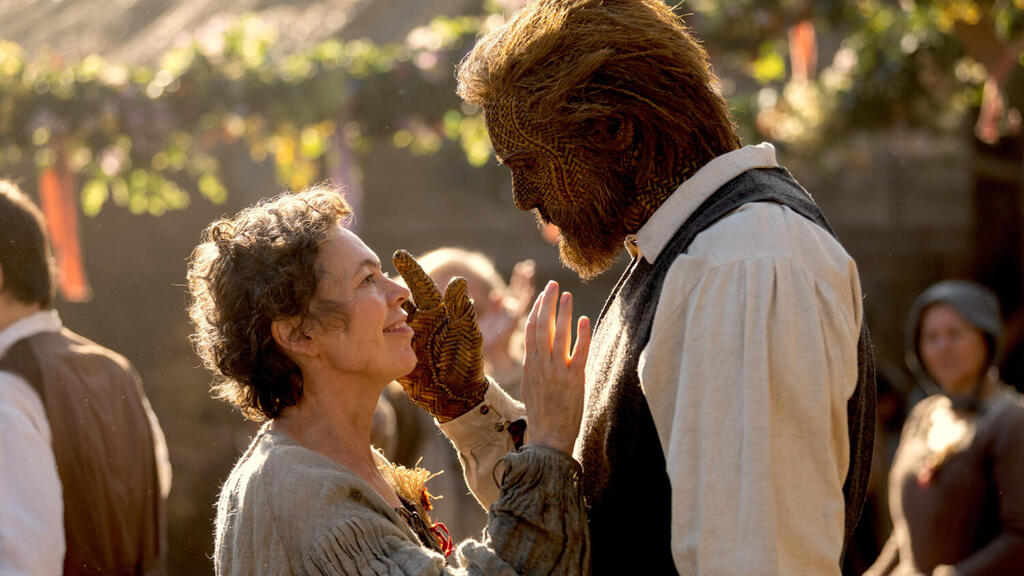
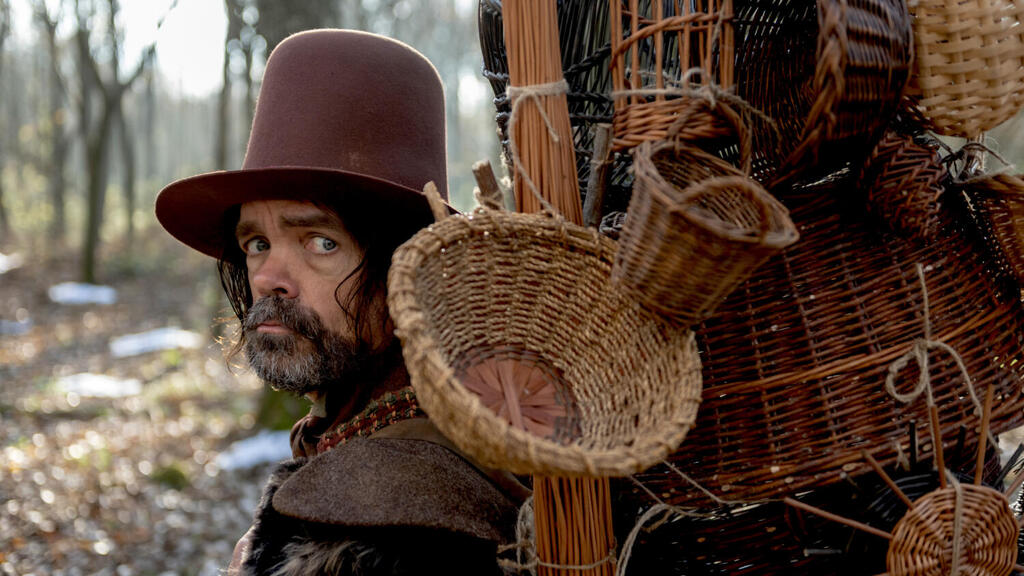
The protagonist (Olivia Colman) is a fishmonger who lives alone on the outskirts of a small village. The locals look down on her because of her appearance, the smell of fish that clings to her body and her low social standing. Nor does she show much interest in the village's conventional rituals of courtship and marriage. But after becoming involved in a local game in which residents guess which couple will marry next, she decides to change her status and approaches the basketmaker, played by Peter Dinklage, asking him to make her a husband. The craftsman agrees and creates a man made of wicker, who takes the form of Skarsgård. The mysterious creation comes to life, and the couple marries in a local ceremony where brides receive not a ring but a metal collar symbolizing their status as their husband's property.
The village looks as though it has been lifted from a medieval English fairy tale: stone houses, muddy alleyways, traditional crafts, trades that define the villagers' identities and a rigid patriarchal social structure. But the film makes no attempt to recreate a particular historical period. Its world operates according to fairy-tale logic, while the dialogue is deliberately peppered with modern, anachronistic expressions. The language is not intended to be historically authentic, but to create a comic clash between the archaic setting and a mindset familiar with contemporary social conventions. The villagers are ignorant, crude and preoccupied with bodily functions, gossip and struggles over social status.
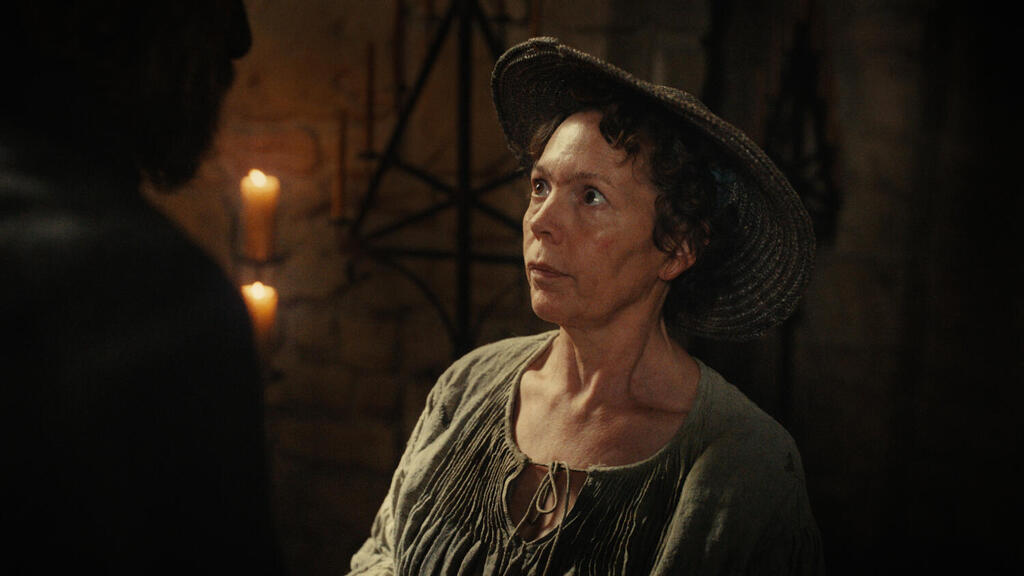
Colman, who won an Oscar for her performance in "The Favourite," knows how to move between physical comedy, emotional vulnerability and almost unpredictable cruelty. Her character does not undergo a Hollywood makeover in which a neglected woman suddenly transforms into a beauty. She remains the same woman, with her shabby clothes, unkempt appearance and fishmongering trade, and the film makes no apologies for it. That is precisely why there is something so delightful about watching her discover the possibility of being desired. Her wicker husband does not try to change her, is not ashamed of her and does not treat her as someone who should be grateful simply for his presence. He loves her unconditionally, almost mechanically, but in a way that gives her a sense of security for the first time.
A medieval English fairy tale; from 'Wicker'
(Photo: Courtesy of United King Films)
Skarsgård has already demonstrated his ability to make use of his striking physical presence, whether in roles where his masculinity is central to his screen persona or in those where that same presence takes on an unsettling or alienating quality. In "Pillion," for example, his masculine physique and sexual charisma are central to a queer master-slave relationship. In the series "Murderbot," by contrast, he adopts a cold, detached and robotic presence to portray a consciousness that does not operate according to human emotional codes. In "Wicker," he combines these two extremes: he is an exceptionally handsome man, but also an artificial, restrained, almost expressionless creature whose entire body is encased in a woven shell.
Casting Skarsgård is more than just a joke about the contrast between a wicker basket and a dream man. It allows the film to challenge conventional gender roles and explore what makes an ideal husband. The wicker husband has no need to display his strength, boast about his achievements or demand that his wife serve him. He is attentive, helps with household chores, treats her gently and needs few words to make his devotion clear. Nor does he compete with her over income or social status. In this sense, he embodies a female fantasy of a partner who is neither threatening nor belittling, and who does not treat love as a transaction.
The film also examines how society reacts to the possibility of marital happiness that does not conform to the established social order. The village women, particularly the tailor's wife, played by Elizabeth Debicki, struggle to accept that the fishmonger, previously regarded as the least desirable woman in the village, has found a devoted and sexually satisfying husband. Their own husbands do not give them the same attention, and the heroine's newfound happiness becomes an unflattering reflection of their own marriages. Debicki plays a bitter, elegant and manipulative woman whose jealousy conceals a deeper distress. Patriarchy is maintained not only by men who oppress women, but also by women who internalize its rules. Rather than challenge the institution of marriage that restricts them, they seek to hurt the woman who has managed to find happiness within it.
It could have been so much more; from 'Wicker'
(Photo: Courtesy of United King Films)
The film's exploration of sexuality with a nonhuman partner places it within a broader cinematic tradition. In Guillermo del Toro's "The Shape of Water" (2017), the love between a woman and an amphibious creature challenges conventional boundaries of humanity, sexuality and otherness. In Maria Schrader's "I'm Your Man" (2021), a robot designed to be the ideal romantic partner raises questions about the difference between programmed love and human intimacy. The television series "Westworld" also explores sexual and emotional relationships between humans and artificial beings, examining various questions about power dynamics between people and the creations they exploit to fulfill their darkest fantasies. "Wicker" offers a low-tech version of this theme, absurdly removing any potentially troubling aspects of intimacy between a woman and a wicker man, solely to establish a parable about society's intolerance of the way she chooses to express her sexuality.
It is an idea that "Wicker" presents effectively but struggles to develop. The suspicions directed at the wicker husband and the crisis that follows feel largely like screenwriting devices intended to stretch the fairy tale and steer it toward a predictable conclusion. At times, the film is too quick to escape moments that might deepen its characters by reaching for another joke. At others, it emphasizes its feminist message too heavily rather than allowing it to emerge naturally from the situations. An original, likable film that could have been so much more.