

Nearly 30 years after Tupac Shakur was fatally shot in Las Vegas, prosecutors opened the murder trial of Duane “Keffe D” Davis on Monday by arguing that the defendant’s own words will help prove he planned the attack.
“Let’s be clear, Duane Davis did not pull the trigger. But he did plan the shooting in retaliation of the beating of his nephew,” Chief Deputy District Attorney Binu Palal told jurors. “Remarkably, you will learn that from Duane Davis himself.”
Davis, 63, has pleaded not guilty to murder with a deadly weapon with the intent to promote, further or assist a criminal gang. He could face life in prison if convicted.
His defense rejected the prosecution’s account outright.
“What they are telling you, they are representing as fact, when it’s really fiction,” attorney Michael Sanft told jurors. “There’s no facts.”
At the center of the prosecution’s case is a confrontation that took place only hours before Shakur was shot on Sept. 7, 1996.
Palal showed jurors footage of Shakur’s entourage attacking Davis’ nephew, Orlando “Baby Lane” Anderson, outside a boxing match at the MGM Grand. Prosecutors say Davis then spent roughly two hours planning retaliation before Shakur was gunned down “in an act of revenge.”
Shakur, who died at 25, remains one of the most influential figures in hip-hop.
Prosecutors are expected to rely heavily on statements Davis made over the years about the shooting.
During a 2008 interview with a federal task force investigating the killing of Shakur’s rival, the Notorious B.I.G., Davis discussed Shakur’s death instead. He described handing a gun to men sitting in the back seat of a white Cadillac, from which shots were fired at a black BMW carrying Shakur and record executive Marion “Suge” Knight.
As prosecutors played audio of Davis recounting the shooting, members of Shakur’s family, including his stepbrother Maurice “Mopreme” Shakur, listened from the courtroom gallery.
Palal said Davis’ hostility toward Shakur endured for decades and ultimately led him to repeatedly discuss the killing.
According to the prosecutor, Davis spoke to the FBI in 1998 and 1999 and acknowledged being in Las Vegas when Shakur was shot. Palal said Davis also admitted his role in the killing during a 2009 interview with Las Vegas police.
“And now 30 years later, we’re going to ask you to finally hold Duane Davis accountable,” Palal told jurors.
The prosecution also presented Davis’ 2019 memoir, “Compton Street Legend,” which it plans to use alongside several interviews he gave. The defense had unsuccessfully sought to keep that material out of the trial.
Davis sat quietly in court in a blue suit and tie, occasionally nodding during his lawyer’s opening statement and looking around the courtroom gallery.
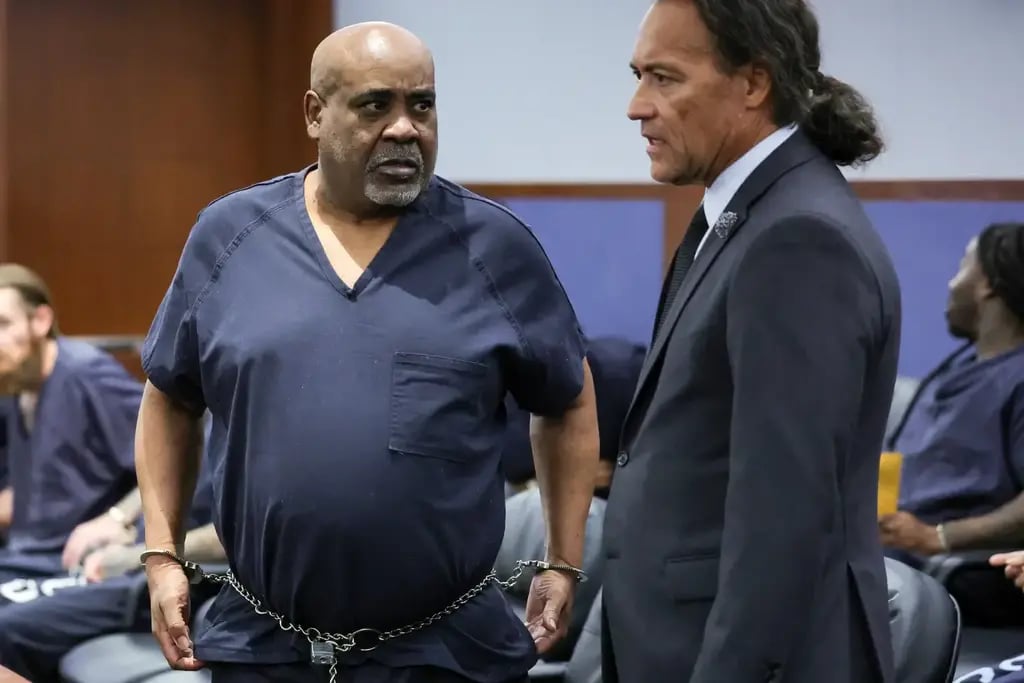
Duane Davis, left, talks with his attorney Michael Sanft in Clark County District Court during a calendar call and motion hearing for Davis’ upcoming trial
(Photo: AP)
Sanft argued that Davis had not previously been charged because investigators knew he was “full of crap.” He also pointed to missing records in the original investigation and distrust between law enforcement agencies, accusing one detective of conducting work that was “biased,” “sloppy” and “incomplete.”
The trial also briefly touched on another of hip-hop’s most notorious unsolved killings.
Former Los Angeles Police Department detective Fred Miller, who worked on the investigation into the 1997 killing of the Notorious B.I.G., whose real name was Christopher Wallace, testified remotely that Davis had briefly been considered a suspect in that case.
Davis acknowledged attending a party at the Petersen Automotive Museum in Los Angeles where Wallace and Sean “Diddy” Combs were present. Wallace was fatally shot after leaving the event.
Sanft objected to that testimony, and the judge, with prosecutors’ agreement, told jurors that police do not believe Davis was involved in Wallace’s death.
The Tupac case has long been complicated by reluctant witnesses and the deaths of people believed to have been directly involved.
Davis was not indicted until 2023. The other three men who prosecutors say were riding in the Cadillac at the time of the shooting have all since died.
Retired Las Vegas police officer Garry Dale became the first of an expected 35 to 45 prosecution witnesses in a trial expected to last about a month.
Dale testified that he and another officer stopped Knight and Shakur’s vehicle shortly before the shooting because it was missing a license plate. They gave the pair a warning and allowed them to leave.
About 10 minutes later, Dale said, officers responded to reports of gunfire and found emergency crews pulling Shakur from the vehicle. Knight had been grazed by bullets but urged officers to focus on Shakur.
Dale said he entered the ambulance and asked Shakur who had shot him. According to the retired officer, Shakur replied with words to the effect of, “no, we’ll take care of it.”
Former Las Vegas homicide detective Brent Becker testified by video that Knight later arrived for a police interview accompanied by attorneys, something Becker found unusual because Knight was himself a victim.
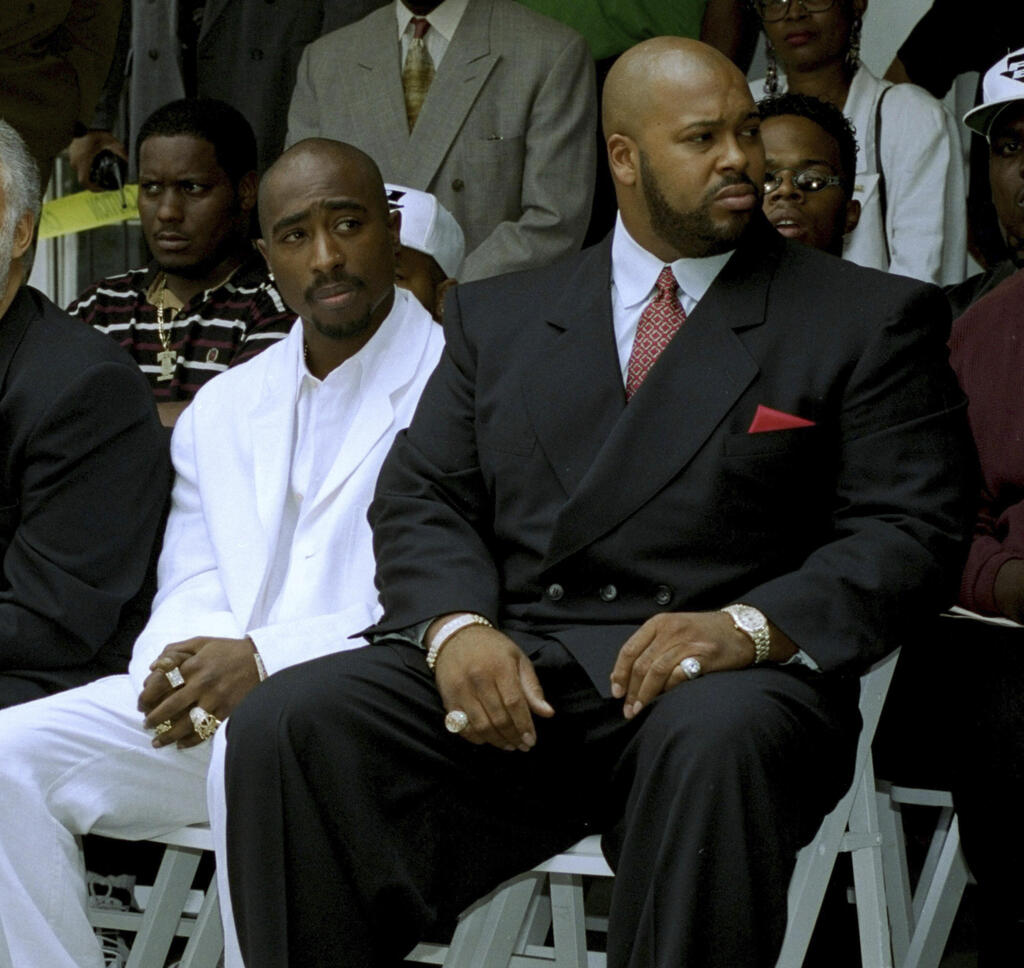
Tupac and Suge Knight
(Photo: AP)
Knight appeared timid and rehearsed and claimed to know nothing about the attack, Becker said.
“I thought he lied to us,” Becker testified.
Investigators struggled to persuade other witnesses to cooperate. Becker said police focused on Davis, Anderson, Deandrae “Freaky” Smith and Terry “Bubble Up” Brown as the four men in the Cadillac, but lacked living witnesses who could identify them.
Another witness, Ingrid Stokes, described being near Knight’s vehicle when the shooting erupted.
Stokes testified that she and friends encountered Shakur and Knight while preparing to leave Las Vegas. Knight invited them to a nightclub, and the group agreed to meet them there.
Their car was one lane over and roughly one car length ahead of Knight’s vehicle when they heard gunfire, she said. They fled in fear and nearly collided with a white four-door vehicle.
When they returned to the scene, Stokes said, police made them sit on the sidewalk and treated them as suspects.
She said she had long feared speaking publicly about the case because of possible retaliation and her concerns about how law enforcement would treat her.
“Snitches get stitches,” she told the court.