


Cinema is hardly unfamiliar with the race-against-the-clock thriller, a tightly wound narrative device in which a hero is pushed to the limit as every step and heartbeat counts down toward disaster. But in Amazon Prime’s new thriller The Runner, that mechanism fails to generate anything close to breathless suspense.
Instead, the film offers roughly 80 minutes of frantic running, hyperactive editing and a plot so implausible that the appropriate response to much of what unfolds ranges somewhere between amusement and indifference.
The Runner trailer
(Video: Courtesy of Amazon Prime)


The protagonist is Maya Martin, played by Gal Gadot, a London lawyer, single mother and daughter of immigrants from an unspecified country. Her son Noah, played by Rory Wilmot, has diabetes, making the monitoring app on Maya’s phone an important part of their daily lives. What Maya does not know, and what viewers learn near the beginning of the film, is that someone has managed to hack her phone.
On the day the story takes place, Maya is preparing to put a heavily protected state witness on the stand to give incriminating testimony in the trial of a brutal organized crime boss accused of murdering two women. It is a busy morning, but with an hour still to go before the witness reaches court, Maya refuses to skip her morning run. And what a run it turns out to be.
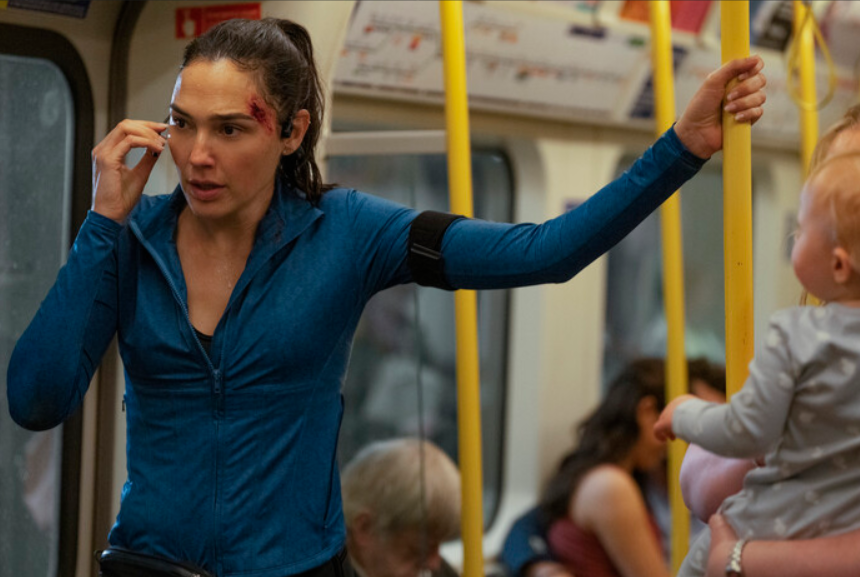
From The Runner
(Photo: Courtesy of Amazon Prime)
After dropping Noah at school, Maya heads to a park. The sequence establishes not only her fitness but her highly competitive streak as she takes on a fellow runner who mistakenly assumes she will not be able to overtake him, all to the sound of Blondie’s Heart of Glass.
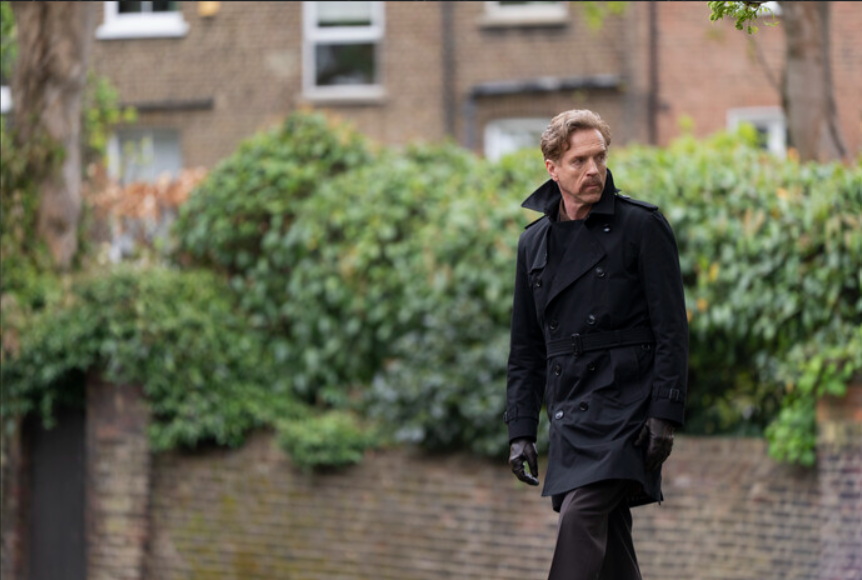
The routine is shattered when “the caller,” played by Damian Lewis, informs her that he has kidnapped her son. He gives Maya an ultimatum: She has exactly one hour to use her security clearance to infiltrate the protected location and kill the state witness. If she fails to follow his instructions precisely, Noah, whose medical condition has now become part of the threat against her, will not receive the treatment needed to save his life.
From that point on, the film attempts to unfold in something close to real time as Maya races through London. We get what might best be described as Street View via Gal Gadot Maps: The camera chases her across bridges, onto boats, through the Underground and repeatedly into bewildered pedestrians.
But director Kevin Macdonald’s London never becomes a living, breathing character. Instead, the city feels more like the backdrop for a frantic tourism commercial or promotional video. London in an hour.

Damian Lewis in The Runner
(Photo: Courtesy of Amazon Prime)
From its opening sequence, The Runner also tries to say something about modern society. Its introductory montage jumps between city residents absorbed in their phones, using them for every conceivable form of interaction, from the banal to the criminal. Everyone appears disconnected from the physical world around them.
Maya is about to spend a nightmarish hour enduring plenty of proverbial blood, sweat and tears as an unseen figure controls her through instructions delivered directly into her ear. To passersby, her behavior appears wild, unstable and at times dangerous.
The film’s smartphone critique, however, is shallow and tiresome, particularly because the movie itself enthusiastically exploits the same technology for constant visual stimulation: notification sounds, pop-up messages, surveillance-style camera angles and an endless stream of digital noise.
Any movie built around nonstop running through an urban landscape inevitably invites comparison with Tom Tykwer’s Run Lola Run from 1998. Tykwer used Lola’s constant motion to explore the fate of a younger generation and the role of chance in human life, employing a branching narrative inspired by Krzysztof Kieślowski to show alternate versions of the same situation.
The Runner has considerably less on its mind. Here, running mostly disguises a lack of depth and plausibility. The film belongs more comfortably alongside thrillers in which a psychopath remotely manipulates a protagonist through a phone, such as The Commuter from 2018 with Liam Neeson or Carry-On from 2024.
Like those films, it depends on the premise of a twisted antagonist forcing the hero into criminal acts while somehow maintaining near-total surveillance over every move. Such stories are rarely models of plausibility. They must simultaneously explain how the villain can exercise seemingly absolute control and devise a believable way for the hero eventually to overcome it.
The invasion of privacy feels implausible and poorly explained. From ‘The Runner’
(Photo: Courtesy of Amazon Prime)
One of the film’s main points of interest is the dynamic between Maya and “the caller.” Lewis performs about 99% of his role while seated, his face appearing only in brief, shadowy flashes, as he subjects Gadot’s character to a kind of brutal psychological analysis.
He penetrates the private folders on her phone, including a look at photos of Maya in lingerie. They are not especially revealing, but they still place the villain, and by extension the viewer, in an unmistakably voyeuristic position. He also launches into a taunting analysis of Maya’s personality, dredging up a family trauma involving an abusive father who was killed by her mother.
The monstrous “other” penetrates Maya’s psyche, dissects her motives and forces her through a painful psychological process even as she remains physically on the run. “Did you become a lawyer so you could impose your will on violent men?” he asks.
One could compare this dynamic, with apologies for making the comparison at all, to the relationship between Hannibal Lecter and Clarice Starling in The Silence of the Lambs. That film also featured a “monster” performing a form of brutal psychological analysis, one that nevertheless had constructive dimensions, on an FBI trainee.
But the comparison only underlines the weaknesses in Mark Gibson’s screenplay. In Jonathan Demme’s classic, the psychological duel was gripping and layered. Here, the dialogue is clichéd and hollow. “Fear is a stronger motivator than love,” we are told. The film’s invasion of Maya’s privacy, meanwhile, feels both ludicrous and insufficiently explained.

Marks a sensitive point in her career. From ‘The Runner’
(Photo: Courtesy of Amazon Prime)
For Gal Gadot, The Runner arrives at a sensitive point in her career. After briefly becoming one of Hollywood’s biggest stars with Wonder Woman, that status increasingly appears to be slipping away. A succession of critical and commercial disappointments has weighed on her standing.
Netflix’s 2023 spy thriller Heart of Stone received lukewarm reviews. The 2025 failure of Snow White brought Gadot a share of the blame, unfairly in my view. Julian Schnabel’s ambitious In the Hand of Dante, released on Netflix two months ago, also failed to make much of an impact.
This week, Gadot also provoked anger in parts of the film industry after speaking in favor of using artificial intelligence in filmmaking, technology that is being incorporated into her next project, Bitcoin, directed by Doug Liman. That is unlikely to make her more popular in Hollywood. Another mediocre Amazon Prime streaming thriller is hardly going to help rehabilitate her career.
The film does little for Kevin Macdonald’s filmography either. Macdonald is the grandson of Emeric Pressburger, the Hungarian-born British filmmaker who formed one half of the legendary filmmaking partnership with Michael Powell. Macdonald himself has directed several excellent documentaries, including One Day in September and Touching the Void, as well as acclaimed narrative films such as The Last King of Scotland.
But in The Runner, he gives himself over to rapid-fire editing, frantic zooms and excessive effects, suggesting an attempt to conceal the screenplay’s weaknesses and the film’s inadequate suspense beneath visual noise.
Ultimately, this is a typical streaming product: not entirely boring thanks to its brisk pace and short running time, about 86 minutes including credits, but burdened by major logical problems, a thin screenplay and shallow techno-sociological pretensions. Recommended for fans of London, Gal Gadot and running, or anyone fortunate enough to belong to all three categories.