


The Eurovision Song Contest is introducing another round of rule changes, and at least one of them carries clear implications for Israel.
Under the new rules announced by the European Broadcasting Union, winning Eurovision will no longer automatically guarantee that the victorious country hosts the contest the following year if security concerns, war or a sensitive geopolitical situation could jeopardize the event.
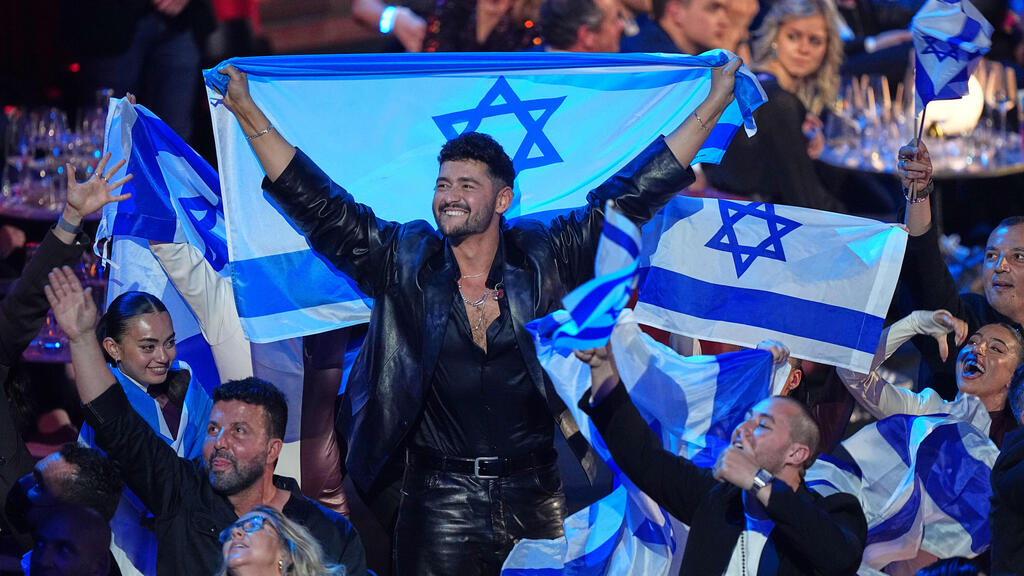
Noam Bettan, Israel’s representative at Eurovision 2026 in Vienna
(Photo: AP Photo/Martin Meissner)
The provision is particularly relevant to Israel and Ukraine, both of which have faced prolonged wars in recent years. It also comes after Israel came close to winning the 2026 contest in Vienna, with Israel's entry coming in second place.
If concerns arise over whether the winning country can safely stage the competition, the EBU will be able to commission an independent security assessment of the proposed host location.
After reviewing that assessment, the organization will determine whether the winning broadcaster is capable of hosting Eurovision safely. If it decides that it is not, the EBU will select another broadcaster to stage the contest.
The substitute broadcaster would not host Eurovision “on behalf of” the winning country. Instead, it would assume the full rights, obligations and responsibilities associated with producing, organizing and staging the event.
The principle has precedent. Ukraine was unable to host Eurovision in 2023 after winning the previous year because the EBU concluded that the war made it impossible to guarantee the safety of participants, staff and spectators. The contest was instead held in Liverpool, with the BBC hosting in cooperation with Ukraine’s public broadcaster.
Minimum age raised to 18
The EBU also is raising the minimum age for Eurovision contestants from 16 to 18.
The organization says the change is part of its continuing effort to better protect young performers and address the intense pressure involved in participating in an event on Eurovision’s scale.
Another change clarifies the rules governing live vocals.
The fundamental requirement remains unchanged: the lead singer or singers must perform the song’s main melody live.
Backing tracks and prerecorded elements will still be permitted within the rules, but prerecorded vocals cannot replace the lead singer or support the main melody in a way that effectively substitutes for a live performance.
The latest changes follow a significant overhaul introduced ahead of the 2026 Eurovision in Vienna, after controversy over voting and promotion in previous contests, much of it centered on Israel.
Among those changes, juries were returned to both semifinals, while the maximum number of public votes per person was cut from 20 to 10. The EBU also strengthened safeguards against coordinated or fraudulent voting and tightened rules intended to prevent disproportionate third-party promotion, including campaigns backed by governments or government agencies.
The EBU said at the time that the measures were intended to protect the contest’s neutrality and prevent attempts to unfairly influence the results. It did not single out Israel in announcing the changes.
The changes followed controversy surrounding strong public support for Israeli entries and allegations that government-backed campaigns had encouraged viewers to vote for Israel.
Under the rules introduced for 2026, unusual voting patterns can also be scrutinized and measures taken against coordinated or fraudulent voting.
Bulgaria to host Eurovision 2027
The next Eurovision Song Contest will take place in Bulgaria after Bulgarian singer DARA won the 2026 competition in Vienna. The Vienna contest drew 132 million viewers across 35 measured television markets, according to the EBU.
The 2027 edition will also mark another major change for the contest: Canada is set to make its Eurovision debut.
The EBU and CBC/Radio-Canada formally announced in July that Canada would participate in Eurovision 2027 in Bulgaria, becoming the first new country to join the competition since Australia entered in 2015.
For Israel, however, the most consequential change may be the new hosting provision. A future Israeli Eurovision victory could still bring home the trophy, but under the revised rules, it would no longer necessarily bring the contest itself to Israel the following year.