


Jazz artist Keith Jarrett’s Cologne concert, held at the opera house in the German city on January 24, 1975, at 11:30 p.m., is considered one of the milestones in jazz history. Over 66 minutes of continuous improvisation, Jarrett created a one-time work that became the best-selling solo album in jazz history. The concert itself nearly did not happen, but thanks to the determination of an 18-year-old girl, that singular event took place. Whether it really happened as depicted in Ido Fluk’s successful film, “Köln 75,” does not really matter. The film is about the place where history and fantasy meet. The one fact is that not a single sound or note from that concert is heard in the film, for rights reasons. What does it mean, really, that a film made for the 50th anniversary of a defining event does not include the event itself? It is an interesting question, and Fluk’s film answers it well.
I admit that my interest in Jarrett or the Cologne concert has never been especially high. But what is beautiful about the film is that it is not intended only for fans. On the contrary, it seems to me that it is aimed precisely at those who do not know the story, or those who are not expecting a film “about Keith Jarrett.” The film seems to ask: If you could not tell Jarrett’s story, what story would you tell? If you could not play the Cologne concert, how would you tell the story of that concert? The answer is presented right at the start, through a somewhat unclear comparison to the Sistine Chapel. But film history is full of such stories, about people who worked behind the scenes of defining events. One example is the Taviani brothers’ “Good Morning, Babylon” from 1986, about two brothers who were among the builders of the enormous sets for D.W. Griffith’s “Intolerance” from 1916.
The story of “Köln 75” centers on Vera Brandes, played by Mala Emde, a young German woman who, even before turning 18, became one of her country’s leading jazz concert organizers. The film opens with her arranging a tour for the Ronnie Scott Trio from the clinic of her tyrannical dentist father, played by Ulrich Tukur. Later, she hears Jarrett for the first time at a solo concert in Berlin and is mesmerized. Her dream of bringing him to Cologne for a one-time improvised concert comes true after the local opera director agrees to rent her the hall, and her mother lends her the 10,000 marks needed for it. Jarrett himself, played by John Magaro, is traveling through Europe with the legendary producer Manfred Eicher, played by Alexander Scheer, on a tour of improvised jazz performances. He agrees on one condition: The piano made available to him must be a Bösendorfer Imperial. The performance is set to begin after the end of Alban Berg’s opera “Lulu,” which is being staged there that evening, and Brandes must sell about 1,300 tickets to fill the hall.
Things become complicated just hours before Jarrett is supposed to begin improvising. The moment is critical: Jarrett has no idea what he is about to play, how it will begin or when it will end. A work is to be born that very night. But it turns out that instead of the high-quality piano, one of the best of its kind in the world, there is a rehearsal piano that needs tuning and has a broken pedal. In addition, Jarrett is suffering from agonizing back pain, dinner at the restaurant before the performance is delayed, and when a replacement Bösendorfer is finally found, it turns out that the insurance cost for transporting it to the opera house is beyond Brandes’ means. Jarrett, for his part, refuses to hear of any other option.

At the same time, the film follows Michael Watts, played by Michael Chernus, a jazz journalist whose character is based on several journalists of the period and who serves as our narrator, addressing the camera several times. He even summarizes the history of jazz to explain Jarrett’s place in it. I am not sure that real jazz lovers or experts would approve Watts’ version, but the film presents him as a character for whom fiction is an inseparable part of his being. There is a beautiful scene here in which the choice between reality and legend is made before our eyes. This character seeks to place the mythical performance in the twilight zone between a historical concert and fantasy, the way anyone who was there would want to remember it.
Fluk’s direction, by an Israeli-born filmmaker who previously directed “Never Too Late” from 2011, an Israeli road movie produced partly through crowdfunding, tries to find visual equivalents for the spirit of jazz. These include the seemingly arbitrary transitions between stories, characters addressing the audience directly, texts written on the screen like in a presentation and the film’s shifting tones, moving from rhythmic to contemplative. But enjoyable as it is, “Köln 75” lacks a real soul. It is the kind of soul that was present, for instance, in Bertrand Tavernier’s “Round Midnight” from 1986, which dealt with the relationship between an enthusiastic French fan and a jazz musician, played with authenticity by Dexter Gordon, living in exile in Paris. Watching Fluk’s film does not really clarify the connection between the young woman and jazz. Perhaps she loves this music, or perhaps she simply enjoys performances, but nothing in her conveys soul. And what is jazz without soul?
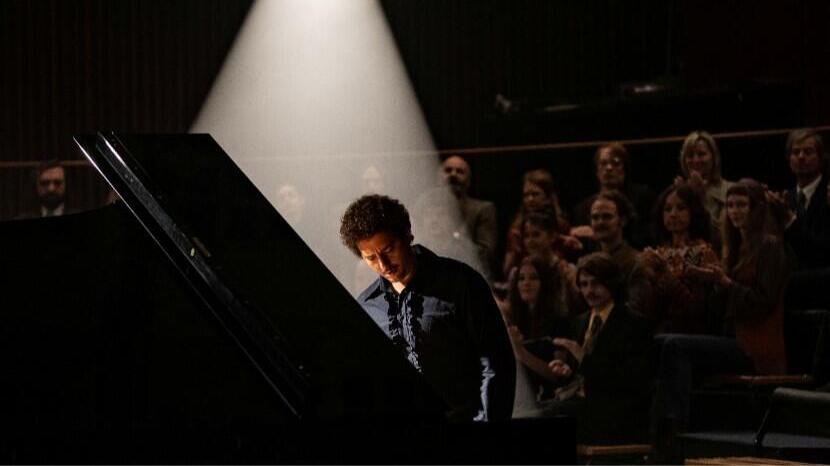
From 'Köln 75'
(Photo: Courtesy of Nachshon Films)
None of this diminishes Emde’s performance as Vera Brandes. She is an exceedingly charming actress, even though she is about a decade older than the 18-year-old she plays. Still, the screenplay presents her motives mainly as an expression of rebellion against an oppressive, violent father who also abuses his eldest son. In any case, the whole concert story seems to become Vera’s way, eventually joined by her brother, of proving something to her terrible father. If there is another reason, meaning one not connected to teenage rebellion and father issues, it is not really possible to extract it from the film.
Jarrett’s music, I learned, is melodic, calm, even conciliatory. It has something contemplative about it that recalls the atmosphere of Terrence Malick’s films. The film, by contrast, is dynamic, cheerful and a true crowd-pleaser. I liked its more intimate moments more than its youthful antics. In those moments, Fluk reveals himself as a filmmaker capable of observing his characters, when he is not rushing toward the next lively, rhythmic moment.
Above all, I loved the film’s great absence: the concert after which it is named. It may be the result of a constraint, but that constraint gives the film another, beautiful layer of meaning. The best way to speak about history is to turn it into legend. A one-time event cannot be recreated on film.