


Only toward the final act of Hamnet does the full name finally surface: William Shakespeare. The new film by Oscar-winning director Chloe Zhao (Nomadland), based on Maggie O’Farrell’s novel of the same name, explores the tragic death of the great playwright’s only son as an event that influenced the writing of Hamlet and other plays, including Twelfth Night and Romeo and Juliet. Yet this is not a film about art born of torment — not at all. Shakespeare himself is almost incidental to the story, as is the child Hamnet. This is a historical fantasy that places at its center the playwright’s wife, Agnes, known historically as Anne Hathaway — not to be confused with the contemporary actress.
A brief historical backdrop: The 16th-century playwright married Anne Hathaway when he was 18 and she was 26 and already pregnant with their first child, Susanna. In 1585, the couple’s twins, Hamnet and Judith, were born. Hamnet Shakespeare died at age 11 — in the book and film, his death is attributed to the plague — and scholars have long traced echoes of this devastating loss in plays written afterward. For most of their marriage, Shakespeare lived in London, staging his works, and only rarely returned to Stratford, his hometown, where Anne remained with their children. An opening title card notes that in Elizabethan England the names Hamnet and Hamlet were considered interchangeable, suggesting a link between the real-life tragedy and the fictional one.
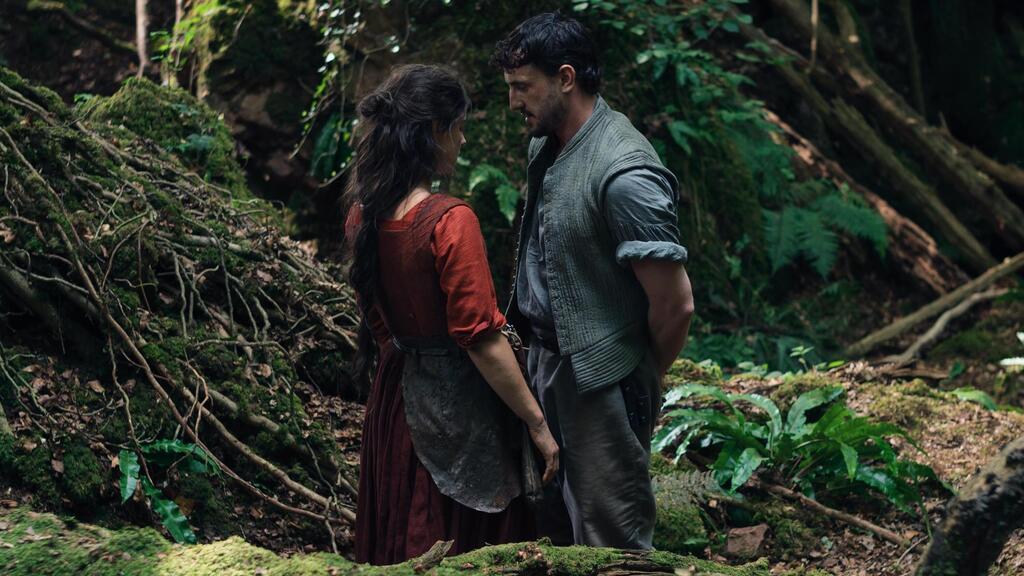
In both the book and the film, the heroine is Agnes, portrayed in a striking performance by Jessie Buckley. Zhao, who co-wrote the screenplay with O’Farrell, shapes Agnes as a figure deeply entwined with nature. In her first appearance, she is curled in a fetal position inside a hollow tree trunk — a poetic, symbolic image that signals what is to come. Dressed in red, skilled in herbal medicine and accompanied by a hawk, Agnes embodies an ancient feminine archetype that exists beyond patriarchal control and language.
As the film unfolds, she represents an experience that cannot be processed: the grief over her son’s death, which she lives and endures beyond words, while her husband transforms that experience into language, into theater, into art. The encounter between lived experience and artistic creation forms the emotional peak of Hamnet.
A parallel can be found in Hanoch Levin’s play The Constant Mourner, staged several years ago at Tel Aviv’s Cameri Theatre, in which a king repeatedly reenacts the death of his young son through a horrific performance. Hamlet, as filtered through Hamnet, offers a similar experience: the possibility of reliving the death of the prince-son again and again across time and place, onstage, until it becomes a tangible creative expression onto which Agnes — present in the Globe Theatre audience — can project her grief. This sequence leaves viewers breathless, especially when accompanied by Max Richter’s On the Nature of Daylight.
Earlier in the film, Agnes meets Will (Paul Mescal, one of the finest actors of his generation), a Latin teacher who abandons his classroom upon first seeing her and runs after her. They fall in love, to the disapproval of both families. Will’s father is unhappy with his son’s devotion to writing rather than manual labor, while his mother (Emily Watson) believes Agnes to be the daughter of a forest witch. Agnes’ own family questions why she would bind herself to a poor man. When Agnes becomes pregnant, the two marry. Two more children are born — the twins — and while Will is mostly absent, his work as a playwright is mentioned almost in passing. Agnes is left to manage the household.
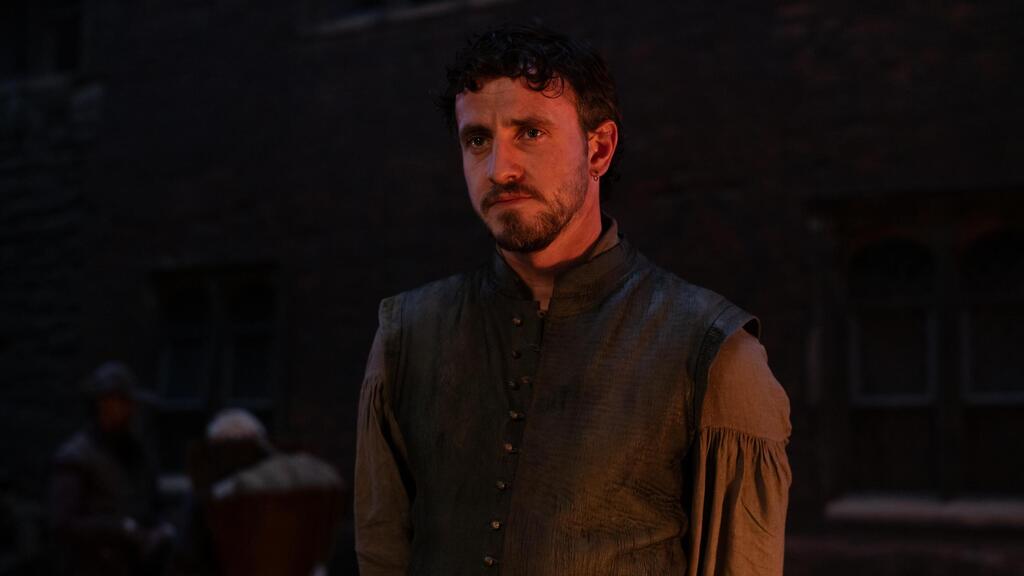
From ‘Hamnet’
(Photo: Courtesy of Tulip Entertainment)
There is an underlying tension in this portrayal, heightened by Zhao’s camera, which often moves independently of the characters, like a ghostly presence observing domestic life and foreshadowing the tragedy to come. Shakespeare’s plays are hinted at obliquely: his dissatisfaction with Romeo and Juliet, or his children playacting the witches from Macbeth.
The film lingers on the bond between Hamnet and Judith, whose favorite game is switching identities. In one of the film’s most powerful moments — revealed gradually — their gender-fluid play is sealed in tragedy. Death permeates the film long before it occurs, shaping our interpretation of the literary creation that follows.
In this sense, Hamnet is a film about the source of art. It rejects the “death of the author” only to reframe it, privileging lived experience over genius mythology. Would Hamlet have been written without Hamnet’s death? The film allows space for that counterfactual question.
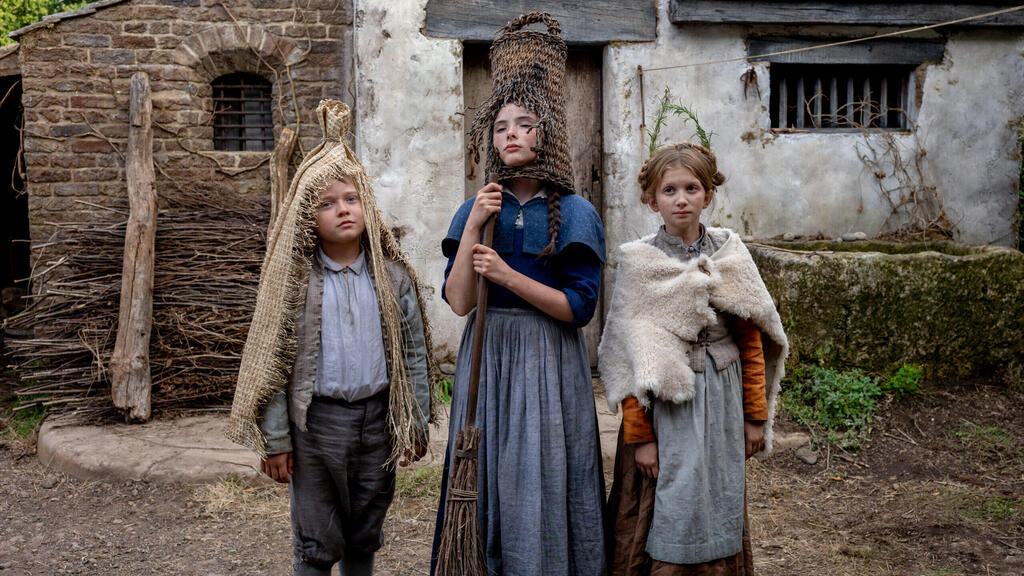
From ‘Hamnet’
(Photo: Courtesy of Tulip Entertainment)
Hamnet is not about the torment of creation. Only in its closing section does Agnes, as a spectator, fully grasp how death shaped her husband’s work, even reflected in casting: Shakespeare himself plays the Ghost of Hamlet’s father, while Noah Jupe (A Quiet Place), who plays Hamlet, is the real-life older brother of Jacobi Jupe, who portrays the dead Hamnet.
For most of its 90 minutes, the film follows Agnes’ daily life, emphasizing her almost supernatural qualities — she seems to breathe life back into Judith, who is born not breathing. Zhao contrasts Agnes’ spiritual presence with her husband’s artistic output. Birth and death, presence and spirit, word and soul are all woven together.
At its peak, Zhao — who also co-edited the film — ventures into territory reminiscent of Lars von Trier, employing emotional manipulation that is nearly irresistible and infusing the film with an ecstatic dimension: a meeting between two grief-stricken figures that finally takes place within the theatrical space.
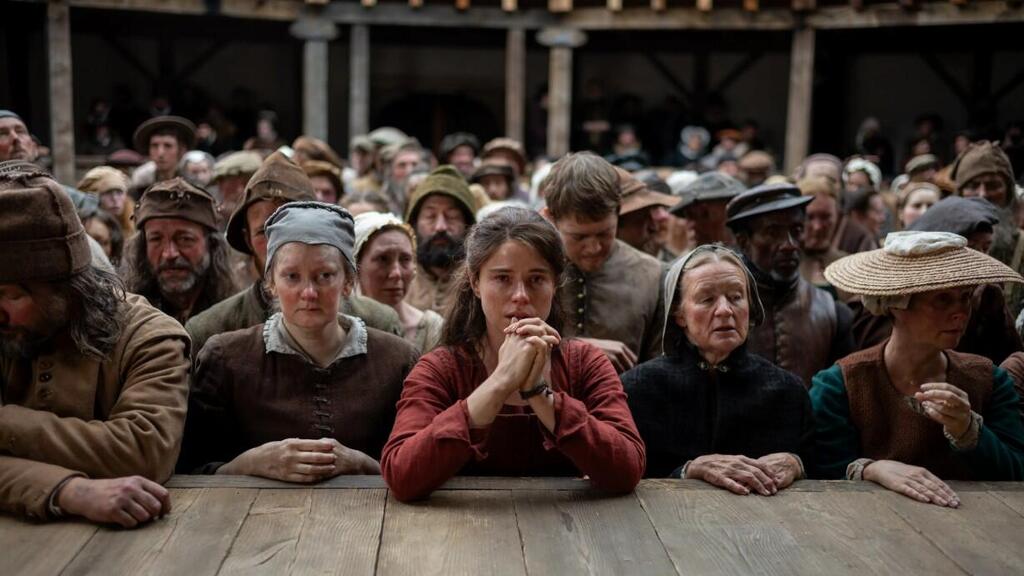
From ‘Hamnet’
(Photo: Courtesy of Tulip Entertainment)
Wisely, Hamnet is not another film about “the wife of.” Nor does it court the audience the way Shakespeare in Love (1998) did. It moves at its own pace, unafraid of overt metaphors. While it may not reach the heights Zhao set for herself with The Rider (2017) and Nomadland (2020), perhaps because of its turn toward a period, ars poetica mode, it is not surprising to see Steven Spielberg credited as a producer — it resembles a film he himself might have directed.
As for Jessie Buckley as Anne Hathaway: the Best Actress Oscar of the year already feels spoken for, if only for her haunting performance in the film’s final act. In a curious coincidence, another Anne Hathaway won a supporting actress Oscar 13 years ago, also for a single unforgettable moment — in Les Misérables.