


We film critics tend to snort with contempt at musical biopics about various living and dead legends, whose creation is controlled entirely by the real-life singers, their relatives, lawyers or estate managers. They are, of course, designed to present them as the most talented and brilliant people who ever lived, people who helped cats and elderly women cross the street and certainly did not, heaven forbid, abuse children.
“Michael,” of course, goes too far, and it really is a terrible film that feels like a scheme to take your money and transfer it directly to the Jackson family, which continues to profit from the body. And yet, in light of the release of “Mother Mary,” about a fictional pop star, one might jokingly say that perhaps we should not have complained so much.
Because “Mother Mary,” a much-discussed, highly pretentious independent film starring Anne Hathaway as the miserable pop star of the title, is, first and foremost, not fun. It comes with nine measures of sadness, seriousness and heaviness. For better or worse, that is entirely intentional on the part of the distinctive director David Lowery (“The Green Knight,” “A Ghost Story,” “The Old Man & the Gun”). The musical genre most associated almost by definition with lightness, pop, is given here the full weight of a film about the meaning of life.
Hathaway plays an iconic pop star in the Madonna/Lady Gaga mold, her real name is never said, who is in the midst of an existential crisis. At the start of the film, years after an incident during a performance sidelined her and took her offstage amid a wave of rumors, she arrives at the home of her former costume designer and onetime soulmate, Sam Anselm, played by British actor Michaela Coel.
Anselm, like Mother Mary, carries a name heavy with Christian meaning, and for most of the film she, too, seems more enigmatic than a monk full of cryptic lines in “The Name of the Rose.” Mary comes to her former friend and asks, practically begs, her to make her a dress in three days. It is a dress meant to accompany her to her comeback performance, where she will sing, note this, “the greatest song ever written,” which she wrote herself and which, of course, is never actually heard in the film.
The dress in question is supposed to embody her entire musical career up to this point and everything she will be from now on. This is not an outfit. It is a statement with implications for the future of humanity. The film absolutely behaves as though it believes that.
The first half of “Mother Mary” is built entirely like a play for two actors. At the same time, it is an exceptionally “cinematic” play. Even if the two spend most of the time verbally digging through their past and their emotions while sitting sadly in the costume designer’s studio, Lowery energizes the dynamic between them with an array of camera moves and mise-en-scène that recall other directors who excelled at adapting plays for the screen, foremost among them Mike Nichols (“The Graduate,” “Who’s Afraid of Virginia Woolf?,” “Closer”), Bob Fosse (“Cabaret”) and Sam Mendes (“American Beauty”), all of them fond of mature, acidic cinema about adults hurling truths at one another.
They escaped the feeling of “filmed theater” through cinematic craft full of power games and color contrasts between characters, and it is clear Lowery is desperate to follow in their footsteps.
Desperate, but not always successful. “Mother Mary” is the kind of film that, before deciding whether it is good or not, ultimately, that is above all a matter of taste, can certainly be called “interesting.” It is an entire film concerned largely with the symbolic construction of a woman through song, dance and appearance.
Interestingly, it arrives a moment after we got to see Hathaway, truly one of Hollywood’s hardest-working actors, shine in the sequel to “The Devil Wears Prada,” another film that asks, in its very light way, how fashion can represent and define women and, if you like, all of Western culture. That, and how to get all those clothes for free.
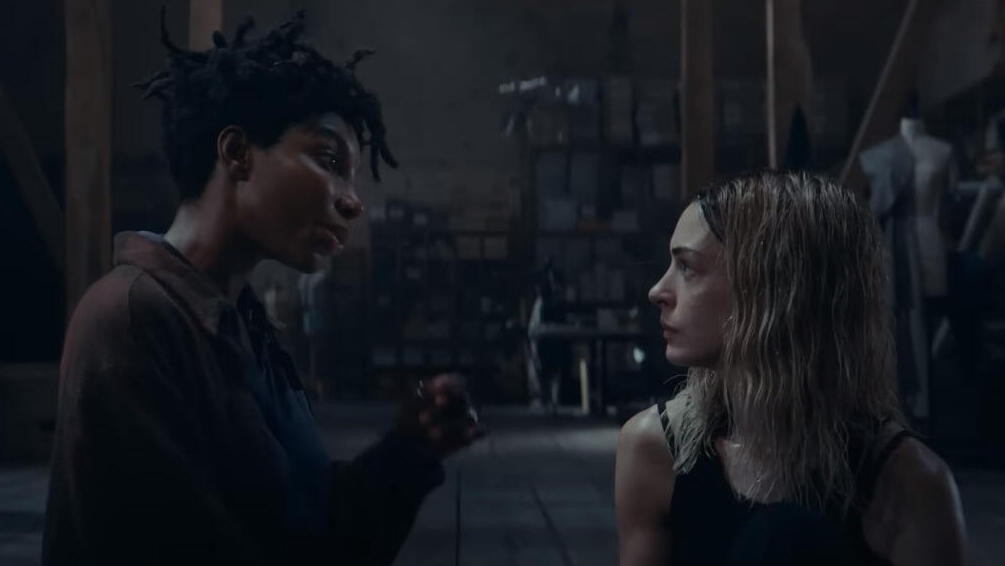
From 'Mother Mary'
(Photo: Courtesy of Forum Film)
But if “The Devil Wears Prada” is sweet and tasty like an industrial cheesecake packed with empty calories, and another film about fashion and similar themes, Paul Thomas Anderson’s “Phantom Thread,” is like a sublime, snobbish lemon tart from a boutique bakery in Paris, then “Mother Mary” is bitter licorice.
Another film that comes to mind, this time from the pop direction, is the 2018 musical drama “Vox Lux,” directed by Brady Corbet, who later broke through with the Jewish-themed “The Brutalist,” in which Natalie Portman played a burned-out star whose career was in decline. That, too, was a distinctive film and not for everyone, and it is well worth discovering. But one basic difference between the films is that “Vox Lux” at least had quite a bit of self-awareness and humor — from Portman, from the film and from the entire situation in which someone who built a career playing “good girls” suddenly plays a “bad girl.” In “Mother Mary,” by contrast, there is no humor. We did not come to enjoy ourselves.
The film is entirely about symbols and images. Its characters have no family lives or friends, and even the little that is mentioned about their past is vague. It is steeped in the feeling of people sacrificing their lives for art, and it draws an interesting parallel between religious sacrifice and artistic sacrifice.
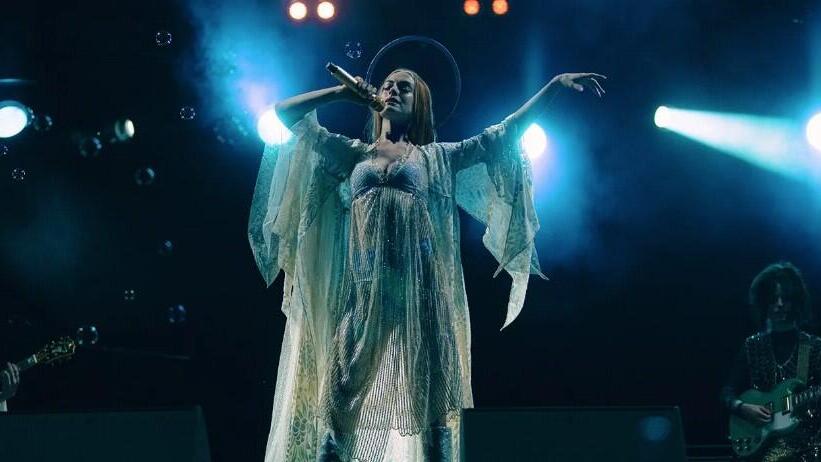
In the film’s most impressive shot, truly one of the best of the year, Hathaway goes up and down stages endlessly, without a second to breathe. It looks almost like a piece of modern ballet, one that is stressful and suffocating. How many films can you say contain moments like that?
In general, in its best moments, it seems Lowery had one singular film in mind while making his own: “The Red Shoes,” the enchanted 1948 British drama by Michael Powell and Emeric Pressburger about a ballet dancer and her obsession with dance. There it was ballet and red shoes; here it is pop and a red dress. In both cases, the feeling is that this is first and foremost a story about the heroine’s eyes, red from crying.
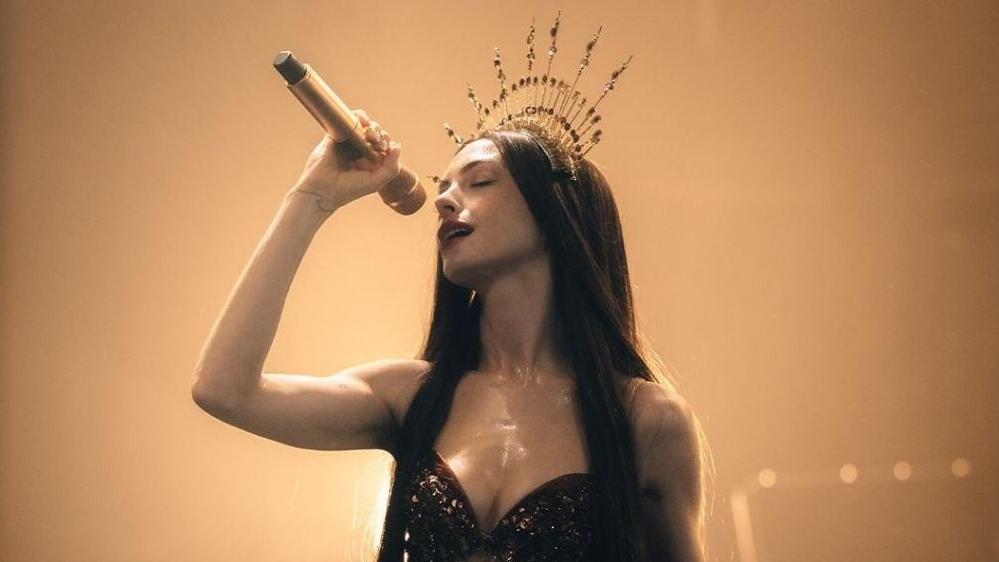
From 'Mother Mary'
(Photo: Courtesy of Forum Film)
The problem is that when you try to get close to a masterpiece, its sunlight blinds you and melts your wings. “Mother Mary” is as ambitious as it is deeply flawed. I am avoiding calling it “bad” or “boring,” because, as noted, it contains enough fascinating experiments. But in its second half, after the theatrical section, the two heroines sink into a backstory and the film takes on David Lynch-style horror twists, with ghosts and the like.
It is not especially frightening or interesting, and above all, it is predictable from miles away. These are also the moments when everyone remembers that “Mother Mary” is a typical, almost parodic product of A24, Hollywood’s special children, “Everything Everywhere All at Once,” “The Lighthouse,” “The Smashing Machine” and most of Lowery’s films over the past decade, with their built-in fondness for “elevated horror.” Do you have a film in which a character stares in terror into the unknown, flashes of color, a shot of her fainting, chilling music? It is probably A24. So is this film.
The result is a film that is certainly worth sampling, provided everything I have just written does not put you off. Music fans will also find some comfort in the songs composed by Charli XCX, closing a busy cinematic year after “Wuthering Heights,” a film with points of similarity, though even that had more humor and camp than “Mother Mary.”
But as noted, “Mother Mary” proudly carries who and what it is. Like a dramatic pop star convinced that the future of humanity lies in the dress she is wearing.