


“Barbie” (2023) was a phenomenal success, grossing $1.43 billion, earning eight Oscar nominations and sparking a lively debate over its feminist messages. Toy giant Mattel has another franchise in its arsenal, though its core target audience is boys. The time has come to give it a lavish film adaptation that might complement the success of “Barbie.” That franchise is “Masters of the Universe,” a fantasy world led by the muscular, blond action hero He-Man. Now Amazon/MGM has produced a live-action version with a budget of about $200 million.
“Masters of the Universe” began as a toy line developed in 1982. The characters were created in an attempt to blend all the fantasy worlds beloved by boys into a sure-fire success: a sci-fi fantasy that could rival “Star Wars” toys, “Conan the Barbarian” characters for children inspired by the paintings of Frank Frazetta, and a fantasy version of a modern army, similar to G.I. Joe toys.
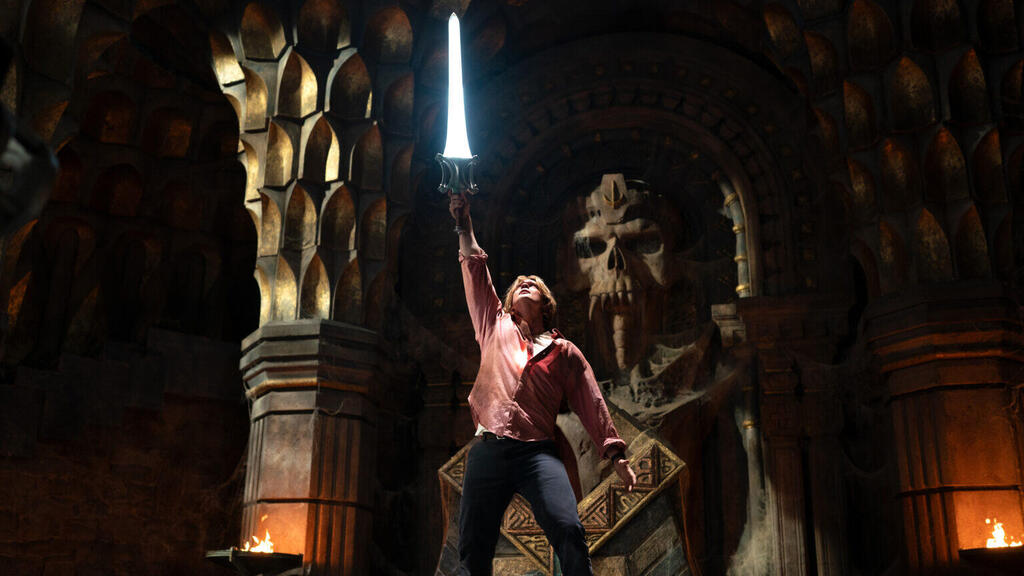
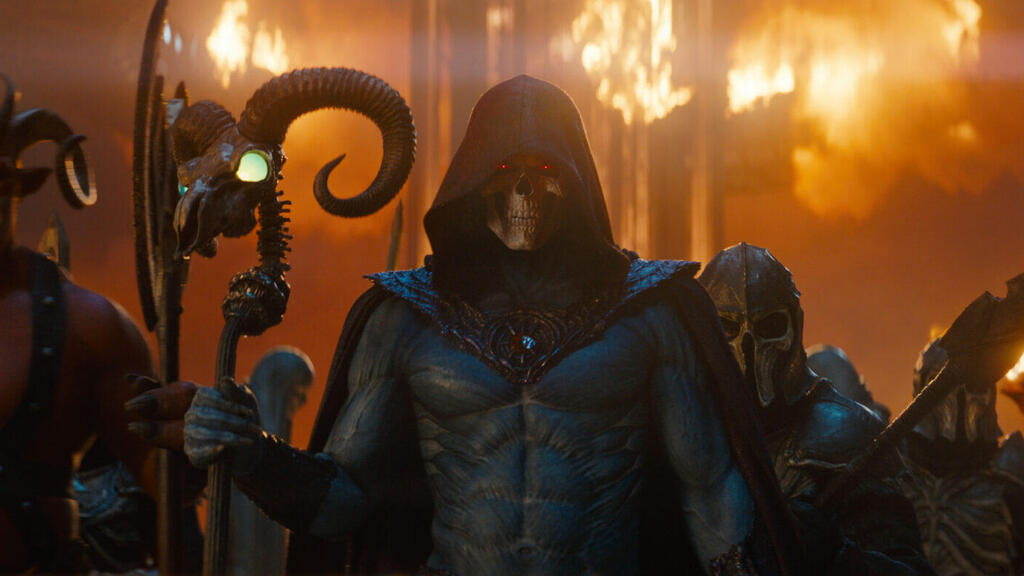
The strange mixture required an explanation for the eclectic nature of this fantasy world. And so an animated series was born, running from 1983 to 1985, with episodes that functioned as commercials to sell toys. In the backstory, there is Eternia, a fantasy kingdom with sci-fi technologies, mostly weapons, and which relies on a magical force emanating from Castle Grayskull. The great threat to the kingdom is Skeletor, a muscular sorcerer with a skull face. Prince Adam, son of King Randor, is ostensibly a feeble nobleman. But when he holds the Sword of Power, raises it high and declares, “By the power of Grayskull — I have the power,” he becomes He-Man, the most powerful hero in the universe.
Alongside He-Man is an ever-expanding group of supporting characters, each with unique combat abilities. There is always a need for new toys. Skeletor, too, was given more and more monsters with strange appearances and abilities. The supporting characters were developed in a madcap, throw-spaghetti-at-the-wall fashion: see what sticks and becomes a hit with children.
The “Masters of the Universe” franchise was expanded into six more animated series, including the She-Ra spin-offs centered on He-Man’s sister, in repeated attempts to recreate the success of the 1980s. There were also comic books, under both DC and Marvel, books and computer games. The series “He-Man and the Masters of the Universe” arrived in Israel in the 1990s and aired on the Children’s Channel. Perhaps it was the cultural difference, or perhaps the decade-long delay, but it seems it never really caught on in Israel.
There was an earlier attempt to make a live-action film. In 1987, Cannon Films, owned by Menahem Golan and Yoram Globus, produced an adaptation starring Dolph Lundgren as He-Man and Frank Langella as Skeletor. The film failed because of the amateurishness of those involved, a meager budget and a plot that mostly took place in California rather than on the planet Eternia.
A different kind of problematic adaptation came in 2021, in the form of the Netflix animated series “Masters of the Universe: Revelation,” whose showrunner was director Kevin Smith of “Clerks” fame. The series attempted to update the testosterone-driven fantasy world of “Masters of the Universe” for the woke era: The male characters were pushed aside, He-Man dies at the beginning of the first season, and control was handed to the female warrior characters, who are always and inevitably right and loving, mostly toward one another, as they try to fix all the failures that were always and inevitably caused by men. Critics liked the series, which was so correct in its political up-to-dateness, but those who grew up on He-Man’s muscles hated it with all their might.
From 'Masters of the Universe'
(Photo: Courtesy of Forum Film)
The challenge in making a contemporary adaptation of “Masters of the Universe” lies in the reactionary basis of the original: a fantasy of masculine power for children, built according to the absurdly hypermasculine parameters of the Stallone and Schwarzenegger era. How can that be brought back to the present with a straight face? How can one try to persuade a new generation of children of those values? On the other hand, an attempt to turn the world and the characters into something that contradicts their essence is destined to fail, as Smith’s series did.
The person taking on the challenge is director Travis Knight, the CEO and chief animator of Laika, a studio specializing in stop-motion animation. As an animator, he directed the beautiful feature “Kubo and the Two Strings” (2016), and as a live-action director, “Bumblebee” (2018), the only “Transformers” film that does not induce a migraine. The screenwriters are brothers Aaron and Adam Nee, who made the Sandra Bullock comedy “The Lost City,” and Chris Butler, who worked with Knight on Laika projects. These are screenwriters with a comic orientation, an approach that proves central to the current adaptation.
From 'Masters of the Universe'
(Photo: Courtesy of Forum Film)
“Barbie” tried to bring feminist enlightenment to a plastic icon of conspicuous consumption and ever-changing fashion. As you may recall, by the end of the film, she even went to schedule a gynecologist appointment. “Masters of the Universe,” by contrast, is not interested in a political transformation that would cancel out the values of the series. It has to recoup its production budget and hopes to be the first chapter in a very profitable film series, though I doubt that will actually happen.
Knight tries to maintain a balance that is not easy to achieve: laughing at the absurdity of the original while preserving the pleasure of its silliness. Most U.S. critics consider the result mediocre to poor. To my mind, the self-awareness of the original’s trashiness has been translated into effective humor, and the film as a whole is enjoyable. The jokes at the expense of its outdated elements are made with affection that should not alienate fans of the original. There is even a “passing of the torch” nod connected to the failed 1987 live-action film.
At the start of the film, we meet Adam, the 10-year-old prince of Eternia, played by Artie Wilkinson-Hunt. The sweet boy fails to show in his combat training the courage expected of an heir to the throne, much to the displeasure of King Randor, played by James Purefoy. Skeletor launches a successful attack on the palace of the king and Queen Marlena, played by Charlotte Riley, and even manages to capture them. Prince Adam is saved by Teela-Na, the good sorceress who guards Castle Grayskull, played by Morena Baccarin. Adam is thrown through a portal to a place where Skeletor will not be able to find him — specifically, Oklahoma City, United States. While on his way to his world, the Sword of Power slips from the prince’s hands. He loses the ability to return to Eternia, to eventually become He-Man and to defeat Skeletor.
From 'Masters of the Universe'
(Photo: Courtesy of Forum Film)
A jump 15 years forward finds the adult Adam, played by Nicholas Galitzine, living a double life. His feet are planted in the reality of a woke world presented with a measure of mockery. Adam works in human resources, a job in which he is supposed to resolve disputes using “feminine” mediation techniques. He has a boss who manages him with passive-aggressive rhetoric, played by comedian Sasheer Zamata. Worst of all, he wears a pink shirt that conceals his rippling muscles. On the other hand, his head is in the clouds: He is absorbed in a constant search for the lost sword and dreams of returning to Eternia. The two sides of his life do not fit together well, leaving him on the verge of being fired for internet searches about swords in an extremely sensitive workplace. His tendency to share his backstory as Prince Adam also proves to be a date-destroying move.
The Sword of Power is discovered in a store selling toys and action figures. The customers are collectors, grown men who find it difficult to detach themselves from the toys of their childhood. Holding the sword does not give Adam superpowers or return him to Eternia, but it does summon one of Skeletor’s creatures to Oklahoma City. Before Adam is killed, he is rescued by Teela, played by Camila Mendes, a childhood friend and partner in his training days on Eternia. She is, of course, also a potential romantic match for Adam.
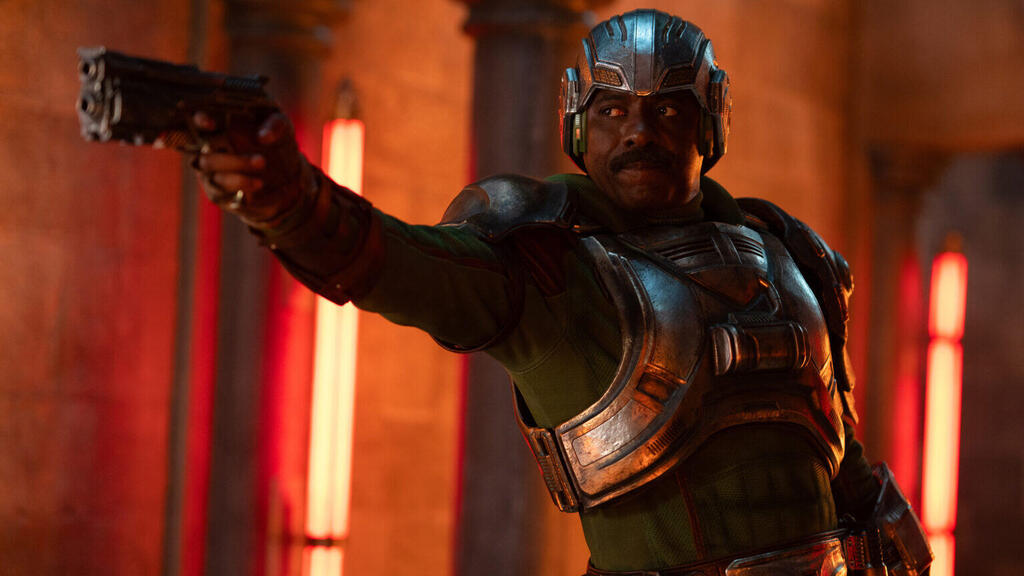
Teela is the daughter of Duncan, also known as Man-At-Arms, played by Idris Elba. Duncan is King Randor’s right-hand man and Adam’s childhood trainer. Upon the return to Eternia, it emerges that his failure to protect the king, queen and kingdom has turned Duncan into a drunk. He will recover.
On Adam’s side, a band of fighters comes together. In addition to Teela and Duncan, it includes Roboto, a war robot whose abilities have been restricted to the duties of a maid, voiced by Kristen Wiig; Fisto, played by Johannes Haukur Johannesson, who has a terrifyingly large steel fist; Mekaneck, played by James Wilkinson, who fights by extending his mechanical neck; and Ram-Man, played by Jon Xue Zhang, who uses his head as a battering ram. Over the years, queer readings of “Masters of the Universe” have developed, viewing it as a series that glorifies muscular masculinity, features scantily clad men and includes many characters whose names contain “Man.” The film provides quite a few jokes in this context, including the connection between “Fisto” and “fisting,” but they will go over the heads of young viewers.
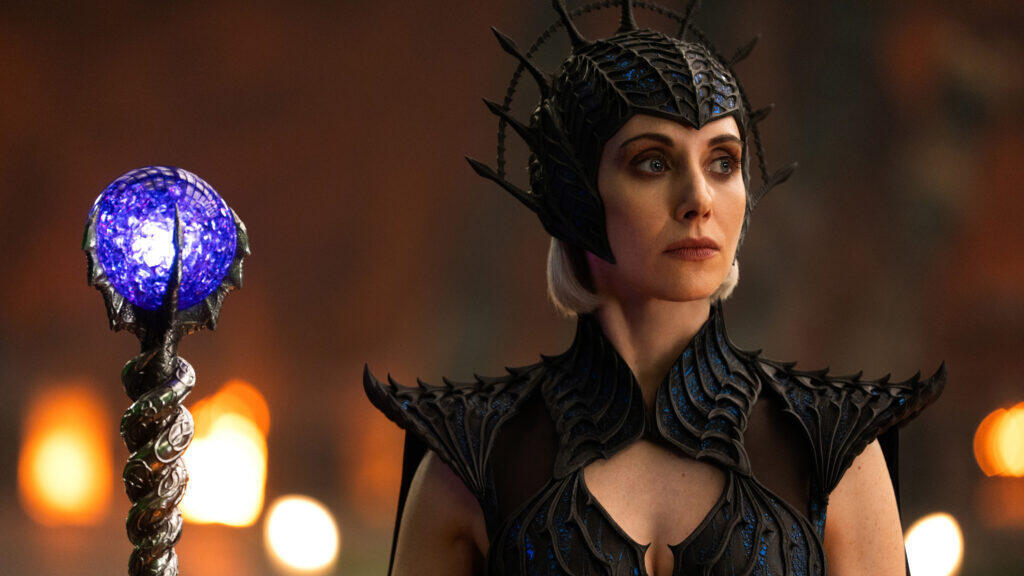
On the other side of the conflict stands Skeletor, a purely evil, theatrical and ridiculous villain who is given a fitting, and rather amusing, performance by Jared Leto. At his side is the sorceress Evil-Lyn, played with particular success by Alison Brie, who seems partly to admire Skeletor and partly to fear him.
The film is long, 142 minutes, but its plot is fairly simple. It seems it would have benefited from tightening. It reminded me of the childhood pleasures of trashy movies that do not take themselves seriously, especially the 1980 version of “Flash Gordon” — and that is definitely a compliment. It is suited to the pleasures of children in the upper grades of elementary school, but even more so to adults who grew up with the animated series. Especially if those adults do not take their nostalgia too seriously, but instead retain an ironic awareness of their lasting affection for something so silly.