

“I’m addicted to food delivery,” says Ho-yoon Pa, a 23-year-old mechanical engineering student from South Korea. “Food delivery is extremely accessible here, so I ordered a lot, ate too much, gained weight and harmed my health.”
One night, while once again scrolling through delivery apps, she found herself wishing she could place an order that would never arrive. “That way, I would be healthier, and so would my wallet,” she says. That strange wish gave rise to an equally strange viral phenomenon: a food delivery service for meals that never come.
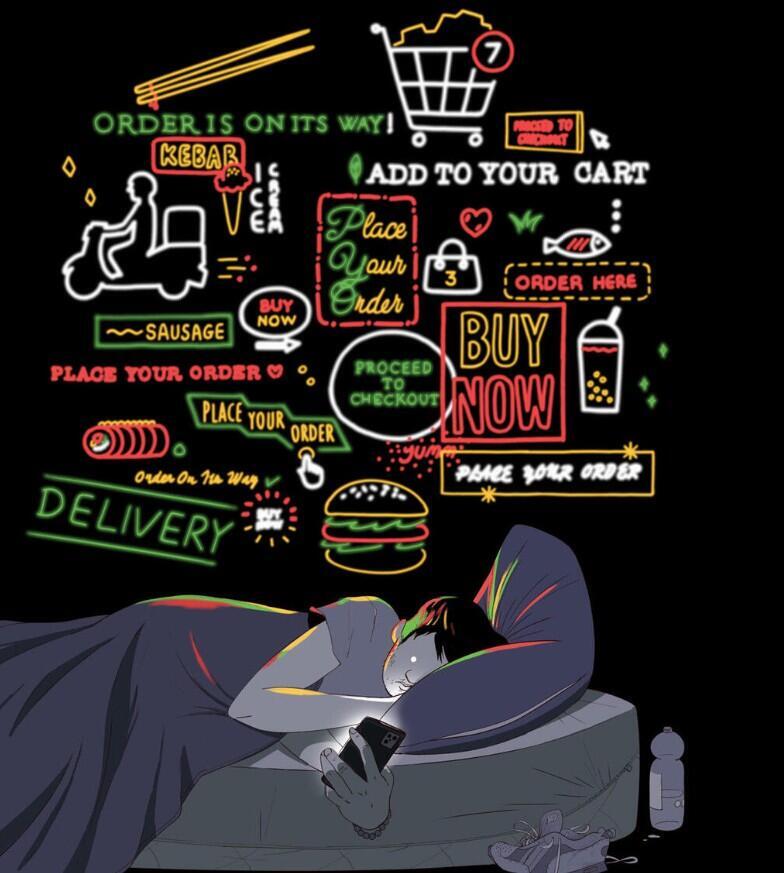
Food never comes
(Illustration: Ovadia Benishu)
Food Never Comes is an app and website developed by Pa that allows users to order dishes from dozens of fictional restaurants across 11 countries. No one cooks the food, no courier delivers it and no customer receives anything.
So what does it provide? I ordered chow mein, a stir-fried noodle dish with chicken, for a fictional 8,000 won, or about 20 shekels ($6), after a discount, plus another 9 shekels ($3) in simulated tax and delivery fees.
Once the order was approved, I watched my courier make his way toward me, much like on a real delivery app. He appeared on the map as Gary the Snail, and for four minutes I followed him as he stopped at a red light, paused to admire another snail on the pavement and silently judged my life choices. Then, instead of sitting down on the couch with my food, I received a celebratory message: “Crisis averted. Wallet safe.”
It sounds ridiculous. Yet since the platform launched in May, users around the world have placed about 700,000 fake orders. Each week, some 35,000 people use it to "indulge the craving", as the site puts it. The figures suggest that sometimes the anticipation of a purchase and the ritual of ordering matter more than the product itself. As Food Never Comes’ slogan says: The food never comes, but the dopamine does.
“People like my app because something is missing in their lives,” says Pa, who also goes by Malhee, in her first English-language interview with a Western media outlet. “Maybe it's money. Maybe they are lonely.”
Was that your goal when you developed it?
“No. I never thought about it in those terms,” she says. “I simply posted the idea on X and received a lot of enthusiastic responses from people my age. I realized it was an app people needed and that it could be useful today.”
Did you expect it to become an online sensation?
“Not at all. I created it as a joke, but I was surprised to find that simply satisfying the urge to order something can feel strangely rewarding, even when nothing arrives,” she says. “That is how many of us behave now, isn’t it? We order food not because we are hungry, but out of habit or boredom. Our hand goes straight to the delivery app. This was my attempt to break that cycle.”
What surprised you most about how people use the site?
“People love ordering the most expensive meals or huge quantities because it makes them feel rich,” she says. “They get a certain satisfaction from saying, ‘I ordered 20 chicken dishes.’ That is also why so many people ask me to add more restaurants.”
A product of relentless pressure
Food Never Comes has attracted attention around the world and is frequently described as a “dopamine website,” meaning a platform whose main purpose is to provide a quick hit of stimulation or pleasure. For now, however, there appear to be only two prominent sites of this kind, and both are South Korean.
Alongside the fictional food orders of Food Never Comes is Damta.world, a virtual cigarette-break website where users can “inhale” smoke, blow rings, tap away ash and watch a pixelated cigarette burn down, accompanied by ASMR-style sounds.
Here too, the main attraction is the simulation of a social ritual. The cigarette break takes place on the roof of an imaginary office building, while comments such as “Wow, the world is really complicated” or “I didn’t hear what you said”, typical of a smokers’ hangout, appear on the screen.
Dr. Irina Lyan, head of the Korean Studies section in the Department of Asian Studies at the Hebrew University of Jerusalem, says the websites reflect the intense social and economic pressure placed on young South Koreans to earn degrees, find good jobs, marry and excel. The fallout includes severe loneliness, limited social mobility, intense pressure to remain thin and high unemployment (among South Koreans aged 29 and younger, the unemployment rate stands at 7.5%).
The convergence of these pressures has also contributed to South Korea having one of the highest suicide rates among OECD countries. In 2025, suicide was the leading cause of death among people in their 40s in the country. “This social and economic pressure comes from every direction,” Lyan says. “Koreans call it ‘Hell Joseon,’ evoking a return to the old Joseon kingdom, a society with little social mobility and no clear way out.”
How does that relate to an app offering food that never arrives?
“The constant pressure over when you will marry and when you will start earning money pushes young people toward activities that appear to have no purpose, result or meaning,” Lyan says. “And that is exactly what makes them liberating. It is like watching cat videos. People do it simply because it makes them feel good.”
It is no coincidence that the app attracting so much attention revolves around food. Eating habits reveal a great deal about the changes transforming South Korean society. “More and more people now eat alone,” Lyan says. “That is significant because people only really began eating together in the 1950s.
“In the Joseon period, eating separately was the norm. After the Korean War, however, that became a luxury, and the government began encouraging communal meals. Restaurants quickly stopped allowing people to sit separately, which was also more profitable for them. But today, in a society with more than 8 million single-person households, accounting for about 16% of the population, eating has once again become an individual activity.”
Solo dining has already produced at least one major viral phenomenon: mukbang, in which people livestream themselves eating large quantities of food so viewers can watch in real time and imagine that they are sharing the meal.
 Dr. Irina LyanBruno Charbit
Who really gets the dopamine rush?
I had never smoked a cigarette, but the situation in the country in recent years had certainly made me curious to try. So when I read about Damta.world, I was pleased by the opportunity to smoke without actually smoking. I joined a colleague during her real cigarette break and proudly announced that I too was going out for a smoke.
Then, grinning foolishly, I sat beside her with the app. That was where the magic ended. While she enjoyed the ritual, the posture and the effects of nicotine, I stared at my phone, tapped the screen from time to time to knock off virtual ash and mostly felt ridiculous. Where was the promised dopamine rush?
“The term ‘dopamine websites’ is inaccurate in this context,” says Prof. Guy Hochman, a behavioral economics expert at Reichman University’s Baruch Ivcher School of Psychology. “Heightened dopamine release during these activities mainly occurs in people who are addicted and have developed pathological patterns, not in people engaging in ordinary daily use,” he says.
“Likewise, simply opening Facebook does not immediately trigger a dopamine release,” he says. “That response develops gradually through prolonged exposure and repeated conditioning of the brain.”
That may help explain why Food Never Comes caught on so quickly in South Korea, where food delivery use is among the highest in the world. The Baemin delivery app alone has more than 22 million monthly active users, nearly half the country’s population.
Malhee says the app has helped her reduce her own dependence on food delivery. “Before I developed it, I ordered food constantly,” she says. “But since I began ordering through the app, I suddenly think, ‘Wow, I ordered too much today,’ and then I no longer want to order anything. I simply go home, make food for myself, and that is it. Many users tell me the same thing: Since they began ‘ordering’ through the app, they order less real food.”
A safer way to escape reality
Hochman says the real reason the fake deliveries have become so popular is not addiction, or even the attempt to overcome it, but a deeper psychological need: escape. That may explain why the concept could succeed not only in socially pressured South Korea, but also in Israel and other parts of the world.
“For the past seven years, the world has been marked by constant instability,” Hochman says. “That is especially true in Israel, where the COVID pandemic was followed by political turmoil and war. In times like these, people begin to feel they deserve some form of relief. Even an illusion or a brief fantasy can become meaningful when uncertainty dominates daily life.”
He recalls an art project from the 1990s in which students created a fake café in Tel Aviv. “People would arrive, sit down, order and receive empty plates,” he says. “They would sit there, talk and then leave. People understand that our future and our money are highly uncertain, so they look for experiences and unusual things.”
 Prof. Guy HochmanPhoto: Gilad Kavalerchik
Games, he says, offer a safe space. “That is why we play on our phones, enter Facebook and ‘order’ something that carries no risks and no uncertainty,” Hochman says. “It is a gimmick that gives us anticipation, something interesting we can discuss with friends, read about and react to. It gives us an experience, and studies show that experiences are much more enjoyable than expenditures.”
So we are chasing the experience of placing the order, rather than the product itself.
“Yes. When people are told, ‘There is no risk. You do not have to worry that the order will fail to arrive or that the service will disappoint you. Everything is controlled. You are simply simulating the perfect purchase,’ they are drawn into an experience that creates an illusion of meaning or excitement,” Hochman says. “But in the end, they may also realize that they have been fooled."
Meaning?
"These websites are built around people’s hunger for novelty and unusual experiences because those things offer psychological value and a sense of meaning. But ultimately, they do not give us what we are truly searching for. They mainly provide an illusion of control and understanding.
“Ordering things that do not exist and scrolling through a phone can be harmless in moderation. But when they become the center of everything and the main way we meet deep psychological needs, we are simply replacing one problem with another.”