

On Saturday, once again, we found ourselves doing what has become all too familiar over the past two and a half years: pausing to take a breath, gathering the children and making our way together to the shelter or the reinforced safe room.
Each person responds differently. For some, the return of sirens triggers anxiety tied to previous rounds of fighting. Others are exhausted from interrupted sleep and the sense that it never truly ends. Some are thinking mostly about Purim and what they are missing.
At the heart of it all is the most human parental question: What do we tell our children, and how do we say it in a way that does not alarm them, yet does not mislead them either?

What do you tell children about frequent sirens?
The simple rule is this: Tell the truth, but tailor it to their age. Children sense when something is happening around them. Their imagination is often more frightening than any explanation you might give. There is no need to overwhelm them with details, but it is important to provide a clear framework: “There is a security situation, which means there may be sirens at times, and when that happens, we go into a protected space to stay safe.”
Then, and this part is crucial, pause and ask: “What would you like to know?” Answer only what they ask, in short and simple language, and make sure they understand. When a child feels heard and knows they can ask questions, their stress level drops.
How do you tell them that the sirens are scary, but we know how to cope?
Many parents try to reassure quickly, and say: “There’s nothing to be afraid of.” But children can tell when we are trying to erase their feelings, and that often increases anxiety.
It is better to respond with something genuine and reassuring: “Yes, it can be scary. Fear is like an internal alarm in the body. It is there to protect us. It tells us to pay attention, come closer together and make the right choice.”
Then add a sentence that restores stability: “We have a plan, and we know what to do. When there is a siren, we go to the safe room, we wait, and then we go back to our routine.”
What about the hard question: “How long will this last?”
Here, it is actually appropriate to say honestly: “I don’t know.” But do not leave it hanging. Add: “What I do know is that we are doing everything we need to do to keep ourselves safe. We have an army, we have defenses and we are not helpless.”
For children, knowing there is an adult who holds partial certainty, someone who can say “I don’t know when, but I know what to do,” is a real anchor.
You can also gently connect what is happening “outside” to what is happening “inside”. We go into the shelter to protect ourselves. That means we are taking action, being proactive and protecting our home. We are not just waiting for it to end. We are doing the right thing in real time. That message builds a sense of competence. We are afraid, and we are still functioning.
How do you help children cope with the disappointment of canceled Purim celebrations?
First, acknowledge the pain. A child who has been waiting for a costume, a party or a school performance experiences a small loss, and it is real. A phrase like “It’s not a big deal” can sound like “You’re overreacting.” It is better to say, “I understand. This is really disappointing.” Only then move to the practical question: “So what can we do instead?”
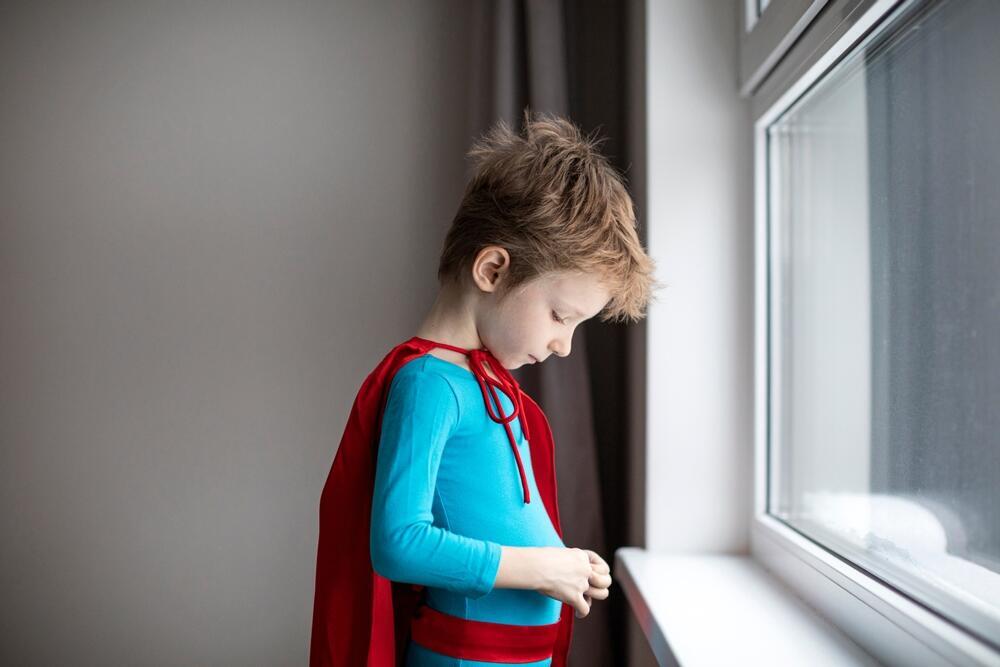
"This is really disappointing"
(Photo: shutterstock)
This is actually an opportunity to make children partners. A costume contest over Zoom with classmates, a short hallway party in the building, a dress-up gathering with a neighboring family, funny photos to send to grandparents, or even a small ceremony at home with music and a festive snack.
The goal is not just to compensate for the party. It is to teach something deeper: When something is canceled, we know how to create an alternative. Even if it is small. Even if it is not perfect.
How does an entire family manage in one safe room, especially if it is one child’s bedroom?
Start with honesty: It's not simple. You can say in advance, “We might be more irritable.” Simply naming it reduces guilt and prepares the ground for cooperation.
Then do something highly effective: Hold a family brainstorming session. Even with young children. “Let’s think together about how to make this more bearable.” Children often surprise us with creative solutions, and most importantly, they feel they have some control. You can decide together on “safe room rules”: Who sits where, what to do if someone needs quiet, which games go inside, what to do when boredom sets in, and how to give each person a “minute to themselves” even in a crowded space.
It also helps to assign roles: One child is in charge of water, another of the flashlight, another of a “boredom kit” with a small game or paper and pens. Roles are powerful because they turn a frightened child into a helpful one. The feeling of “I am contributing” is one of the strongest foundations of resilience.
Ultimately, our goal as parents is not to erase fear, but to teach something more mature: Fear can be present, and we can still act, choose, help and continue living. Sometimes, precisely in difficult moments, children begin to form a quiet inner belief: “I can handle this.” And that is significant.
The author is a clinical and educational psychologist.