

Leaving a kibbutz in central Israel is rare, but Roy and Bar Avni-Naor did just that. The couple, she a data scientist at Israel’s Central Bureau of Statistics and he a space-tech entrepreneur, recently moved with their children to Mitzpe Ramon, seeking better education, a closer connection to family roots, and a chance to help build Israel’s emerging space ecosystem.
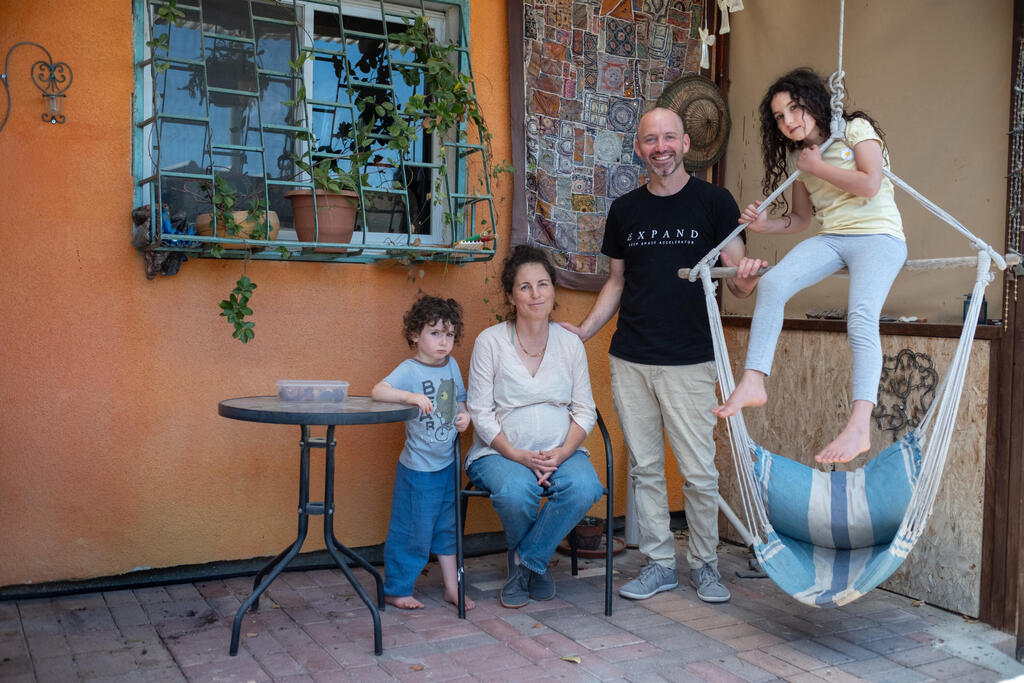
The family rents a single-story house for 6,000 shekels a month (about US$1,800).
“Prices here weren’t as low as we thought", says Roy.
Why did you choose Mitzpe Ramon of all places?
Roy: “We moved here just this month from Kibbutz Naan (near the city of Rehovot in Israel, located within the Central District). People don’t typically leave kibbutzim, especially not the ones in central Israel. From their perspective, it made no sense. It seemed bizarre. But Mitzpe Ramon isn’t foreign to us; Bar’s parents are from here, and her grandfather was one of the town’s founders."
What do you mean by 'founders'?
Bar: “My grandfather, Hagai Avriel, came here in the early 1950s with a small group to establish what was then a very early version of Mitzpe Ramon. They tried to start a cooperative, but it didn’t last long. For me, moving here feels like closing a circle. We had a few reasons for coming; education was a major one."
What kind of education?
Roy: “We were looking for high-quality options. Don’t get me wrong, kibbutz life is great. It’s a choice between good and better. Kamah goes to a democratic school, and Rotem is in a forest kindergarten. Bar is eight months pregnant, so the timing also made sense."
The couple's work
Bar: “I’m a data scientist working with the Central Bureau of Statistics. I’m building a large database focused on children, especially those at risk, so we can identify them early and intervene. My main office is in central Israel, but I can work from home part of the time, which makes living here possible. I love what I do, and I care deeply about science and contributing to society."
Roy: “I’m co-founder and CEO of Creation Space, a company that builds Earth-Space tech companies. The space race is back, this time it’s the U.S. and China competing to dominate the moon, not just to reach it but to stay there, driven by economic motives.
“For example, the first truly profitable resource to bring back from the moon isn’t minerals but data. The world is consuming enormous computing power and storing data at an exponential rate, which demands massive data centers. Those require tons of energy and cooling, which are polluting, and take up huge amounts of land. It’s much more efficient to store and process that data in space.
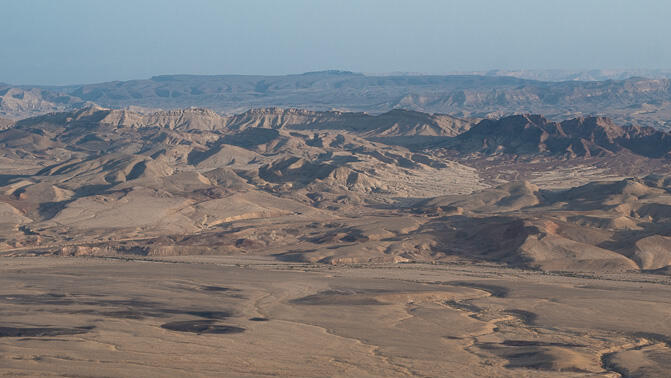
Mitzpe Ramon
(Photo: Israel Bardugo)
“All the major tech companies are investing in this. Within a decade, there will be data centers on the moon. That will drive entire industries because we will need robots to build them, people to maintain them, and those people will need food and medicine.
"This isn’t science fiction; it’s already happening, and Creation Space is part of it. We recently opened our offices here in Mitzpe Ramon, and that’s why I’m here.”
Tell us about the offices
Roy: “The Jewish National Fund-USA built an incredible innovation hub here in Mitzpe Ramon to promote local innovation development, and we’re the first tenants in the new office space.
Our long-term goal is to help build a space-tech ecosystem in Israel. We believe the Ramon Crater is the ultimate site for researching how things behave in space, not only because of its isolation, but because it so closely resembles Mars.
“We identify early-stage startups in the space sector and invest in them. We help them adapt their technologies for space, but also offer practical applications here on Earth.
"For example, to build a data center on the moon, it would need to be buried underground to protect it from radiation. That requires a kind of subterranean tunneling device, basically a space torpedo, that could just as easily be used to dig subway tunnels in Tel Aviv.
“Instead of hiring 100 workers to operate a massive machine like the one currently building the light rail in Tel Aviv, if it’s automated, you save enormously on labor, and that’s how you become a millionaire.”
A millionaire?
Roy: “Honestly, I didn’t know how to manage money because the kibbutz handled everything for you. We grew up on a budget with no personal income, so I had to learn how to be a businessman on my own.
"It’s been a personal journey. But for me, this goes beyond money; this is Zionism. It’s about innovating under extreme conditions and exporting those solutions to the world.
“Israel didn’t know how to farm in the Negev, so we invented drip irrigation, and now the whole world uses it.
"So, if you ask me personally, we don’t have millions in the bank right now. But if everything we’re building works, Creation Space will be worth more than $100 million within a decade. And since I own a significant stake, the bank account will be fine. But that’s not the point. That’s not my motivation.
“People who move to Mitzpe Ramon often lower their standard of living but raise their quality of life. That’s the choice people make here. When I think about what I’d want written on my gravestone, it’s: Roy Avni-Naor contributed to humanity’s effort to break beyond planet Earth.
But even if none of our startups reach space, I’m here to contribute to humanity, and humanity is right here on Earth. Space tech has a way of ending up in every home anyway, like the microwave, the MRI, and even diapers. That’s what I’m aiming for.”
How do you spend your leisure time?
Bar: “There’s actually a lot of culture here—more than we had in our previous area in central Israel. There are festivals, community meals, and daily life here shape how you spend your free time. Sometimes it’s as simple as walking to the edge of the crater."