

An injured flamingo that became separated from its flock was rescued from fish ponds in Nachsholim, a kibbutz and beach resort in northern Israel, by Israel Nature and Parks Authority inspectors, who treated her and returned her to the wild.
Following a report from the manager of the Nachsholim fish ponds about a wounded flamingo unable to fly, Nature and Parks Authority teams arrived at the scene and carried out a swift rescue operation.
Gallery
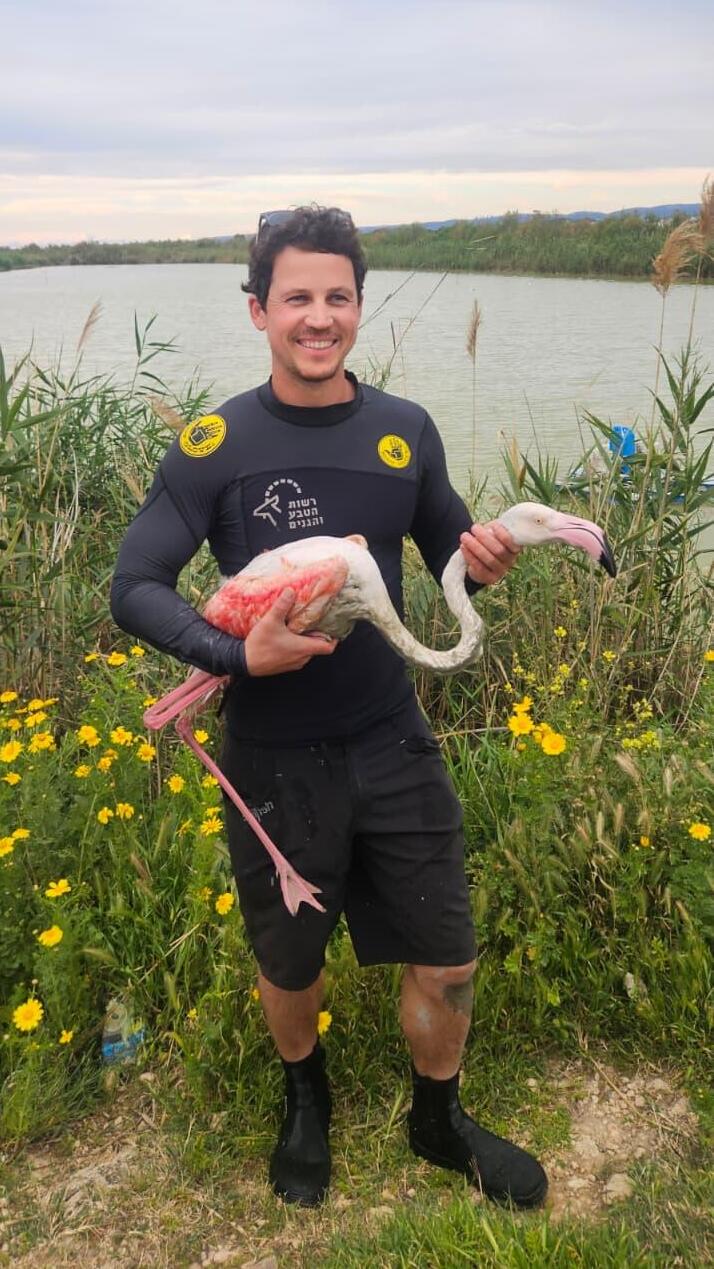
Rescuing the flamingo from a fishing pond
(Photo: Ilya Baskin/Israel Nature and Parks Authority)
The report was received on Thursday from Yankele, manager of the fish ponds at Kibbutz Nachsholim, and resident Asher Avgi, who identified a stranded flamingo in the middle of one of the ponds. Mor Meiri-Solomon, manager of Tel Dor National Park at the Israel Nature and Parks Authority, dispatched marine unit inspectors Ilya Baskin and Shay Kabesa, who arrived quickly, identified the bird as a female, and rescued her using a paddleboard.
An on-site examination revealed that the flamingo had become entangled in fishing equipment, with a hook lodged in its limb and its legs tangled in fishing line.
“After we removed the flamingo from the water, I saw that both her legs were tied and connected to hooks lodged in her leg and between her toes. Carefully, I broke the hooks and removed them, and then transferred her for treatment to veterinarian Hila Retig, a volunteer with the Nature and Parks Authority wildlife ambulance, for fluids and recovery,” Baskin said.
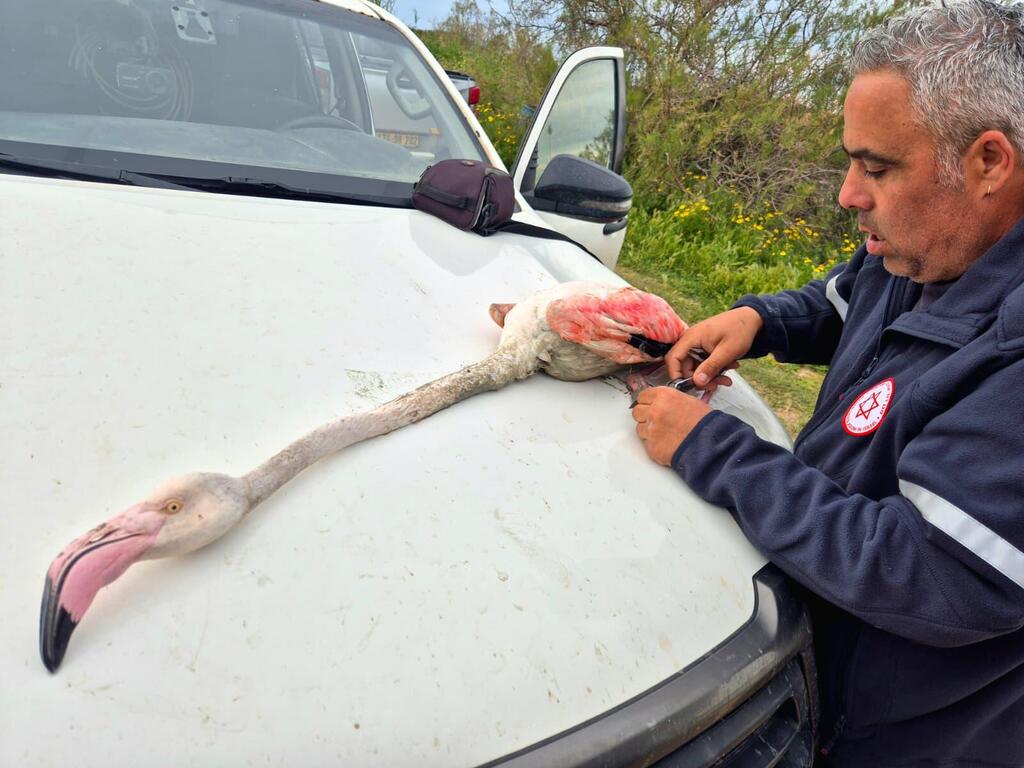
Caring for the injured flamingo at the scene
(Photo: Ilya Baskin/Israel Nature and Parks Authority)
“Cooperation between residents, farmers, field personnel and professionals is a critical component in protecting wildlife in Israel. Quick reporting and environmental responsibility enable effective treatment in such cases and help save many animals.”
The Nature and Parks Authority said the flamingo’s condition improved and it was released back into the wild so it could rejoin its flock. Kabesa, who provided initial treatment at the scene, added: “When I arrived, I saw Ilya entering the water and, with our guidance, reaching the bird. When he came out, we saw she was tied at both legs with hooks embedded in the leg and between the toes. I managed to remove them, and from there we transferred her for further care.”
Retig, who treated the flamingo, said it arrived in a state of severe exhaustion, wet, hypothermic, with a wound on her foot caused by fishing line wrapped around a claw, and unable to stand or lift her head.
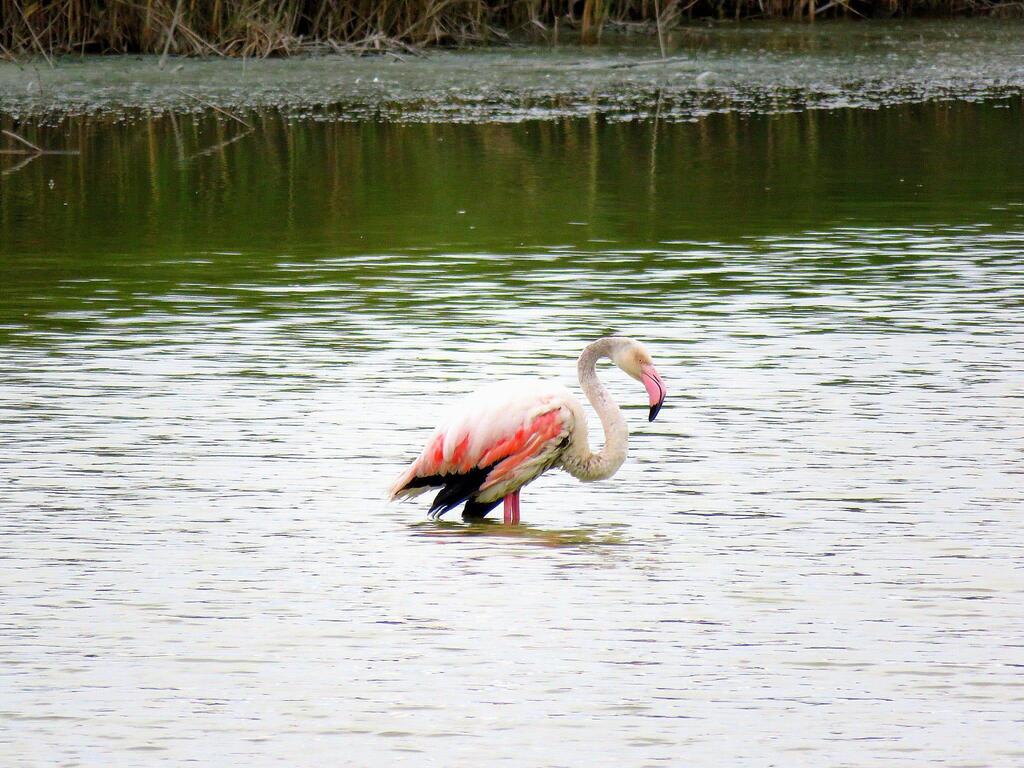
Injured flamingo struggles in fishing pond in northern Israel
(Photo: Ilya Baskin/Israel Nature and Parks Authority)
“She received initial treatment including warming and drying, as well as warm fluids with added vitamins, and was then kept for observation and overnight hospitalization,” she said.
“During the night, her condition gradually improved, and by morning the flamingo was more alert, with stabilized body temperature and better functionality. After consulting with the Wildlife Hospital at the Safari in Ramat Gan, a strategic decision was made to return her to her natural environment — the flock in the Nachsholim ponds — with the understanding that behavioral and social rehabilitation is critical for her survival.
“She will remain under observation in her natural habitat, and if her condition worsens, inspectors will recapture her and transfer her for further treatment at the wildlife hospital. In initial observations after release, the flamingo was seen standing, walking, approaching the flock and eating — positive signs of functional recovery.”
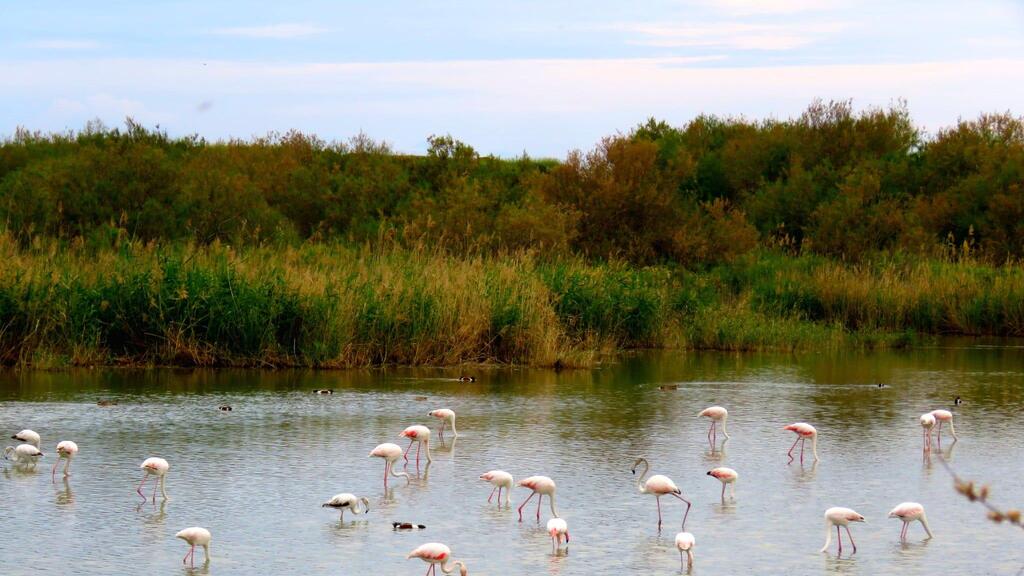
The flock of flamingos in the fishing pond in Kibbutz Nachsolim
(Photo: Ilya Baskin/Israel Nature and Parks Authority)
The Nature and Parks Authority noted that the greater flamingo is a water bird found across Africa, Asia and Europe. It is a social species that lives in large flocks, mostly in shallow saline ponds, lakes and lagoons. It measures between 120 cm and 150 cm (47–59 inches) in length and weighs between 2 kg and 4 kg (4.4–8.8 pounds). Its distinctive downward-curving beak is used to filter food from the water, mainly crustaceans and algae that give it its pink color.
In Israel, flamingos can be seen in winter and during migration seasons, mainly in the salt ponds of Eilat and Atlit, and occasionally in spring and wetland areas such as the Hula Reserve and the Beit She’an Valley.
The Nature and Parks Authority called on the public to report injured or distressed wild animals to its hotline at *3639 and receive guidance on how to assist.
First published: 19:22, 03.31.26