

Among coral reefs, one of the most eye-catching fish can often be seen moving gracefully through the water: the butterflyfish. Its flattened body, vivid colors and striped patterns have made it a symbol of healthy reefs. But behind its elegant appearance lies a complex and intriguing creature that feeds in unusual and surprising ways, forms long-term pair bonds that can last for years and serves as an indicator of marine ecosystem health.
Butterflyfish (Chaetodontidae) are a large family of reef fish with more than 120 species, found mainly in tropical oceans. Yarden Ratner, a master’s student in the lab of Prof. Roy Holzman at Tel Aviv University and the Interuniversity Institute in Eilat, explains what makes them unique, how they survive in crowded and competitive environments and what they can teach us about the future of the oceans in a changing world.
Gallery
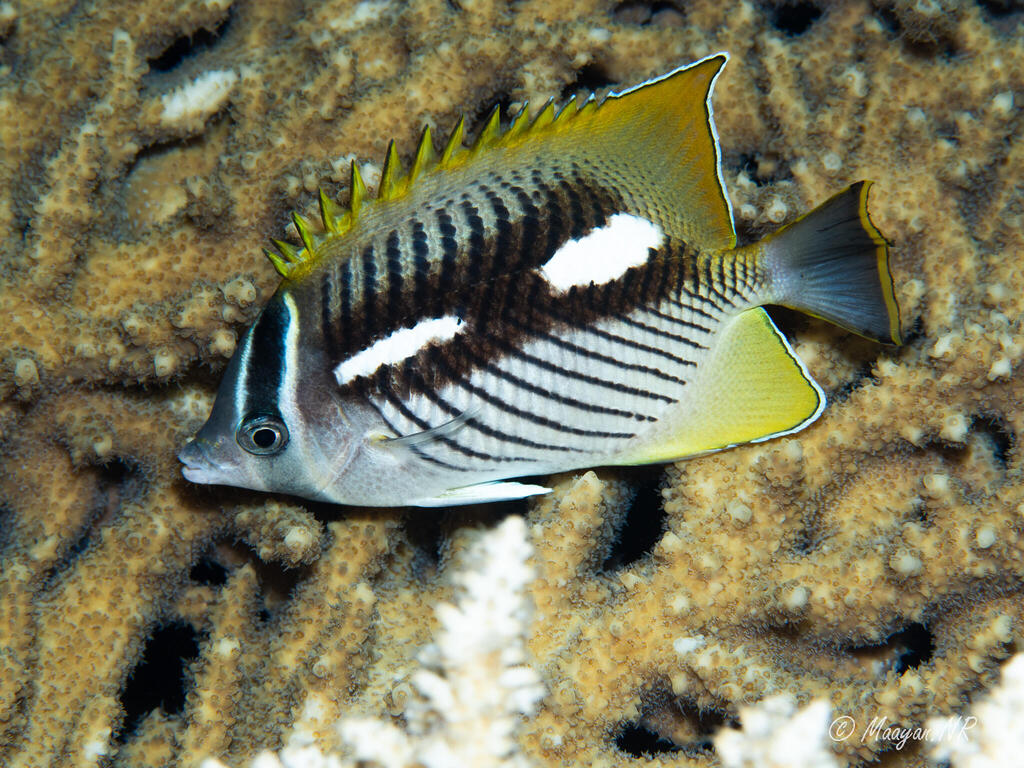
Butterflyfish (Chaetodontidae) are a large family of reef fish with more than 120 species
(Photo: Maayan Neiger Rachmilevitch)
Where are butterflyfish found?
“You can find butterflyfish in the Red Sea, in the Gulf of Eilat. They are present in most tropical regions around the world: the Indo-Pacific Ocean, for example Australia, Indonesia and Hawaii, other parts of the Red Sea such as Egypt and Sudan and also the Atlantic Ocean, including Brazil, Mexico, Belize and Florida.”
What makes their behavior special?
“One of their most distinctive traits is that unlike most reef fish, which live in schools or alone, many butterflyfish species live in monogamous pairs. They live and move together as permanent couples. The bond is so strong that if one partner disappears, the other may stop feeding or show signs of distress for a period of time. They are also highly territorial. The pair patrols their territory several times a day and when they encounter another butterflyfish of the same species, they perform threat displays: they extend their spiny dorsal fins and swim aggressively side by side to drive the intruder away.”
“Another remarkable trait is their unusual camouflage strategy. At night, butterflyfish ‘put on pajamas.’ They switch from their bright daytime colors to muted, blurry patterns that help them disappear among rocky crevices while they sleep. This ‘pajama’ pattern protects them from nocturnal predators such as moray eels and lionfish that hunt in the dark.”
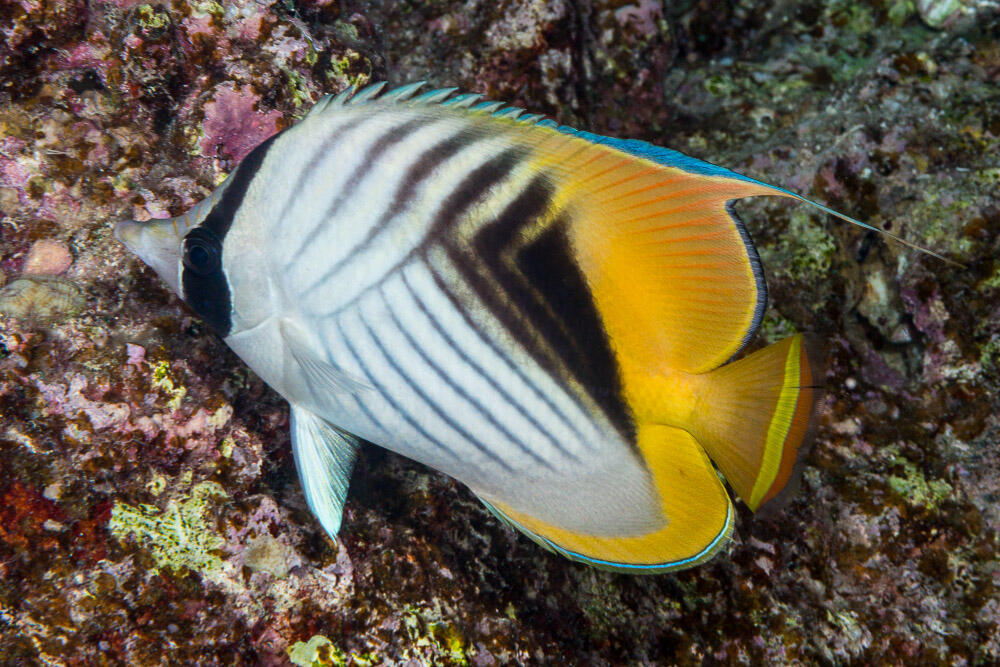
Many butterflyfish species live in monogamous pairs
(Photo: Francois Libert)
“And perhaps their most unique feature is their feeding strategy. Butterflyfish have an additional joint in their jaw. This allows them to close their mouth on prey, such as a coral polyp or sea anemone, while the jaw is still extended forward, creating a strong and efficient pulling force when the jaw retracts. While other fish must use their whole bodies to tear food from the seabed or rely on suction that is not strong enough to detach fixed prey, butterflyfish do it using jaw motion alone. This makes their feeding highly precise and energy efficient.”
How do they support marine ecosystems?
“Many butterflyfish species feed exclusively on coral. They consume coral polyp tissue directly, which makes them biological indicators. Because they depend entirely on living coral, their disappearance from an area is often the first sign that a reef is deteriorating or experiencing bleaching.”
“Butterflyfish are a charismatic and beautiful fish family with a special role as ecological ambassadors. Their unique pair bonding and stable habitat create emotional identification among humans and make them an important communication tool for conservation efforts. A single beautiful fish can make someone smile underwater and inspire a real desire to protect the reef.”
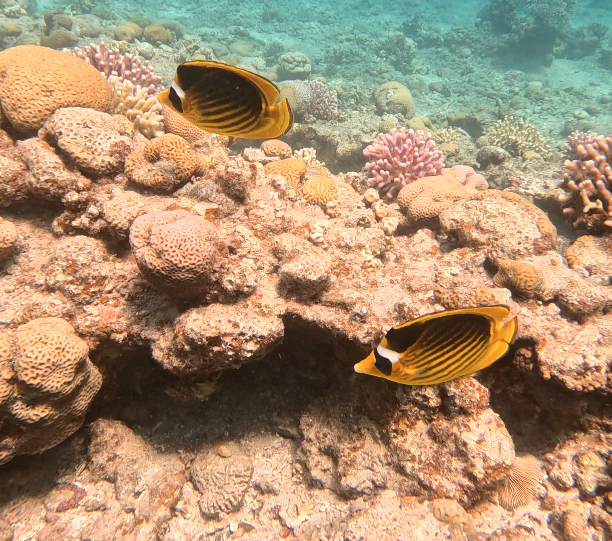
'This ‘pajama’ pattern protects them from nocturnal predators such as moray eels and lionfish that hunt in the dark'
(Photo: Yael Avigad)
What are the main threats they face today?
“The main threat to butterflyfish today is ocean warming, which causes coral bleaching and widespread coral reef mortality around the world. Because many butterflyfish species feed on living coral, damage to corals directly affects their ability to find food. As coral die-offs increase globally, we are seeing declines in species that depend exclusively on coral, including butterflyfish.”
What does your research focus on?
“My research focuses on understanding the ability of butterflyfish to detach prey of different sizes from the reef. I am trying to determine whether the mechanical capabilities of their jaws alone determine feeding success or whether it is a dynamic system in which the fish deploy different ‘tool sets’ depending on the type of food. This could help shed light on their ability to adapt to future changes in reef environments and shifting food availability.”
What is most challenging about the research?
“We study butterflyfish in their natural habitat on the reef. Using a system of high-speed cameras (500 frames per second) and a force sensor, we are able to measure exactly how much force they use to detach prey from the reef.”

Yarden Ratner
(Photo: Courtesy of the subject)
“The biggest challenge is building trust between us and the fish. At first they are cautious about the equipment entering the water, but after a few days of adjustment they become accustomed to it and even swim toward me when I enter the water. There is one butterflyfish we have been studying since the winter of 2022; it still recognizes us today and approaches the system without fear and even with what looks like enthusiasm.”
What do we still not know about butterflyfish?
“The most interesting questions today, in my opinion, involve the connection between their body structure and function. For example, does their jaw structure allow butterflyfish to diversify their diet and consume other types of food? This is a critical question, especially given the disappearance of coral populations worldwide. It is also important to examine whether butterflyfish have mechanisms that allow them to adapt as invasive species in new environments. Answering these questions will help us better understand their ability to survive in a changing world.”
The article was produced by Zavit – the news agency of the Israeli Society for Ecology and Environmental Sciences