


For years, Israel has been able to tell itself that its chronic water shortages were largely a problem of the past. Massive desalination plants transformed the country’s water supply and helped insulate households from drought.
But after two erratic years of rainfall, water officials are warning that the system is under pressure again. “It is not something we should take for granted that, at the end of the day, we have water coming out of the taps,” said Water Authority Director Yehezkel "Hezi" Lifshitz. “We call the desalination plants the Iron Dome of the water sector. They are what make it possible for us to actually have water in the taps.”

The warning comes after the 2024-2025 hydrological year became the driest since measurements began in Israel. Conditions improved during 2025-2026, with rainfall reaching about 90% of the long-term average. But because of the severe deficit carried over from the previous year and the way rainfall was distributed during the season, replenishment of natural water sources reached only about 70% of average.
Farmers were among the first to feel the impact. The coming 2026-2027 hydrological year could prove decisive. According to the Israeli Meteorological Service, the early months of the rainy season, from October through December, are expected to bring precipitation totaling around 120% of the seasonal average for those months.
Those months normally account for about 38% of the annual rainfall. The service expects relatively wet conditions to continue into January 2027, with rainfall forecast at roughly 100% to 120% of the monthly average. Beyond that, however, officials say there is not yet a sufficiently reliable forecast for the rest of the winter.
Desalination under pressure
Israel’s growing dependence on desalination is closely tied to longer-term changes in the climate. “We are in a period of climate change,” Lifshitz said. “This period is characterized by rising temperatures and increasing rainfall intensity, meaning a larger share of the rain falls over shorter periods. Over time, these trends reduce the natural replenishment of water sources. At the same time, there will still be individual years in the future with very high rainfall.”
The immediate problem is that the desalination system is not yet operating at its full intended capacity. “If the desalination plants were working at full production capacity, the situation would be much better,” Lifshitz said.
The Sorek 2 desalination plant was originally scheduled to begin operating in March 2023. Delays caused by the COVID-19 pandemic, rising interest rates and successive wars meant it began producing only about half of its planned capacity in March 2025, two years behind schedule. Lifshitz said the project was also affected by the involvement of international companies, with some foreign specialists unwilling to return to Israel because of the war.
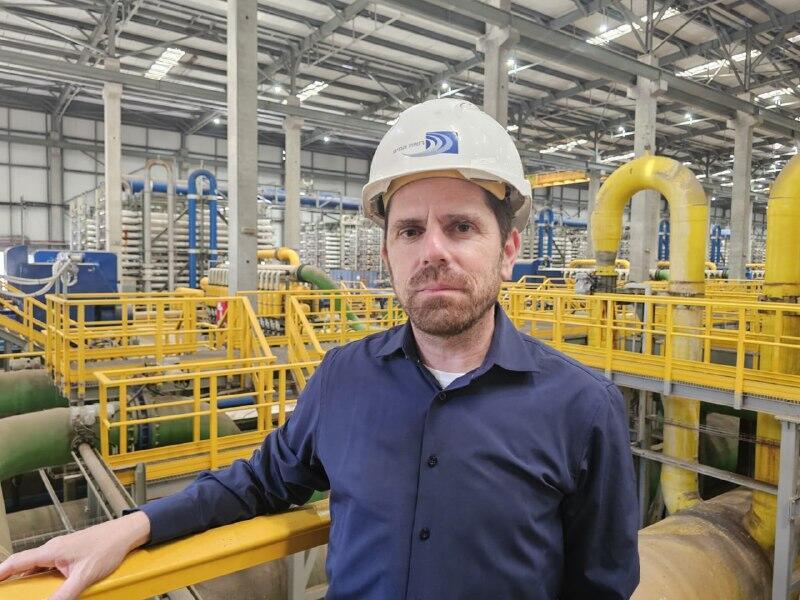
Water Authority Director Yehezkel 'Hezi' Lifshitz
(Photo: Itai Davidi)
The plant has still not reached full capacity. Once fully operational, it is expected to produce about 200 million cubic meters of desalinated water annually. That shortfall has had consequences for natural water reserves. “In 2024, we pumped more than we had planned from the Sea of Galilee because of the shortfall in desalination capacity,” Lifshitz said. “In 2025 and again this year, we are pumping the absolute minimum, around 30 million cubic meters.”
He described those volumes as exceptionally low, particularly after the extreme drought of winter 2024-2025. “This winter was better than we expected, but in the north it was worse than we hoped, and the Sea of Galilee is now on a downward trend,” he said.
Farmers feel the shortage
Some of the most severe effects are being felt in agricultural regions far from the national water grid. In the central Arava and the Eilot region in southern Israel, farmers have faced mounting shortages, with some date crops suffering damage.
Agriculture in the Arava relies largely on local wells, some of which are located across the border in Jordan. Security conditions have at times made it difficult to service wells on the Jordanian side. The Sabkha desalination plant near Eilat also faces environmental constraints because its concentrated brine is discharged into the Gulf of Eilat, limiting the amount of water that can currently be produced.
Lifshitz said the planned solution is to more than double the plant’s capacity to roughly 40 million cubic meters a year. “That would provide a significant solution for the entire region, but it will take several years,” he said.
The island off Kibbutz Ma'agan last November
(Video: Shay Mizrahi)


The central Arava is also expected to be connected to the national water network, although that project will also take time.
Other isolated regions are facing similar challenges. The Golan Heights, for example, still relies heavily on local wells, much like the Arava. Lifshitz said the region is expected to be connected to the national system within about two years.
Israel is now preparing for a major new expansion of its desalination infrastructure. A tender was issued for a new desalination plant in the Hefer Valley in central Israel, which the Water Authority says is expected to become the largest in the world.
The facility is planned to produce about 400 million cubic meters of desalinated water annually. “We are going to double desalination capacity within seven or eight years,” Lifshitz said. “We want to connect all the regions that are currently disconnected.”
The project is intended not only to meet household and agricultural demand, but also to reduce the pressure on natural water sources. Even with desalination, officials say Israel still lacks enough water to fully restore natural flows into rivers, springs and lakes.
Alongside infrastructure investment, the Water Authority is also preparing a public awareness campaign encouraging Israelis to conserve water. The campaign, costing about 4 million shekels, will focus particularly on children and everyday habits such as turning off the tap while brushing teeth.
Lifshitz said the aim was not to frighten the public but to restore awareness that water remains a limited resource. “This is not a fear campaign, but an awareness campaign,” he said. “Like telling people not to pick wildflowers. Don’t leave the tap running.”
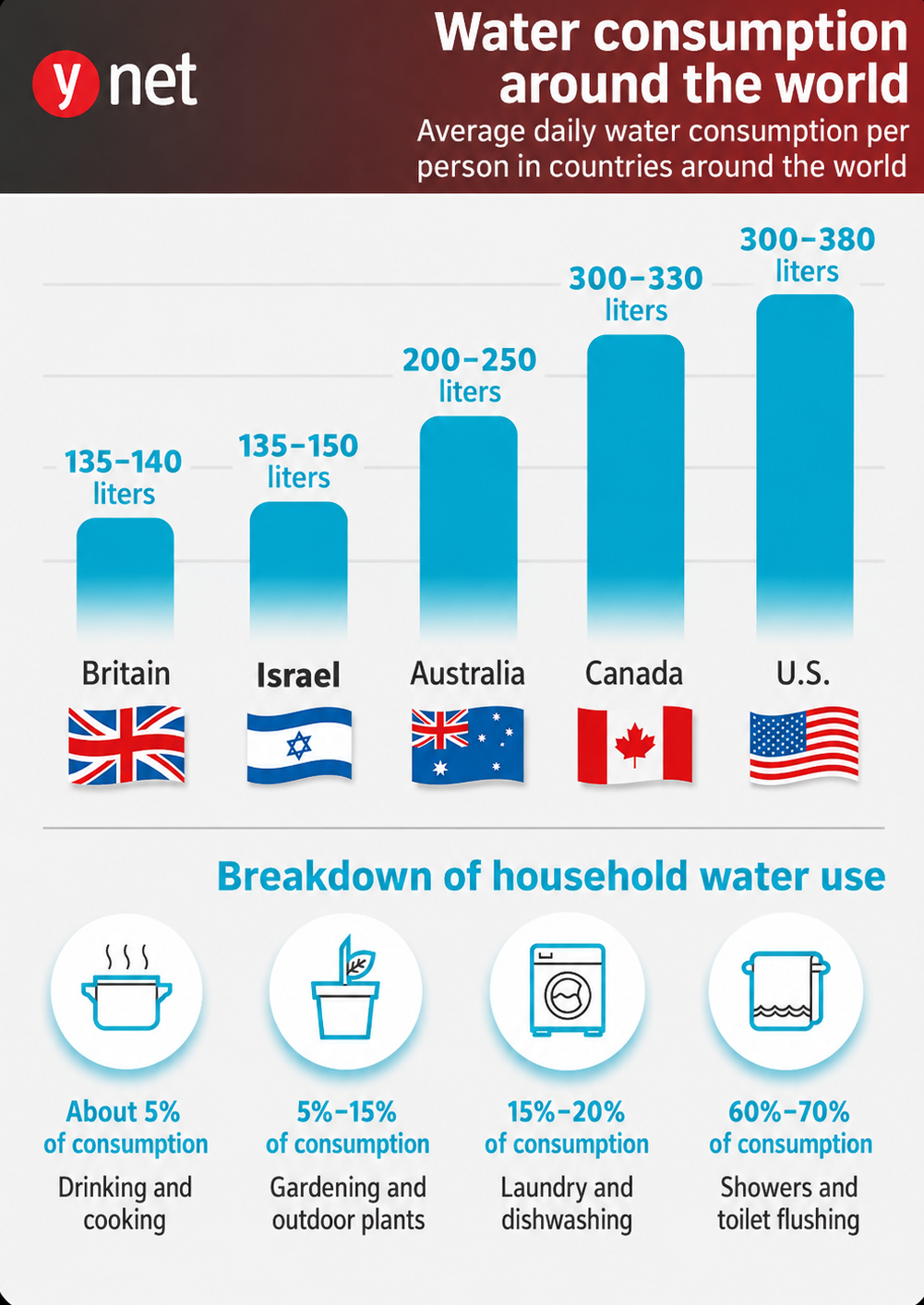
Israeli households consume roughly 1 billion cubic meters of water a year, or about 100 cubic meters annually per household, according to the Water Authority. “If we managed to save 5% a year, that would be equivalent to half a desalination plant,” Lifshitz said. “The Israeli consumer is not wasteful, but consumption can be made more efficient. Water-saving habits have eroded somewhat.”