


Archaeologists have uncovered a rare 1,400‑year‑old personal pendant decorated with a seven‑branch menorah near the Western Wall, shedding new light on Jewish life in Jerusalem during a period when Jews were officially barred from the city.
The lead pendant, discovered in a large excavation conducted by the Israel Antiquities Authority in cooperation with the City of David Foundation and the Jewish Quarter Development Company at the Davidson Archaeological Park, bears identical images of the menorah on both sides and was likely worn by an individual visiting or living in Jerusalem during the late Byzantine period.
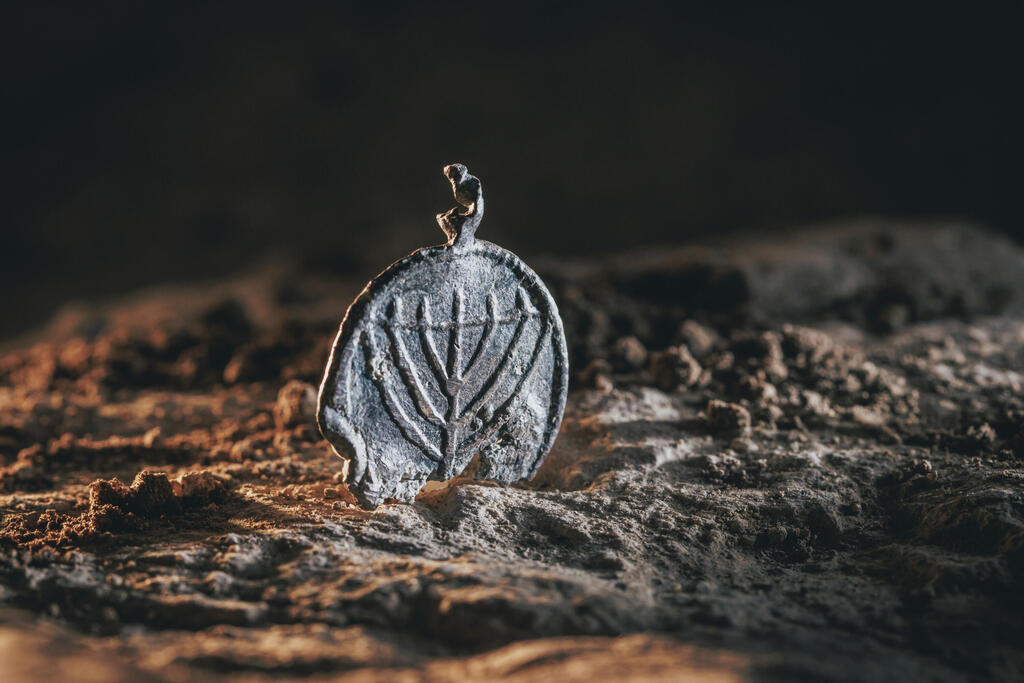
“One afternoon, while I was excavating inside an ancient structure, I suddenly saw something different among the stones,” said excavation worker Iyaw Balta. “I pulled the object from the earth and saw it was a chain pendant with a menorah on it. I showed it immediately to the dig director — and she said this is a very rare find.”
The pendant was located within an approximately 8‑meter (26‑foot) thick fill layer used as a foundation for monumental Umayyad‑period structures. That fill completely covered older remains from the late Byzantine era, including remnants of organized buildings alongside a paved street, researchers said.
The disc‑shaped pendant has a loop at the top for a cord or chain. Each face shows a stylized seven‑branch menorah framed in a raised circular border. One side is well preserved; the other is covered by a natural patina. X‑ray fluorescence analysis by the Antiquities Authority’s lab found the piece to be about 99 percent lead.
“This pure lead pendant with the menorah is extremely rare,” said Israel Antiquities Authority researchers including Dr. Yuval Baruch and Dr. Philip Vukosavovic. “There are known menorah‑decorated pendants made of glass and other metals. But worldwide, we know only one other pendant with this symbol made of lead, held in the Walters Art Museum in Baltimore.”

Dr. Philip Vukosavovic
(Photo: Emil Aljam, Israel Antiquities Authority)
They said the double depiction of the menorah underscores its deep symbolic significance as a visual expression of attachment to the Temple and its memory, even after the destruction of the Second Temple.
Historical sources indicate that during the Byzantine period, Jews were prohibited from living in Jerusalem, making the discovery difficult to interpret. “This fact complicates the understanding of menorah‑decorated objects in their historical context,” the researchers said. “It raises the question whether these were chance finds, or personal objects of Jews who came to the city for various reasons — merchants, administrative envoys or individuals visiting discreetly and unofficially.”
Dr. Baruch, who has directed the site’s excavations for about 25 years and studies menorah imagery, emphasized the importance of the find. “This is not just a material object; it is a personal seal, a token of memory and identity,” he said. “It likely belonged to a Jewish individual who chose to wear it. That choice reflects not just personal religious commitment, but evidence that Jews continued to come to Jerusalem even during periods when imperial edicts barred them.”
Unlike typical jewelry metals of the era, lead was common and may have been used here as an amulet rather than ornament, experts said.
Minister of Heritage Rabbi Amichai Eliyahu called the discovery “moving evidence of the continuity and devotion of the Jewish people to this city. Even in periods when Jews were prohibited from entering Jerusalem, the connection to the place did not cease.”