

Archaeologists have uncovered a remarkably well‑preserved carpenter’s chisel from the 5th–6th centuries CE, found inside a metal concretion retrieved from a shipwreck off the Israeli coast — the wreck of the merchant vessel Tantura A, which sank near Dor Beach (Tantura) off the Carmel coast.
The discovery, made during an underwater excavation led by Deborah Cvikel of the School of Archaeology and Maritime Cultures at the University of Haifa, sheds unique light on the tools and craftsmanship aboard Byzantine‑period ships.
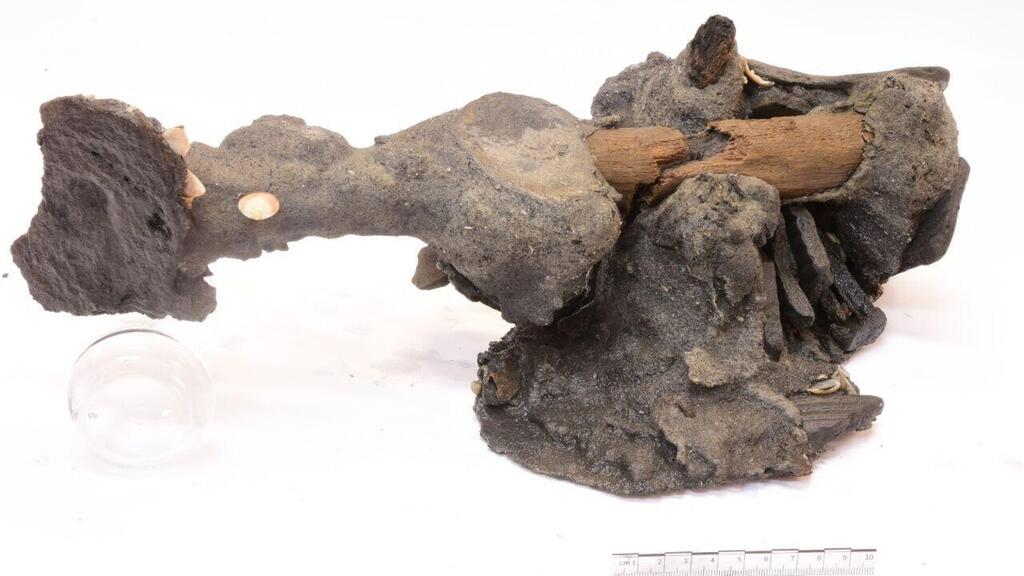
The chisel was uncovered as part of a cluster of concretions retrieved from the wreck during dives last May. Initially, the concretions were scanned using a CT scanner at Rambam Health Care Campus in Haifa. One concretion was then examined with an advanced micro‑CT scanner supplied by defense contractor Rafael Advanced Defense Systems, a collaboration that proved decisive. The high‑resolution imaging was able to penetrate centuries of corrosion and sediment build-up, revealing an intact iron tool—and even a remnant of its original wooden handle.
“This chisel is a shipwright’s tool, likely used by one of the crew members responsible for maintaining the vessel during its voyages,” Cvikel explained. “Thanks to Rafael’s advanced imaging technologies, we can finally see what was hidden for more than 1,500 years. This new information adds another piece to the puzzle of how ships were built and repaired in the Byzantine period.”
According to Rafael, the partnership with the University of Haifa demonstrates how modern defense technologies can contribute to historical and scientific research. As a company spokesperson said, “Systems originally developed for life-saving and security can also advance scientific research and uncover fascinating layers of our homeland’s history.”
The location of the wreck of Tantura A — a 12-meter-long vessel lying about 50 meters off the shore at a depth of 3 meters — had been known for years, but until now could not be fully studied because of technological limitations. With the recent cooperation, researchers managed to extract and examine concretions that had hitherto concealed the ship’s fittings.

The excavations of the shipwreck of Tantura A off Dor Beach
(Photo: H. Bruce)
The find is considered unique in the realm of underwater archaeology in Israel: few tools from this era survive, especially from merchant ships, and the preservation of the wooden handle fragment is particularly rare.
The broader significance of the discovery lies in what it tells us about daily life and maintenance aboard Byzantine maritime vessels. “We are looking at the tangible evidence of craftsmanship, not just the ship’s hull or cargo,” said Cvikel. “It gives us insight into the workers, their tools and the continuous effort required to keep a ship seaworthy.”
The research was carried out by the University of Haifa’s maritime archaeology team in cooperation with Rafael’s NDT laboratory. The excavation was aided by students from Haifa’s Department of Maritime Civilizations. The findings are expected to contribute to a deeper understanding of trade, shipbuilding and seafaring in late antiquity along Israel’s coast.