

Modiin is a city of families, malls and routine, far from the culinary buzz of Tel Aviv. But it is precisely there that one of Israel’s most intriguing pizza brands was born.
Pizza X, now a five-branch operation with locations across the country, including a new outpost in Jerusalem’s Mahane Yehuda Market, started not in a restaurant, but in a modest apartment kitchen. What began between a dining table turned work surface and overworked home ovens has grown into a full-fledged culinary success story.
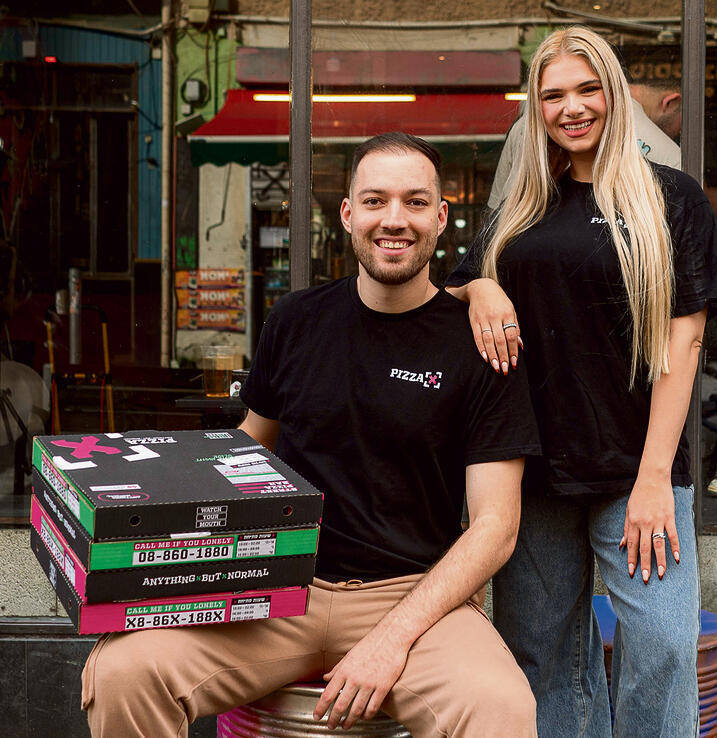
At its core, Pizza X is a story of entrepreneurship, passion and hunger. It is about the romance of food, a near-scientific obsession with dough and a couple in their 30s who built a multi-branch business from nothing.
“We live on pizza,” says co-founder Omer Simon, 30. “I eat 40 to 50 pizzas a month.”
Simon and his wife, Chelsea Dayan, 29, now parents of two, were living in Modiin when the COVID-19 pandemic upended their lives. Simon was a professional handball player in Israel’s top league, while Dayan worked as a makeup artist and social media influencer. Their lifestyle revolved around travel and digital marketing, with the couple having visited around 40 countries together.
“Half the year was handball and half digital marketing,” Simon recalls. “Then COVID came and changed everything.”
Like many pandemic stories, theirs began with a vacuum. The events industry collapsed, sports leagues were suspended and their income streams disappeared. What followed was an improvised solution that quickly turned into something more.
“At the time, everything was closed, and Modiin isn’t Tel Aviv,” Simon says. “There weren’t many options. We found ourselves hungry, so we started making pizzas at home. It was just a hobby.”
The operation began quietly. Customers would pick up pizzas from a bus stop about 50 meters from their apartment, without knowing where they were made.
Dayan remembers the turning point clearly.
“I was abroad with my father when everything shut down. All my work disappeared,” she says. “I called Omer, and he told me, ‘I can’t talk, I’m opening a pizzeria.’ I thought he’d lost it.”
Within days, the couple upgraded their setup. Dining tables became prep stations, ovens multiplied and their home turned into a full-scale production space.
The early days were far from smooth.
“At first, it was terrible,” Simon admits. “The sourdough was bad, and everything was a disaster. I was the cook, the phone operator and the delivery guy. My brother and I did deliveries ourselves. We worked like that from home for 10 months.”
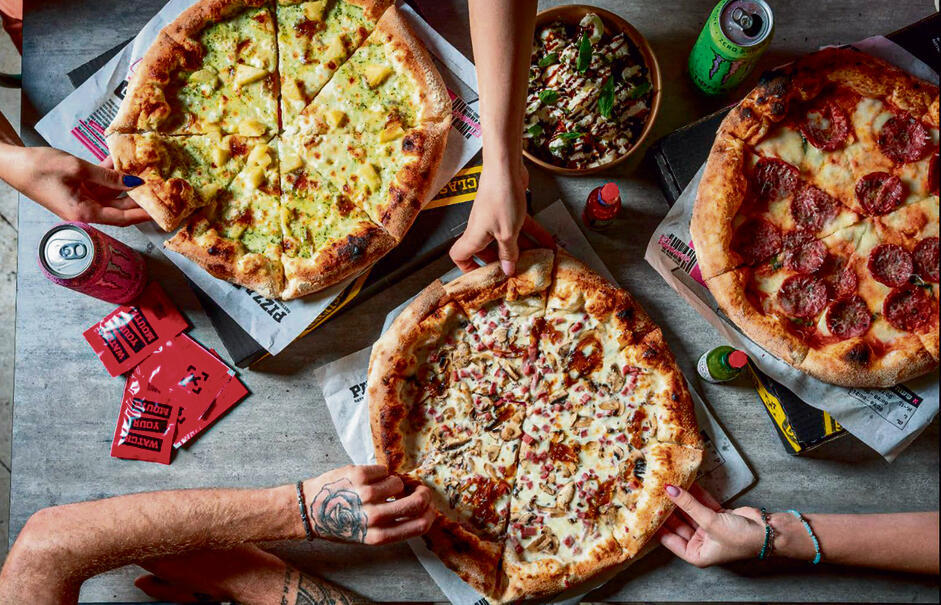
The concept evolved into a localized take on Neapolitan pizza, combining traditional dough techniques with bold, distinctly Israeli toppings.
“We took Neapolitan dough and added flavors Israelis love,” Simon says. “Onion jam, bacon jam, pepperoni jam, basil pesto, chili honey. Everything handmade.”
The first physical location opened in a neglected commercial center in Modiin that many warned them to avoid.
“People told me, ‘Don’t go near that place, it’s full of homeless people,’” Simon says. “There was no lighting. We came in, cleaned it up, added lights, and transformed it. Today it’s one of the strongest spots in the city.”
The initial investment was modest, about 120,000 shekels. But success came quickly, and expansion followed.
New branches opened in central Tel Aviv on Dizengoff Street, at Nahalat Binyamin and Rothschild, in central Rishon LeZion and most recently in Jerusalem’s Mahane Yehuda Market.
“I don’t like calling it a chain,” Simon says. “I prefer ‘group.’ Each location has its own character.”
Despite the growth, the philosophy remains simple: accessible food with high-quality ingredients.
“I want to go out and not feel it in my wallet,” Simon says. “We’re foodies. We eat out a lot. We offer value for money.”
One of their most popular concepts is an all-you-can-eat format offered on Sundays for 89 shekels, allowing customers to sample up to 15 pizzas.
“It’s not profitable,” Simon admits, “but it brings people in, and everyone enjoys it.”
Behind the scenes, however, the operation is tightly calculated.
“I’m obsessed with numbers,” he says. “Restaurants are demanding. If it’s not profitable, you bury yourself. We’ve built a precise formula.”
Simon recently stepped away from his handball career after the business expanded and his family grew.
“You can’t treat handball as a primary job in Israel,” he says. “At some point, I switched from ball to dough.”
The restaurants stay open late, something Simon sees as essential.
“I like sitting there at night and listening to customers,” he says. “Recently, I heard someone say, ‘I can’t believe at 2 a.m. I just had the best pizza of my life.’”
The concept is deliberately non-kosher, a decision Simon says was never in doubt.
“You can’t build this kind of dream and keep it kosher,” he says. “I made fast decisions based on passion.”
His long-term ambition is even bigger.
“My non-economic dream is to get a Michelin star for pizza,” he says. “The new place in Mahane Yehuda is one step before Michelin.”