

On Friday afternoons, Netivot’s temporary food market becomes a vibrant and delicious gathering place for Israel’s many communities. From the North African fare at Ami’s Burika to Ethiopian dishes served by Adeno’s Authentic, the atmosphere is cheerful and relaxed, with air conditioners and fans helping visitors cope with the heat as they wander, eat and return for more.
A long line stretches in front of Yawardee, the stall run by Nadav Alon. A couple from Ashkelon has come for the second time because of his irresistible spicy fish-patty sandwich. Beside them, residents of communities near the Gaza border and foodies from Givatayim and Kiryat Ono wait patiently after seeing Alon’s creations on TikTok and deciding they had to try them.
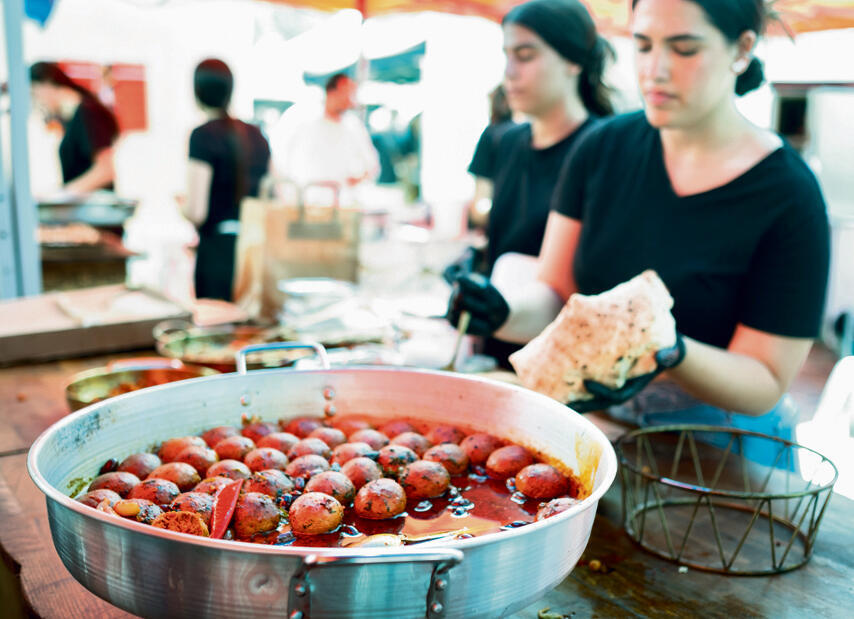
Also in line is Ayala Zrihan, sister of Asaf Day, the colorful finalist from the ninth season of MasterChef Israel. Zrihan came especially from Beersheba. “My son was here and said his mouth was watering, so I said mine should water too,” she jokes. “This market has everything. I’ve already bought stuffed grape leaves and cookies for Shabbat.”
Alon, 27, is effectively the pioneer of the market, which operates only on Fridays. “When I was discharged from the army, I bought a tabun oven and started making dough,” he recalls. “During the coronavirus period, I served meat dishes in the yard of my home. During the Three Weeks, when eating meat is prohibited, I began serving fish patties, and they became an incredible success. I learned the recipe from my mother, a young and beautiful woman of Moroccan descent who cooks like an 80-year-old grandmother.”
About four years ago, Alon decided to expand. In one corner of a large, completely empty parking lot in the city, he opened an IKEA umbrella, set up a small table and brought a tabun and pots filled with fish patties prepared by his mother. He served them inside Moroccan frena bread. The dish became a hit. Today, the entire family works in the business, which also serves Moroccan fish and fish roe.
“That’s the caviar of Moroccans. The best,” Alon says. “Why did I call the business Yawardee? Because that word describes our dish. You take a bite and say, ‘Yawardee, that’s delicious.’ It is also a tribute to the Israeli film Snooker.” Prices range from 55 to 58 shekels.
Following Alon’s success, more people and business owners gradually arrived after recognizing the site’s economic potential, says Adi Rozen, one of southern Israel’s leading culinary tour guides, who also runs a tour of the market.
“Suddenly, this became a packed temporary market attracting people from all over the country,” she says. “Most of the stall operators have completely different professions and occupations. For them, the stall is the realization of a dream.”
Exactly 70 years have passed since new immigrants from North Africa settled in the Azata transit camp as part of a government plan to disperse some of the newcomers and populate the Negev. The camp eventually became the city of Netivot.
Today, the southern city is establishing itself as a culinary stronghold, with the Friday market as its centerpiece. The venues are kosher, although most do not hold official certification.
Tunisian fritters in frena with matbucha
Across from Yawardee stands the stall operated by Shlomi Zigdon, whom Rozen describes as “the fourth generation of Tunisian kfitot.”
“His great-grandfather immigrated to Israel from Tunisia and worked as a laborer for the contractor who built Netivot’s old permanent market,” Rozen says. “When the contractor ran into financial trouble, he offered him a small shop in the market instead of money.”
Around 60 years ago, Zigdon and his wife, parents of 10 children, opened Falafel Zigdon in Netivot’s permanent market. Alongside falafel, they served kfitot, or fritters, as well as brik and fricassee sandwiches.
No one imagined that the small shop would become an institution. The business has since passed from generation to generation, and now the great-grandson, Shlomi, also operates at the temporary market.
As Rozen recounts the Zigdon family history, Shlomi takes a frena loaf and fills it with the kfitot, matbucha and mechouia, all handmade. “The patty recipe is already 60 years old,” he says. “They are vegan patties made from parsley, cilantro, potatoes, onions and semolina.”
Rozen says his is one of the market’s most sought-after stalls. “People travel long distances specifically for the kfita,” she says. One bite explains the line. The fritters are excellent and deeply addictive. A serving costs 50 shekels.
Towering mafrum and airy couscous
At a long table beside the Gveret Tripoli stall sit members of Kibbutz Lohamei Hagetaot in northern Israel, who came south to volunteer and help evacuees from the Gaza border communities return home.
Saar Twito piles the table with an array of Tripolitan delicacies: towering mafrum, airy couscous, bastil, vegetable patties and, for dessert, comforting sfenj. Behind the Gveret Tripoli business, operated by the Twito family from Moshav Yoshivia north of Netivot, is an emotional story reflecting the pain and trauma experienced by many Israelis in recent years.
“After October 7, we did not see one another for 150 days,” says Saar, who studied cooking in Tel Aviv. “My younger brother Noam served in the reserves in Jenin and Hebron, and I fought in Gaza. Today we have reached a combined 600 days of reserve duty. To cope, we received psychological treatment.”
Then their mother, Orna, a certified payroll accountant, and their father, Yaron, proposed another idea. “Our dear mother and father said, ‘Instead of going to psychological treatment, let’s publish a cookbook containing the recipes of our late grandmother Marlene and open a place where we can serve her food,’” Saar says.
Two years ago, the family opened Gveret Tripoli. “The stall makes the family see and meet one another more often,” he says.
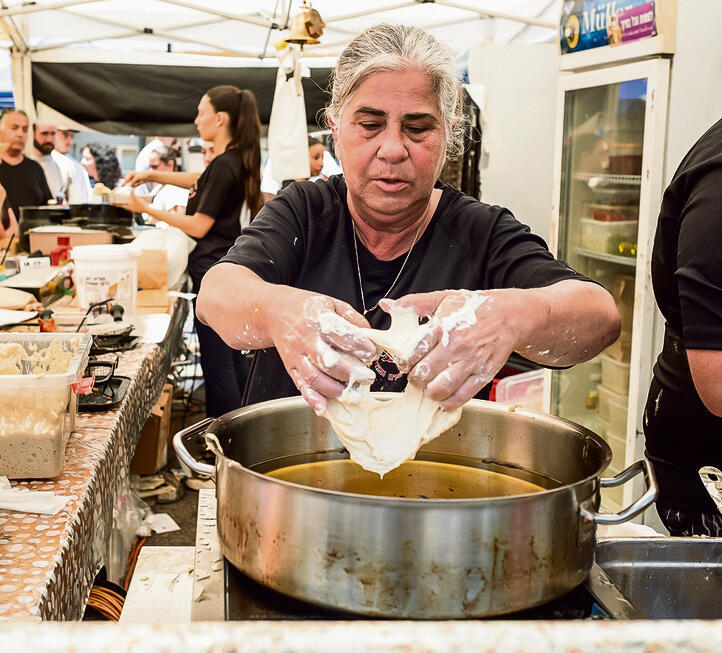
Gveret Tripoli sfenj
(Photo: Assi Haim)
Prices are intentionally accessible, ranging from 5 to 55 shekels. “Pregnant women receive sfenj for free,” Saar says. “At the height of the summer heat, we give away juice. We also have a message: The main thing is that we should always smile and remain united as a people, and that our soldiers return safely, in body and mind.”
Exceptional kebab and piroshki
“You have to eat our Bukhari kebab. It’s exceptional,” urges Sigalit Zavulunov, known as Sigi, as she tends to male and female reservists from the Combat Engineering Corps who have come to enjoy her Bukhari dishes. “One of us was here recently and said we all had to come,” the reservists explain.
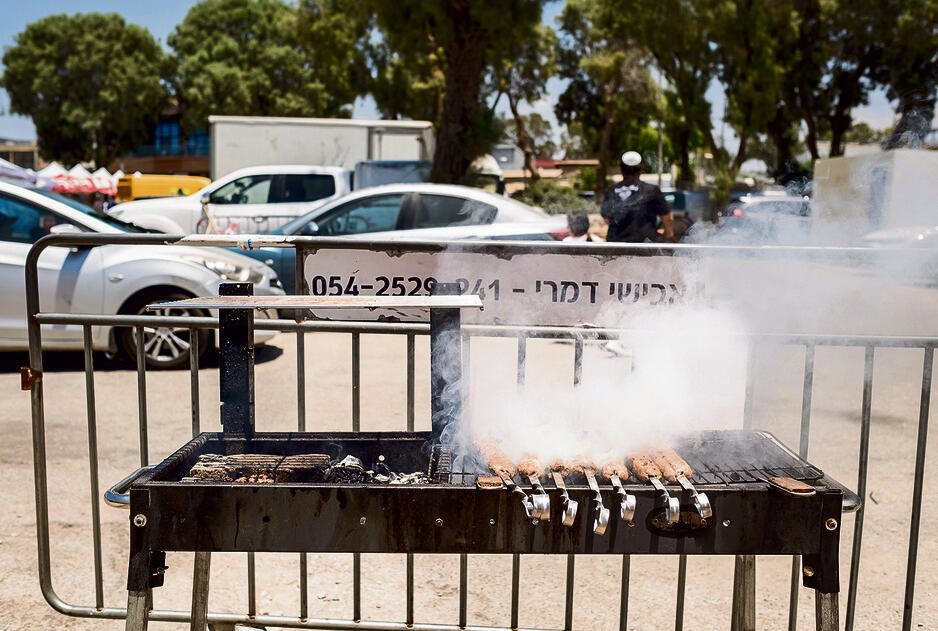
Bukhari kebab
(Photo: Assi Haim)
“That soldier brought the entire battalion,” Zavulunov says, barely concealing her satisfaction. “People come to us even from Haifa and Eilat. I work from the soul. People tell me, ‘I’ve eaten at the very best Bukhari restaurants in Tel Aviv, but your food is something special.’”
As with Gveret Tripoli, October 7 also hangs over this business. Zavulunov had been a deputy head nurse at a hospital. “Then, on October 7 at 11 a.m., our new home in Netivot was hit directly,” she says. “I told my husband, ‘I am not going back to that apartment unless you change it.’ So, in place of my daughters’ bedroom, which was hit by the rocket, I built a huge kitchen. I went to study cooking for my soul. Because of the kitchen and the rocket, I now cook.”
Her menu includes skewers, rice dishes such as oshpelo and bakhsh, and filled pastries including piroshki and manti. “The manti is the biggest hit,” she says.
A diner at a nearby table immediately informs me that “the samsa here is the best in the country.” The recommended choice is a tasting platter for two, priced at 160 shekels. Visitors would also be wise to stock up for Shabbat.
Stuffed spleen with chimichurri
A large photograph of the Baba Sali, the revered Jewish mystic buried in Netivot, decorates Eliyahu Amos’ station. “He is my rabbi,” Amos explains. “Wherever I go, I take him with me.”
Amos specializes in Moroccan-style stuffed spleen. “I prepare it according to a recipe passed down to me by my late father, Shimon,” he says.
Although I had already eaten more than enough by the time I reached his stall, I insisted on trying the stuffed spleen, priced at 60 shekels per serving. The insistence paid off. The dish prompted loud exclamations of amazement.
What is the secret? “Chicken spleens, beef fat, turkey liver, spices and herbs,” Amos says. “I serve it inside frena with lettuce and various sauces, including chimichurri and garlic confit.” The flavorful, spicy merguez sausages are also not to be missed.
A memorial project served on tap
At the center of the Tomer’s Beers cart stands a large black machine gun fitted with beer taps. “Instead of firing bullets, it fires beer,” says Ezra Nagar, pouring drinks for market visitors while recounting the heroism of his son, the late Sgt. Tomer Nagar.
Tomer, a soldier in the Golani Brigade’s 51st Battalion and a devoted fan of Beitar Jerusalem and FC Barcelona, was killed at the age of 21. “Tomer was a principled young man and a volunteer who left a mark everywhere he went,” his father says. “He focused on being meaningful and becoming a better person through endless giving and a love of the country and its people.”
It is difficult to hold back tears as Nagar recounts Tomer’s final battle and describes the person he was. “On October 7, Tomer went up to the bunker position, located 150 meters from the Kissufim outpost,” he says. “At 6:40 a.m., terrorists arrived, and Tomer began fighting them alone for 42 minutes, preventing them from entering the outpost and Kibbutz Kissufim.”
While he fought, the other soldiers at the outpost, who had been inside a shelter and were not yet dressed for combat, ran to their rooms, put on their equipment and went to defend the kibbutz. “Tomer fired 675 bullets,” his father says. “It is completely unimaginable.”
Working at the beer cart are Koren and Nitzan, two surveillance soldiers who were at the outpost that fateful day. “Tomer delayed the terrorists, allowing us to reach the operations room,” they say. “Because of him, we remained alive.”
To commemorate Tomer, his parents, Ezra and Hanna, his sisters and his friends created a social beer initiative called Tomer’s Beer. “Tomer loved beer,” his father says. “He used to say, ‘Every day is a good day for a beer.’ He wanted to brew beer but never had the chance.”
The family now produces five types of craft beer using special recipes. Gift packages are also available, some containing a bottle opener and a snack. The Nagar family operates stands across Israel, and all profits are donated to children with special needs. “With the profits, we built an innovation center in Petah Tikva that includes a driving simulator,” Nagar says. To reach the market, enter Ohel Shem Synagogue in Waze.
Food, stories and people
Adi Rozen, a resident of Netiv HaAsara near the Gaza border, founded the Culinary Story company eight years ago. It specializes in food tours across southern Israel.
She created the business out of a love for people, food and the local stories of the south, believing that the best way to fall in love with the Gaza border region and southern Israel is through the people who live and create there.
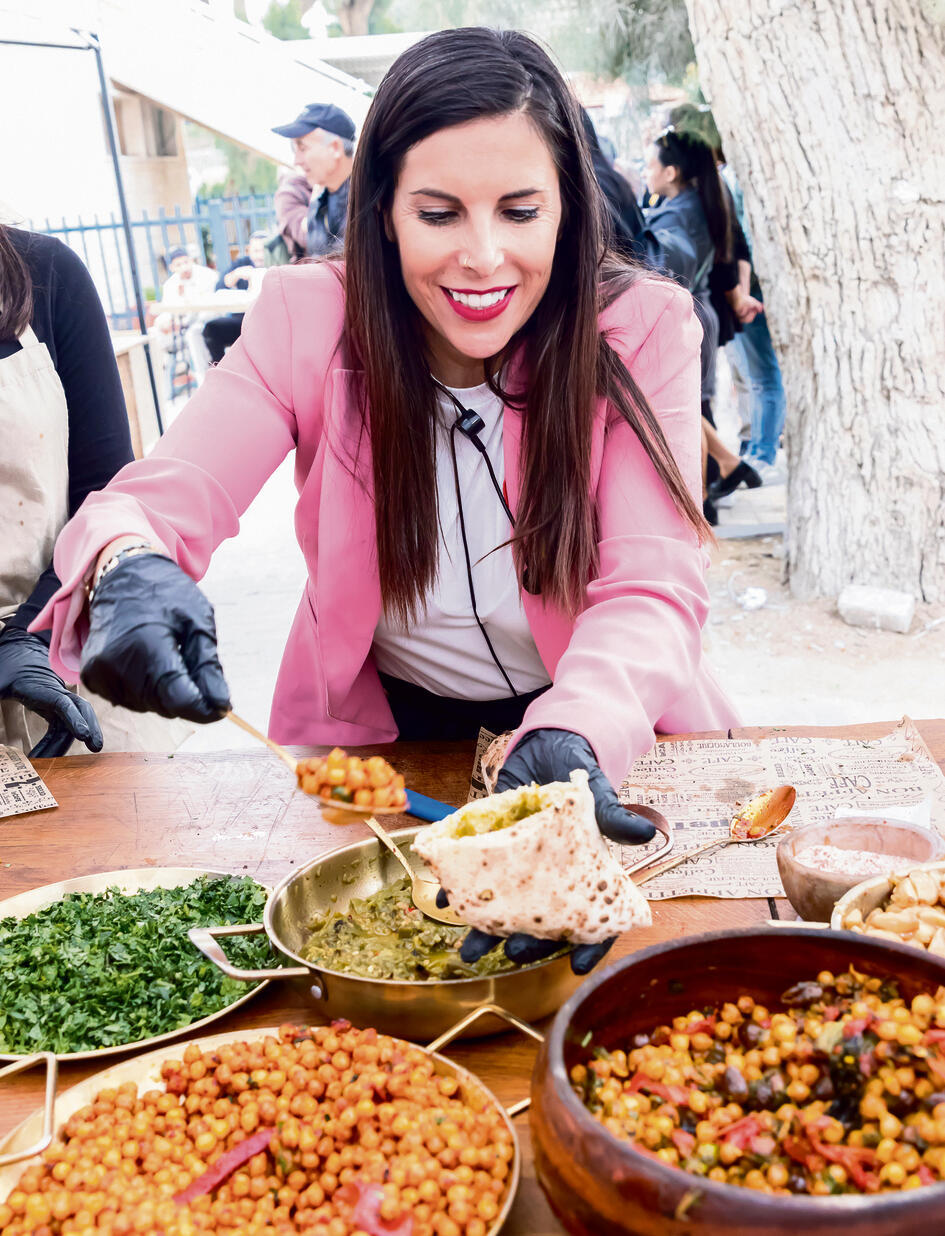
Adi Rozen
(Photo: TOMER BNC )
Today, Culinary Story operates tours in Sderot, Ashkelon, Netivot, Ashdod, Gedera and Mitzpe Ramon. In Netivot, it offers one tour through the city and another at the Friday market. The tasting tours are kosher and take visitors to leading local businesses, where they eat while hearing stories about the region’s people, history and culture.