

It begins almost like surgery. On the table lie some of the most expensive and extravagant fish currently available in Israel: a massive tuna that looks as if it came out of a movie, an unusually large red snapper, a local trout and a strange-looking turbot that seems more like a creature from the ocean floor than something meant to be served on a plate.
The setting is the kitchen of chef Adi Ashkenazi at "&Moshik", Moshik Roth’s Tel Aviv restaurant, where rare fish are handled with the precision of an operating room, cut with Japanese techniques and ultimately served to diners prepared to pay, and pay a lot, for an exceptional culinary experience.
“Not everyone who comes here enjoys it,” Ashkenazi admits. “We aim for something very high and very precise. This is not a place that tries to flatter everyone or compromise, and we have a very specific audience.”
Behind each fish, he says, is an almost obsessive pursuit of rare raw ingredients. “There are fishermen who suddenly call me and say, ‘Adi, I have a fish you must take!’ and that happened today too,” he says, pointing proudly at the enormous tuna before opening a professional case filled with razor-sharp Japanese knives of every kind.
An apex predator
The first fish on the table is a 50-kilogram (about 110 pounds) Israeli bluefin tuna. Ashkenazi pulls out a long knife and begins breaking it down in slow, precise movements. It looks less like preparation for cooking and more like the work of a surgeon.
“You don’t fillet fish this size like a regular fish,” he explains. “We disconnect certain parts so they can fit in the refrigerator. Right now we’re working on the kami, the upper front part of the back.” The cut is considered especially prized among fans of high-end sushi.
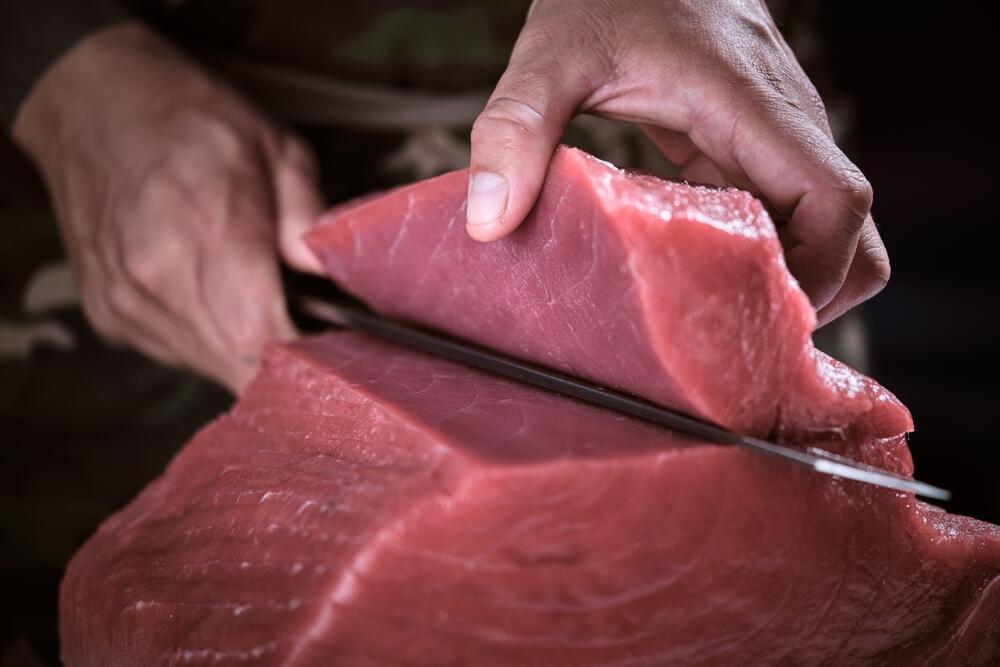
In Japan, Ashkenazi says, truly large fish weighing 300 to 400 kilograms (about 660 to 880 pounds) are broken down with an actual sword. He pushes the thin blade deep into the fish and cuts in a clean, straight line down to the spine.
“Our tuna hadn’t even reached its final size,” he says. “If it hadn’t been taken out of the water, it could have reached 300 kilograms. Once tuna get to those weights, you can’t stop them in the sea. They’re already apex predators.”
So, how much does the gastronomic pleasure of fresh Israeli tuna from the Mediterranean cost? “This tuna costs about 200 shekels (about $70) per kilogram,” Ashkenazi says with a sigh. “In the end, we’re talking about around 10,000 shekels for the fish.”
But the price, he says, is only part of the story. “The problem with fish this large is not just how much they cost, but how you store them. A person at home doesn’t know what to do with a fish like this.”
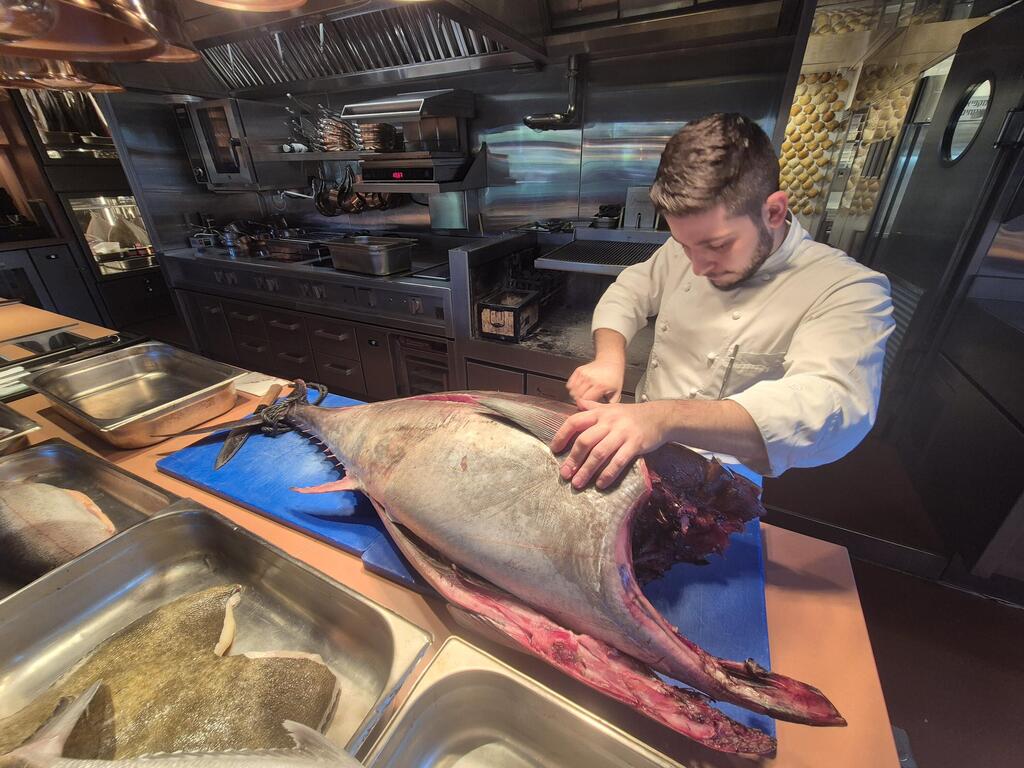
Chef Adi Ashkenazi at work
(Photo: Assaf Kamar)
In the world of luxury fish for the top 1%, it turns out, even that eye-watering price is not considered extreme. “A year ago, an 800-kilogram tuna was sold in Japan for millions,” he says with a laugh. “The bigger the fish gets, the fattier and more expensive it becomes.”
Then comes the moment that is hard to forget. Ashkenazi scrapes a little red flesh from the bones with a spoon, drips a few drops of three-year-aged Japanese soy sauce over it, and serves a radical tasting straight from the fish skeleton.
“All over the world, the meat closest to the bone is considered the tastiest,” he explains. “In Japan, some restaurants serve the skeleton itself and let diners scrape off the meat on their own.”
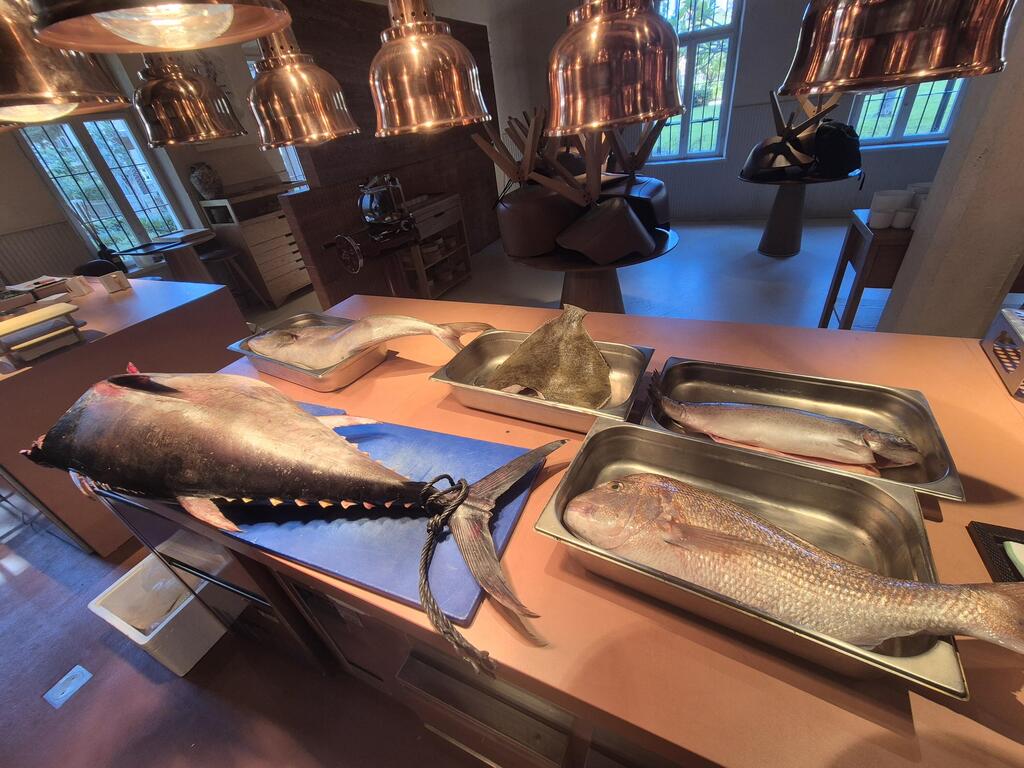
Work area
(Photo: Assaf Kamar)
The fresh Israeli tuna is bright red and almost melts in the mouth like butter, with a deep, sea-like flavor. Suddenly, it becomes easier to understand why people fly to Japan and pay stacks of money for an experience like this.
Japanese peeling
After the noble tuna comes the red snapper, an indulgent and unusually large fish rarely seen in Israel. It weighs 5 kilograms (about 11 pounds) and costs 540 shekels (about $190).
Here, Ashkenazi turns to a traditional Japanese skinning technique called sukibiki. Instead of scraping off scales one by one, as is often done with local fish, he separates an entire layer of skin and scales in one long, astonishingly precise motion. “It’s a technique I encountered in Japan,” he says. “It’s much cleaner and much more precise.”
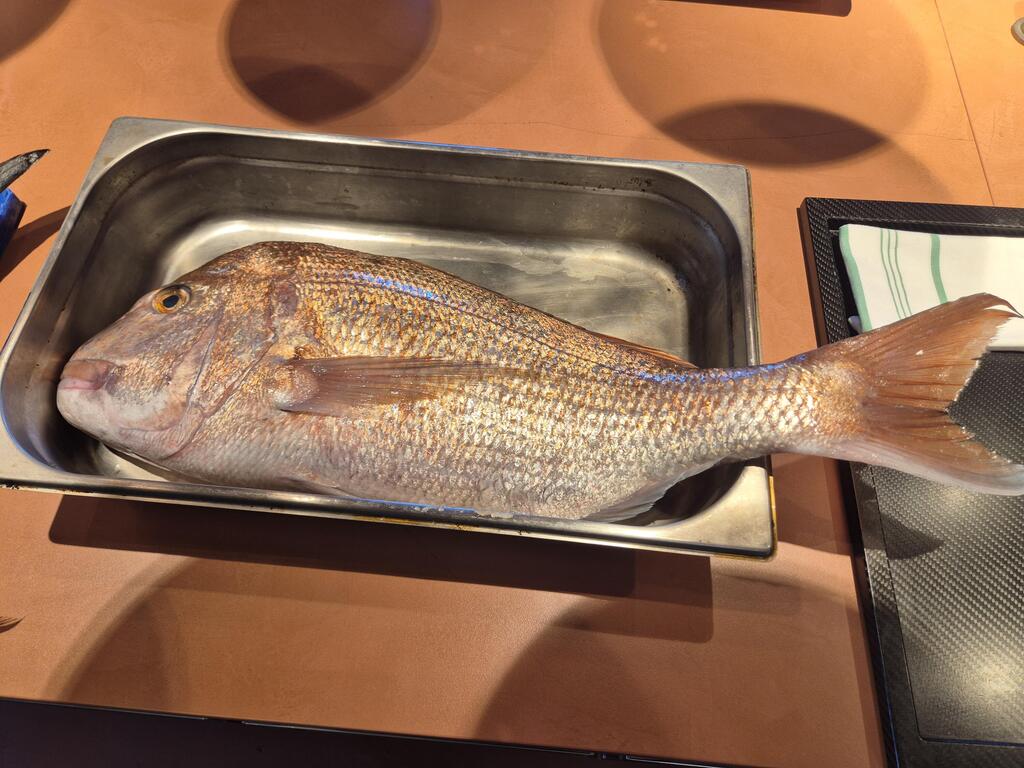
A huge red snapper
(Photo: Assaf Kamar)
The filleting looks almost impossible. A particularly thin blade slips between the skin and the scales without damaging the flesh, while the chef cuts gently, slowly and with intense concentration. After the skin is removed, the fish undergoes a thorough cleaning of its internal organs.
“We clean it completely and then move it to aging in a dedicated refrigerator,” Ashkenazi explains. “Aging completely changes the flavor and texture of the fish.”
Israeli, with a little salt
After the heavy sea monsters, a trout from the Dan River, also known by its scientific name, rainbow trout (Oncorhynchus mykiss), sounds almost modest until you see its enormous size. “There are even bigger ones,” Ashkenazi says with a smile. “In the United States, you see trout three times this size.”
The local star weighs 3 kilograms and costs 330 shekels. Ashkenazi fillets it with especially delicate movements, barely damaging the flesh. Then comes a long, painstaking stage of removing the bones one by one with tweezers. “Some people pull out the bones and damage the flesh,” he says with a sigh. “But with fish, you have to know how to work gently.”

Rainbow trout
(Photo: anmbph / shutterstock)
For Ashkenazi, the trout itself is a winning fish. “Everyone thinks tuna is the peak, but if you ask me which fish I would eat every day, it’s trout,” he says with a laugh. “It’s fatty, juicy and works with so many things. I like to make it on the grill, with a little salt and that’s it.” The secret, he says, is precisely its simplicity. “It’s a fish that doesn’t need to hide behind sauces.”
The Rolls-Royce with gills
Then comes the turbot, imported personally from Europe. It looks like a diving accident, or some evolutionary mistake: completely flat, with a bizarre body structure and strange eyes that migrate to the other side of its head as it matures. “It starts life like a regular fish,” Ashkenazi explains, “and then at some point it simply flips over and lives sideways on the seabed.”
The price matches the oddity: 290 shekels per kilogram (about $45 per pound). I find myself short of breath; the strange fish on the table weighs about five kilograms (11 pounds) and costs roughly 1,500 shekels ($515).

Turbot
(Photo: Corina Daniela Obertas / shutterstock)
“This is a fish served in three-Michelin-star restaurants,” Ashkenazi says. “And it's not forgiving at all; one small mistake in the cooking level and I’ve ruined a 1,500-shekel fish,” he adds with a laugh.
That evening, he plans to sear it in butter using the basting method, repeatedly spooning hot butter over the fish to control the cooking level with precision. “Turbot is the Rolls-Royce with gills,” Ashkenazi says. “It’s a fish that needs delicate treatment and a great deal of respect.”
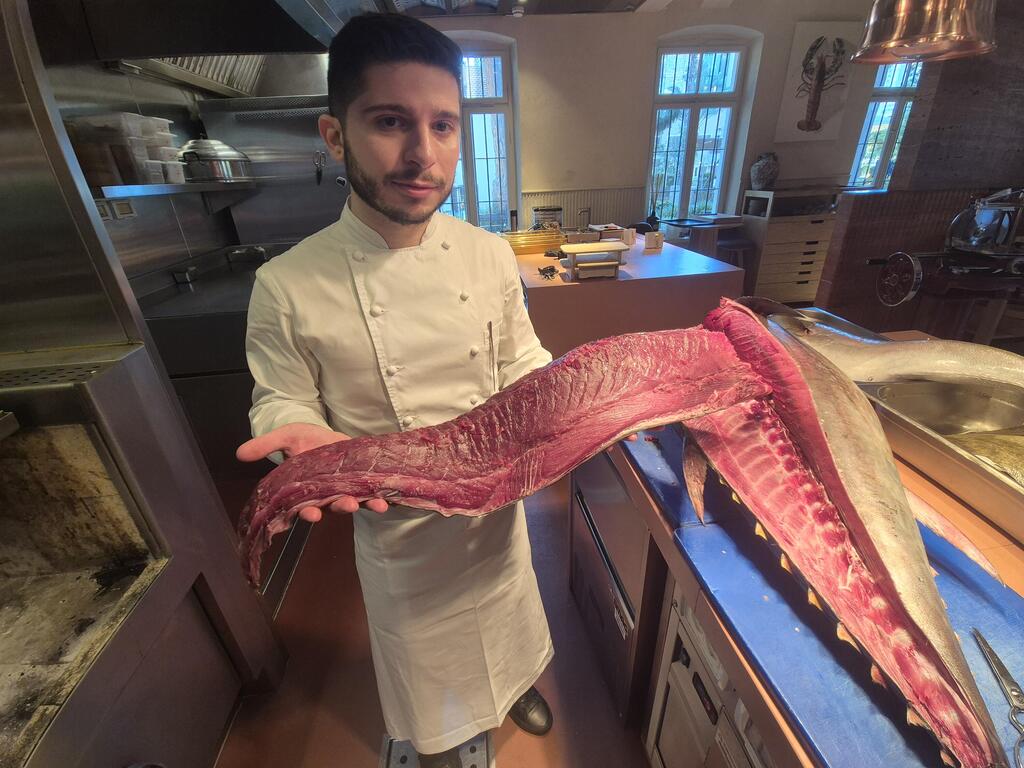
Chef Adi Ashkenazi with the tuna
(Photo: Assaf Kamar)
Its strange physical structure makes cleaning it especially complicated and even requires scissors. Ashkenazi begins by carefully dividing the fish into two parts, back and belly, before working cautiously between the bones to separate the fillet without tearing the white flesh.
Unlike regular fish, which are filleted along the spine, the work here is done almost across the body of the fish. “If you apply too much pressure, you lose very expensive meat,” he says as he works.
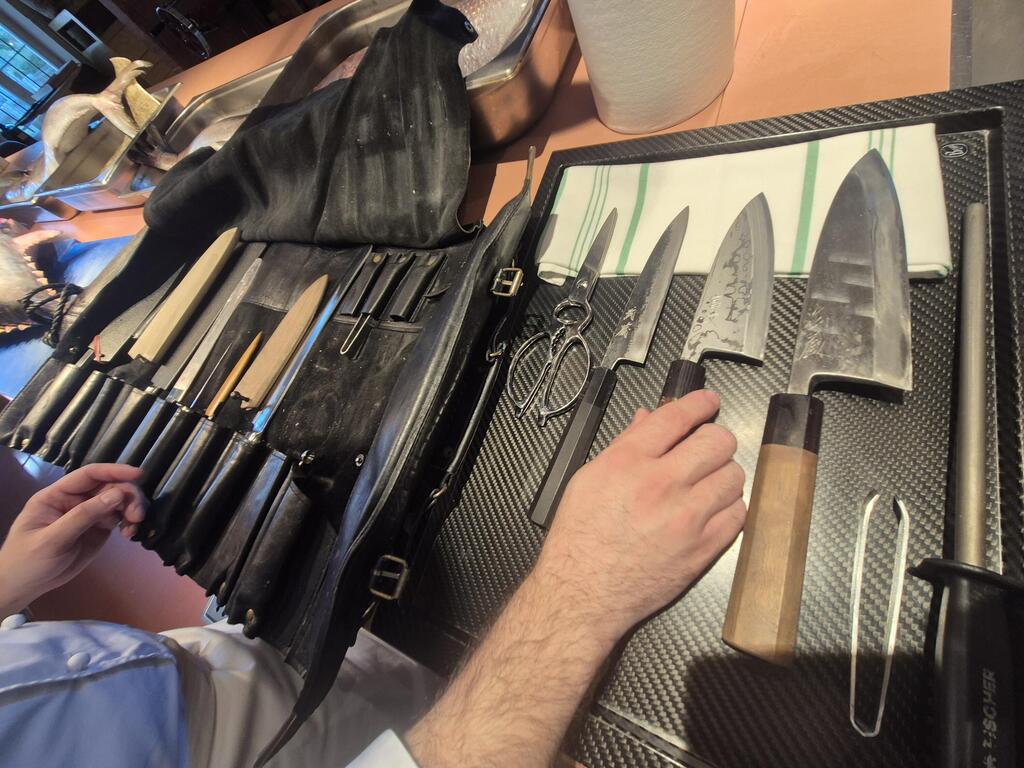
Tool kit
(Photo: Assaf Kamar)
All the techniques we saw that day come from the world of fine dining. “These are things I learned in Michelin restaurants I worked in around the world,” he says proudly.
As the day goes on, it becomes clear that this is not just about food, but a glimpse into a hedonistic world obsessed with perfection: sharp knives, rare fish, Japanese techniques, textures and flavors people fly halfway around the world to experience, and which some suddenly find in Sarona Park, in the middle of Tel Aviv.
Ashkenazi says the high prices of luxury fish draw plenty of reactions. “If you go into the comments, they’ll say the price is excessive,” he says with a smile. “But most of the people writing that have never even tasted it.”