

A decade ago, when model and aspiring lawyer Fanta Prada opened the Ethiopian restaurant Balinjera in Tel Aviv’s Yemenite Quarter (4 Malan Street), eyebrows were raised.
“For years I was focused on personal success,” Fanta says. “Then I felt the need to take on something more meaningful."
Her decision puzzled many, including her parents. “They asked how I could give up a job with a title, a suit, and a degree, things that define success. But I opened the restaurant to introduce Israelis and tourists not just to Ethiopian food, but to a beautiful culture that’s fading away.
"At events I host, I talk about communal eating and preserving cultural traditions. I want to promote tolerance and patience to help break down stereotypes.”
Inspired by her story, we set out to explore several restaurants led by women who immigrated from Ethiopia.
Balinjera, Tel Aviv: Just like mom taught me
For Fanta, Balinjera was more than a business; it was a mission rooted in personal growth. “I made aliya at the age of eight through Operation Moses (covert evacuation of Ethiopian Jews),” she says. “As a child of new immigrants, I wasn’t connected to who I was. I just wanted to be Israeli like everyone else. Over time, I got wiser. I asked my mother questions and reconnected with my roots."
With support from her husband Eran and their children, Fanta is determined to shatter misconceptions about Ethiopian cuisine. “Ethiopian food is very healthy and gluten-free. The biggest myth is that it’s all sour. That’s because people taste the Injera, a sour fermented flatbread, traditionally made with teff flour, without any additional dish. I never let customers eat injera without the stews. It’s a disservice to our incredible cuisine.”
“When people hear I own a restaurant, they say, ‘Wow, I’ve always wanted to try Ethiopian food, but it’s all spicy. Others say, ‘Your food is so poor.’
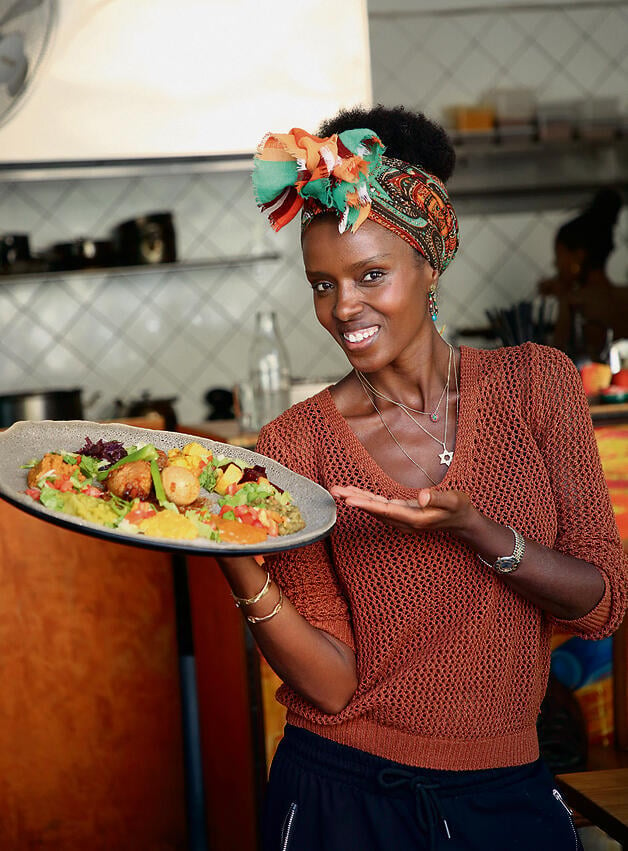
"I see it as rich, sugar-free, no processed ingredients, no oil. It nourishes the body, as it includes legumes, root vegetables, meats. People today are more health-conscious, and our cuisine meets many of their needs. Our most popular dish is the vegan platter for two; non-vegans love it, too. The dishes are colorful and beautifully plated."
Fanta shares cheerful videos on social media, praising Ethiopian food and performing traditional dances. She admits the menu has been adapted slightly for Israeli palates.
“In my mother’s kitchen, everything was fiery hot until you sweat. I love spicy food, but I realized I had to strike a balance to appeal to more people,” she says.
“Still, some dishes are made exactly the way my mother taught me. Ethiopian cuisine doesn’t have appetizers, but I serve some, like eggplant and Ethiopian-style tahini. I also offer specials like pumpkin with meat or beef with mushrooms. In winter, I serve beef or lentil soup."
While Ethiopia’s restaurant industry is traditionally male-dominated, many Ethiopian eateries in Israel are led by women.
“In Israel, women are more daring and knowledgeable,” Fanta says. “Sometimes suppliers walk in and ask, ‘Who’s the owner?’ I used to get angry when they didn’t believe this petite woman could be in charge. Now I just smile. Customers sometimes ask, ‘Can we speak to the owner?’ When I say, ‘What would you like to say?’ and they reply, ‘The food was amazing,’ I tell them, ‘I’m glad you think so, I’m the owner.’"
“Questions like that only motivate me to keep debunking stereotypes. Today, more and more Ethiopian-Israeli women in the restaurant scene are gaining recognition and respect."
Balinjera, 4 Malan St., Yemenite Quarter, Tel Aviv
Elilta’s Mesob, Ashkelon: Healthy and spicy
A year ago, Elilta Ababa, remarried and mother of three daughters, decided it was finally time to fulfill a long-held dream and open a restaurant. She did it all on her own, fully self-funded.
“I always told my mother I wanted to open a restaurant, partly because I love hosting,” she says. “I worked in hospitals, but I realized that if you don’t pursue your dream, you’re not really living."
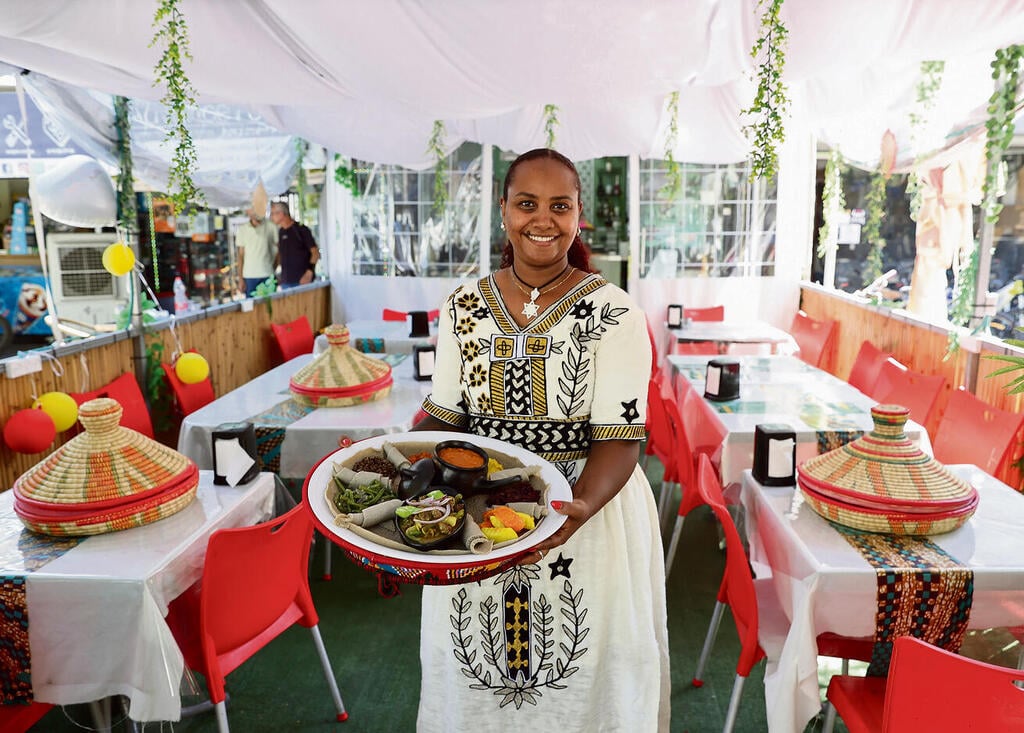
She named her modest, spotless eatery “Elilta’s Mesob,” after the traditional handwoven basket, the mesob, used to serve food. The restaurant features colorful mesobs on every table, each one carrying her exceptional dishes.
(Photo: Gadi Kabalo)
“As a child, I was always in the kitchen with my mom and grandmother. I cook from their recipes,” says Elilta, who immigrated to Israel at 17 from Asmara, the capital of Eritrea, which was still under Ethiopian control at the time.
For Elilta, opening the restaurant was a way to share both Ethiopian food, “which is very healthy and naturally gluten-free”, and her culture. “Come, get to know me. I speak through food. I’m putting myself out there, my daughters, my life stories, my memories."
She sees herself as a role model for her daughters. “They tell me, ‘Mom, we’re so proud of you. You’re so brave.’ I want to show them what it means to be a woman: you’re not allowed to fall. You just keep going, no matter what we’ve been through or who or what we’ve lost. You have to get up and fight. Without a fight, there’s no success."
On Tuesdays, Elilta prepares special dishes: Zilzil (grilled strips of beef), Frittata (seasoned scrambled eggs with vegetables), Minchet Abish (spiced ground beef stew), and Kita Firfir (Ethiopian version of pancake).
The dominant color in the restaurant is green. “Green symbolizes growth, blooming, something beautiful,” she says.
Elilta also hosts a 'buna' ceremony, a traditional Ethiopian coffee ritual. “It represents hospitality and quality time with family and friends, three times a day, even without guests. It’s a ritual that brings people together."
Elilta’s Mesob, 33 Herzl St., Ashkelon
Gojo, Rehovot: Gluten-free with a kick
During the war with Iran, a missile struck near Gojo, causing serious damage. “It landed about 150 meters from us,” recalls owner Bosena Beyna. “The restaurant’s windows shattered, and our event space was damaged too. We repaired everything quickly, thank God, and we’re back to business."
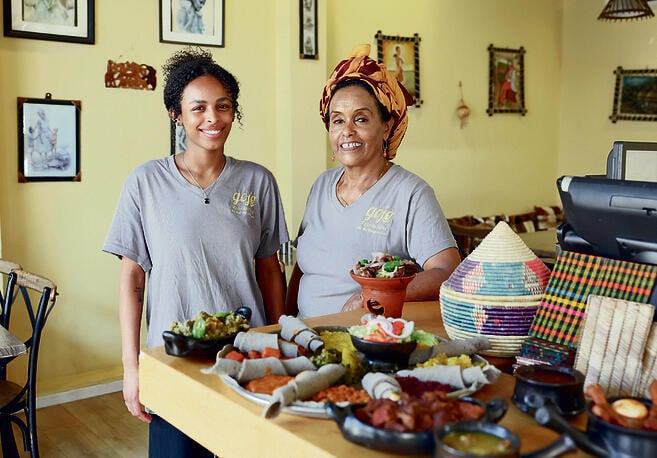
Gojo (“home” in Amharic) offers flavorful, diverse Ethiopian cuisine served in beautifully designed spaces and a charming courtyard. Bosena and her daughter, Eden Fanta, host with warmth and flair, presenting their dishes in vibrant traditional servingware.
(Photo: Dana kopel)
Bosena was born near Gondar. “My parents were smart and worked in agriculture - beekeeping, crops, and dairy,” she says. She studied in Addis Ababa, married, and immigrated to Israel in the early 1990s, settling in Kiryat Gat.
“My parents always told us, ‘Work hard, don’t be lazy, and you’ll earn a living.’ So I worked at the Polgat textile factory for 17 years. After it closed, I found other jobs and cared for my father,” she says.
Ten years ago, Bosena opened Gojo. “As a child, I loved being with my mother while she cooked. I helped her chop and clean, and I learned how to cook. After mourning my father, I decided to pursue my dream of opening the restaurant, not just for the Ethiopian community, but for everyone. I told myself, ‘If it works, great. If not, at least I tried.’ Thank God, it worked. The kitchen is my kingdom.”
Among the most popular dishes: stir-fried entrecôte beef, chard with meat, and goulash.
The restaurant is entirely gluten- and lactose-free. “Lots of vegans and vegetarians come here,” says Eden, the youngest daughter. “I take orders, help in the kitchen. My mom is my role model; I watch her and learn. My siblings and father also help out. We do deliveries, and we have regular orders from city hall and the local police."
The menu changes daily, with dishes like azifa (black lentil stew), gomen (chard with potatoes), sukar dinich (sweet potato and pumpkin stew), and key sir (red beet stew).
And the spice level? “I lived in Addis Ababa for a few years, and the food there isn’t all that spicy,” Bosena says. “I adjust according to taste, less hot when needed, more when it’s called for."
Lunchtime specials for two are priced at 90 and 135 shekels.
Gojo, 32 Yisrael Teller St., Rehovot
Beyaynetu, Petah Tikva: A favorite of Israeli journalist Brahano Tagania
When Israeli crime reporter Brahano Tagania craves Ethiopian food, he heads to Beyaynetu in Petah Tikva. “Once a week, he picks up food for the whole week,” says restaurant owner Ilana Askias with pride. “Brahano eats everything, and every time he asks for extra injera.’ My injera isn’t sour. I tone down the sourness so everyone can enjoy it."
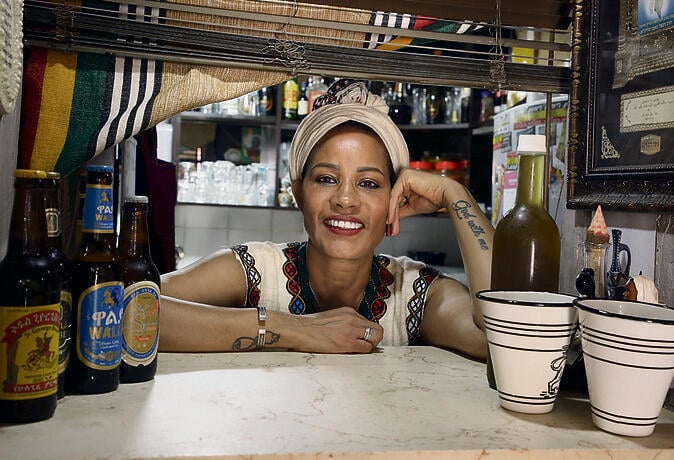
Ilana immigrated to Israel from Addis Ababa at age 9. One of ten siblings, she’s the middle child. Her father is a well-known importer of teff flour to Israel. Seventeen years ago, Ilana opened Beyaynetu (named after the signature vegetarian platter on the menu) making it one of the oldest Ethiopian restaurants in the country.
(Photo: Ryan Frois)
“Before I opened the restaurant, I traveled to Ethiopia to study the cuisine,” she says. “At first, the restaurant was vegan, but people kept asking why there was no meat, so I added meat dishes. Twice a year, I fly to Ethiopia to bring spices."
From her modest kitchen, Ilana prepares dishes like tibs (fried meat), kai siga wat (beef cubes in spicy red pepper sauce), shiro (ground roasted chickpeas), and of course beyaynetu, a platter of five different vegetable stews.
With a playful spirit, she lightly pokes fun at some of her peers, for becoming too Ashkenazi, lowering the spice level,” she jokes.
Still, her dishes, though spicy, are approachable, attracting diners from all backgrounds.
The cozy space is filled with Ethiopian art and furniture, including carved wooden chairs bearing images of historical Ethiopian figures. Upstairs is a treasure trove of cultural artifacts, and the restaurant even rents out traditional Ethiopian attire for weddings.
Bayaynetu, 8 Bar Kochva St., Petah Tikva
Melkam Migib, Netanya: Authentic and irresistible
On the second floor of a rundown building in downtown Netanya you’ll find a hidden gem worth discovering: Melkam Migib, which means “bon appétit” in Amharic.
The restaurant is run by Tamar Mamo, who was born near Gondar and came to Israel at age 9 through Operation Moses. She arrived with her uncles, without her parents. “It was hard adjusting,” she recalls. “Being moved from one place to another made it even harder."
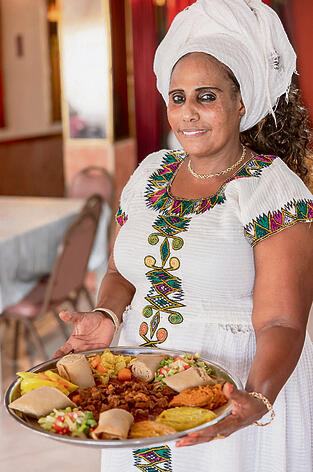
Eventually, Tamar settled in. She married and had five children, working over the years in nursing homes and as a guide for new immigrants through the Jewish Agency. In 2019, she realized a long-held dream and opened a restaurant, first on HaNotea Street and later moving to a larger space due to its growing popularity.
(Photo: Eli Dasa)
“After working so many jobs, I realized food was where my heart was. I decided to go for it,” she says. “Now people come from all backgrounds, American and French tourists, food tours. At night, there’s live music. It’s really lively here."
Her daughter Moran, who helps run the place, adds, “Some people wander in out of curiosity, try Ethiopian food for the first time, and now they’re regulars. It’s amazing to see. When someone comes back, you know you’re doing something right."
Like other women featured in this story, Moran is eager to defy stereotypes about Ethiopian food. “There’s much more variety than people think. And yes, there’s fish, too. We serve a spicy red fish stew, for example. My mom is a master of spices. Her cooking is totally authentic, no additives. We don’t tailor the food to Israeli tastes. Some dishes aren’t spicy at all and are seasoned mainly with cardamom and turmeric."
Melkam Migib offers unique dishes not found elsewhere, including organ meats. But the vegetarian and vegan platters are the top sellers, along with doro wat (chicken stew with hard-boiled eggs), slow-cooked beef stew, and tibs (stir-fried beef with peppers), which Moran notes is especially popular: “Some customers even put it in a pita."
Don’t miss the firfir, which is served in other restaurants, and a dish I became addicted to while researching this piece, which features pieces of injera and beef in a rich, reddish sauce.
Melkam Migib, 2 Smilansky St., Netanya