

In a makeshift shelter overlooking a freshly plowed field, four men are sitting together: Adnan Abu Jabal, Adham Khatib, Bilal Taha and Abu Mohammed, better known to us as Hussam Abbas, the legendary chef of El Babor, whom we have known for 30 years.
The village of Kafr Kanna stretches out before us, surrounded by the last crops of summer.
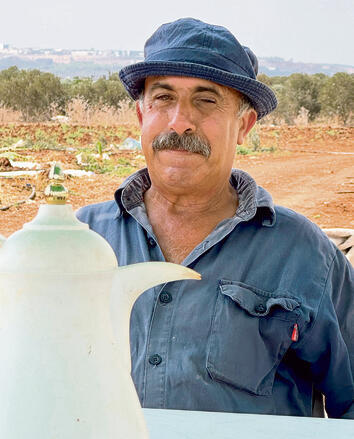
A chef and three men who work the land, their faces marked by decades of sun, harvesting and planting in the Israeli heat. On the folding table sits a traditional Arabic coffee pot, its long, pointed spout ready to pour coffee that is hot and absolutely perfect.
Then we head into the fields.
Green gourds, the final round of summer tomatoes, hot peppers, small sweet eggplants, haroush, a traditional local variety somewhere between a melon and a cucumber, and cucumbers so crisp and sweet that after the first bite, we find ourselves slightly annoyed at every cucumber we have ever eaten before.
We didn't bring bags, so we wander between the furrows, gathering the produce in our shirts.
Abu Jabal, who comes from the nearby village of Tur'an, farms land around Kafr Kanna. A walk through his fields offers a lesson in traditional agriculture, and in the kind of knowledge that cannot be learned overnight.
The local baladi crops, traditional varieties cultivated in the region, carry generations of agricultural experience. Season after season, farmers selected the strongest plants, saved their seeds and planted them again the following year.
It was slow, systematic improvement without a laboratory coat in sight. You needed to know which plant to watch, then return the following year to discover whether your judgment had been correct.
Abu Jabal explains that the seeds he preserves are adapted to the conditions here: the soil, the water and the heat.
Elsewhere in the world, they call this terroir and add it to the price. Here, they call it a cucumber and offer us a taste.
Not everything has remained exactly as it was. Traditional rain-fed agriculture relies on rainfall and the moisture retained in the soil, but these fields now also have irrigation pipes and protective ground coverings. We wouldn't be shocked to discover fertilizers or, when necessary, pesticides.
Tradition knows when to accept a little help.
Still, the distance between this plot and industrial farming is enormous. Here is a man who knows his plants individually, working with a growing season that cannot be accelerated simply because someone is waiting for a delivery.
We reach the tomatoes. The enormous, misshapen, intensely flavorful baladi tomatoes have long since finished their season. The last plants carry smaller, redder fruit. This is already the third or fourth harvest of the summer, and yields are dwindling.
Abu Jabal picks and thins the plants. They are struggling.
He moves his weathered hands between the branches, gently shaking the leaves, and suddenly the air fills with the unmistakable aroma of tomato plants. Green, sharp and sweet. It is a smell that no tomato taken from a refrigerator could ever explain.
Nearby are young zucchini plants, still being planted at this time of year. According to Abu Jabal, under the right conditions, barely three weeks can pass between planting and harvest.
Then Hussam begins talking about the gourds.
At first, he took them to the restaurant and home. Then he started giving them to friends. Then he gave them to anyone willing to accept one. Eventually, even he ran out of recipients, and the gourds remained on the ground, growing to proportions that could almost be considered a municipal problem.

Hussam Abbas: a chef who helped change Arab cuisine in Israel, and has every reason to be proud
Beside an orange pumpkin grows qara, a bottle gourd with a thinner skin that makes it particularly suitable for stuffing.
Adham Khatib explains how to prepare it. Peel the gourd, cut off the top and keep it. Scoop out the center, fill it with rice, a little meat, fat and spices, then replace the top like a stopper. Arrange the gourds in a pot and cook them in crushed baladi tomatoes with a little tomato paste.
It is the kind of recipe that grows naturally out of the field around us.
Khatib and Hussam have known each other since childhood in the village. Khatib was something of a troublemaker and, as it turns out, barely finished school.
A few years ago, he arrived at El Babor. Hussam was surprised to see his childhood neighbor sitting with three young men, ordering a feast fit for a village dignitary.
After Khatib paid the bill, Hussam asked who the young men were.
They turned out to be three of Khatib's five children. All three were doctors. Of the other two, one was a pharmacist and the other an engineer.
"I gave him his money back for the meal," Hussam tells us. Then, after a moment, he adds: "Besides, I could tell from what he ordered that he loves food and understands it."
That, apparently, is an admission requirement.
But the men are now talking mostly about education. Hussam has 12 grandchildren and proudly lists their studies and academic degrees.
Every man sitting in that shelter has worked hard to build a future for the next generation that involves an air-conditioned office rather than a scorching field. They love the land. They also know exactly how hard it is to work it.
The chef who changed the Arab restaurant scene
We say our goodbyes and drive to the restaurant with the vegetables we have collected.
El Babor built its culinary identity around seasonal baladi produce long before the words "local" and "seasonal" became mandatory declarations of intent on virtually every restaurant menu.
In the late 1990s, this was a genuine departure from the prevailing Israeli restaurant scene: an Arab kitchen centered on slow-cooked dishes, vegetables, the seasons and inherited knowledge, with those traditions receiving the space and respect they deserved.
Hussam recalls that in the early years, most of the restaurant's customers were Jewish Israelis. The previous generation in Arab society, he explains, rarely went out to restaurants.
Today, a different local generation is arriving. Educated, financially established, accustomed to traveling abroad and dining in Tel Aviv, its members also want excellent Arab restaurants close to home.
Most of El Babor's diners now come from the surrounding area. Meanwhile, more and more restaurants are opening nearby, serving ambitious Arab cuisine that is neither cheap nor confined to familiar formulas.
Their menus feature traditional stews and regional dishes alongside curiosity, creativity and a willingness to experiment.
The old combination of hummus, fries and salad can no longer carry the entire menu.
"I go to the new Arab restaurants, look at the menu and see El Babor there," Hussam says. "It used to frustrate me. Today I'm happy. Proud. Many of the chefs grew up in my kitchen. They're my children. They're spreading their wings, and I want them to succeed."
His influence extends far beyond Arab restaurants.
Israel has plenty of talented and successful chefs, but very few have fundamentally changed what other people cook, serve and understand as local food.
Rafi Cohen changed Israeli fine dining. Eyal Shani transformed the language of restaurant menus, not to mention the price of a tomato. Erez Komarovsky brought together bread, the land and Galilean cooking in a culinary language that others learned to speak.
And Hussam gave Arab cuisine here a prominent, confident stage, with stuffed leg of lamb and baladi vegetables that have no reason to apologize to any cut of meat.
There are others, of course, and we apologize to those we haven't mentioned. But it is a remarkably short list.
A great deal of what we eat today rests on those shoulders.
From the field to the plate
And now the eggplant arrives, straight from the field.
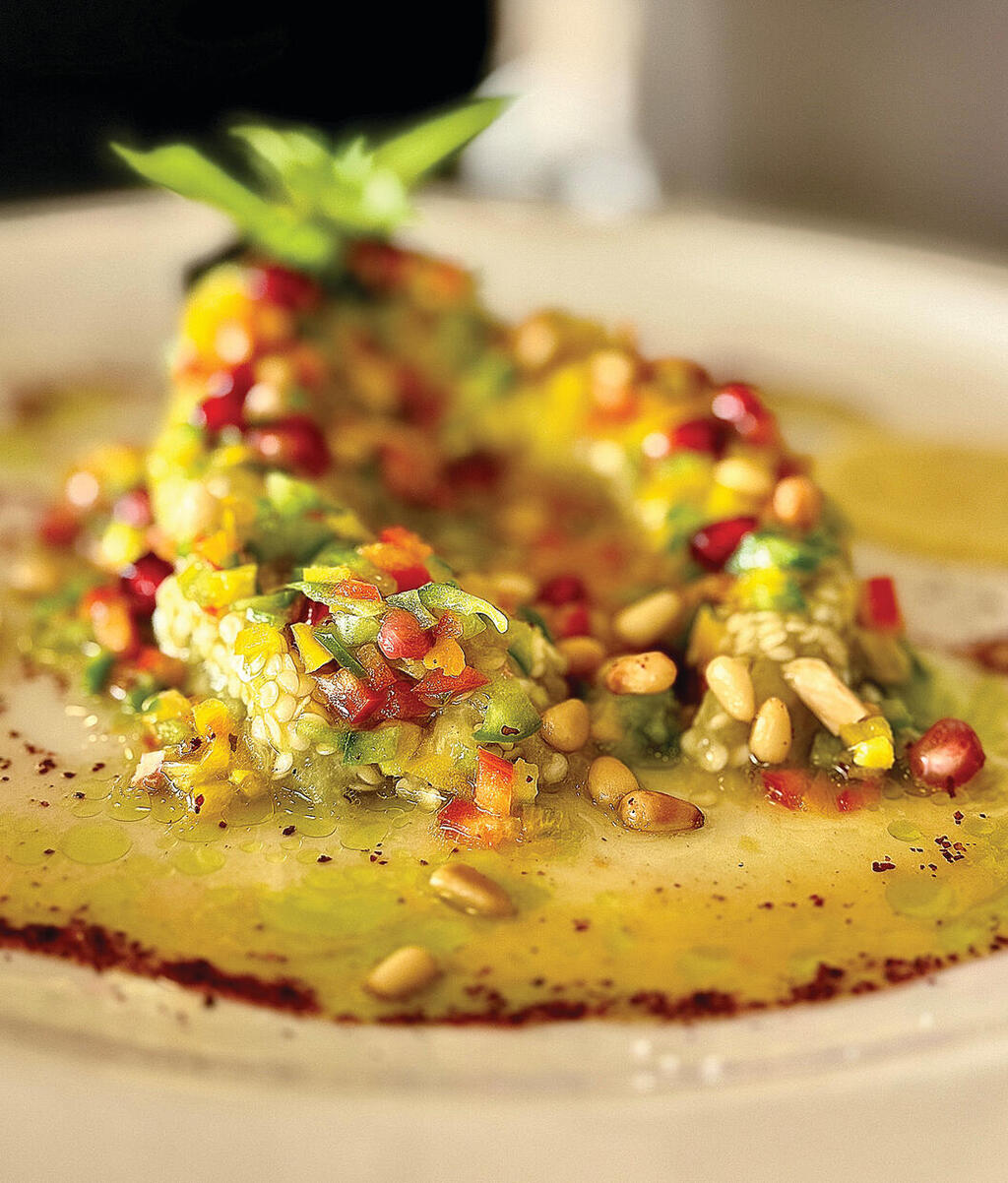
Thoroughly charred, peeled and left whole, it is dotted with tiny cubes of yellow, green and red peppers, pomegranate seeds and pine nuts. Wonderful olive oil and sumac complete the dish.
Next comes the haroush, sliced into delicate matchsticks and folded into rich sheep's-milk yogurt with a little garlic and olive oil.
It retains its crispness and gentle sweetness. A tzatziki that makes several of our past vacations in Greece seem a little less impressive.
Then comes the tomato salad.
The tomatoes are astonishingly crisp, tossed with red onion, green onion and plenty of fresh mint. We take one bite and immediately decide to make it at home.
Then we remember that we'll need to find tomatoes like these first.
Every vegetable receives royal treatment here, but nobody exhausts it on the journey to the plate. The eggplant remains an eggplant. The haroush stays crisp. The tomato fills the mouth with flavor.
An hour ago, we were standing beside the plants, collecting their produce in our shirts. Now we are eating it.
We find ourselves thinking again about Khatib and the meal Hussam refunded. About five children who went on to higher education and a father who remained in the fields.
About the chefs who came out of El Babor's kitchen and went on to open restaurants of their own.
Hussam sits here, able to recognize something of himself in their menus, and feel proud of what they have become.
No more hummus and fries: Arab restaurants rewrite the menu in Israel
Three recipes from El Babor's kitchen
1. Fire-roasted eggplant with peppers, pomegranate and pine nuts
The eggplant should remain whole, the toppings should be chopped very finely, and the olive oil should be good enough to mop up with bread.
Ingredients (serves 4)
- 2 medium eggplants, firm and relatively light for their size, preferably baladi varieties with few seeds
- ¼ yellow bell pepper
- ¼ red bell pepper
- ¼ green pepper, hot if desired
- ⅓ cup pomegranate seeds
- 3 tablespoons toasted pine nuts
- 6–8 tablespoons olive oil
- 3 tablespoons freshly squeezed lemon juice
- ½ teaspoon sumac, preferably fresh
- Salt, to taste
How to prepare
1. Char the eggplants over a gas flame or grill, turning occasionally, until the skins are blackened and the flesh is completely soft. Alternatively, roast them on a parchment-lined baking sheet in an oven heated to 250°C (480°F), until thoroughly softened and well browned.
2. Allow the eggplants to cool slightly, then peel carefully without rinsing them or removing their stems. Try to keep them whole. Place them in a colander for 15–20 minutes to drain excess liquid.
3. Finely dice the peppers. If the pine nuts have not already been toasted, toast them in a dry pan until golden, then immediately transfer them to a plate.
4. Place the eggplants on a serving platter and gently open the flesh with a fork. Season with salt and lemon juice.
5. Scatter the peppers, pomegranate seeds and pine nuts over the eggplants. Drizzle generously with olive oil, sprinkle with sumac and serve at room temperature.
2. Haroush with sheep's-milk yogurt
The secret here is the crunch. Cut the vegetable just before serving, mix and eat immediately. If haroush is unavailable, use small, firm, sweet cucumbers.
Ingredients (serves 4)
- 500 grams young haroush or small cucumbers
- 400 grams thick, rich sheep's-milk yogurt
- 1 small garlic clove, crushed
- 2 tablespoons olive oil, plus a little more for serving
- Salt, to taste
How to prepare
1. Wash the haroush and trim the ends. Remove the seeds.
2. Cut into very thin matchsticks. If using cucumbers with especially watery centers, remove some of the central flesh before slicing. A mandoline or grater can also be used.
3. Combine the yogurt, garlic and olive oil in a bowl. Add the haroush and mix gently.
4. Season with salt immediately before serving. Transfer to a serving plate, drizzle with a little more olive oil and serve at once.
3. Tomato salad with two kinds of onion and mint
This salad contains only a handful of ingredients, which means there is nowhere for any of them to hide. You need excellent tomatoes, good olive oil and a confident hand.
Ingredients (serves 4–6)
- 500 grams baladi or Magi tomatoes
- ½ medium red onion
- 3 green onions
- 30 large mint leaves
- 4 tablespoons olive oil
- 1 tablespoon lemon juice, or to taste
- Salt, to taste
How to prepare
1. Cut the tomatoes into wedges or bite-sized pieces.
2. Thinly slice the red onion, chop the green onions and cut the mint leaves into fine strips.
3. Just before serving, add both kinds of onion and the mint to the tomatoes. Dress with olive oil, lemon juice and salt, mixing gently.
4. Taste and adjust the seasoning. If the tomatoes are sufficiently acidic, reduce the lemon juice or omit it entirely. Serve immediately, with bread to soak up the juices at the bottom of the bowl.