

“There will be those who click their tongues and ask: What are you whining about, doctor? It was only 10 days at Shura. But imagine yourselves opening around 120 bags of murdered people, and with each opening you are tense, emptied out and flooded with violence again and again — and then we’ll see how you come back the same people you were.”
Dr. Tomer Portnoy, a radiologist at Schneider Children’s Medical Center, speaks quietly. Only 10 days of reserve duty, but they left a mark on him that has not gone away.
Gallery
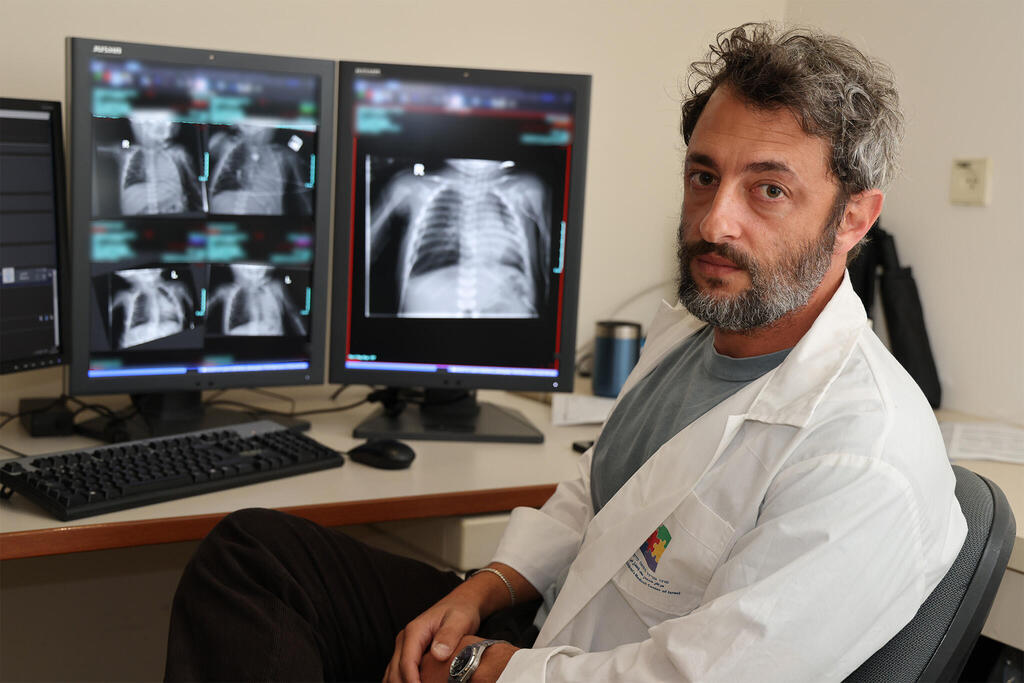
Dr. Tomer Portnoy, a radiologist at Schneider Children’s Medical Center, served in the reserves at Shura military base
(Photo: Yariv Katz)
At noon that Saturday, October 7, 2023, he received an emergency call-up order and reported to Shura military base. As a radiologist, he immediately understood that his role would be essential. But when he arrived at the base, he discovered he had not been drafted for the job he had expected. He said goodbye to his wife and two young children — Eli, 7, and Ari, 5 — packed a bag, took his uniform down from the shelf and headed to the base. There, he learned he would be required to open bags containing murdered victims, document bullet entry and exit wounds, and identify every detail that could help identify the bodies.
“When I completed the medical officers’ course, I was assigned to the Military Rabbinate’s unit for identifying fallen soldiers,” he says. “They wrapped it in lofty words like values and mission, and told me it was tailor-made for a radiologist who could provide additional directions in interpretation. It was a punch in the face, but I reminded myself that I was on a national mission and would do whatever I was told.”
As soon as he entered the base, he saw four trucks waiting to be unloaded. “It became clear to me the second I arrived that I had come to work in a cemetery.” In each of the workrooms, a doctor, a dentist, a military photographer and a representative of the Military Rabbinate gathered. Only occasionally was Portnoy called in for a complex radiological interpretation. “We worked at a frantic pace — one bag in, one bag out, multiplied by 12 times a day.”
The moment the zipper of each bag was opened is an experience he struggles to define. “I was extremely tense. My alertness was sharpened to the maximum, and violence was raging inside me. But nothing in my professional life, which had exposed me to difficult sights, prepared me for the horrors each of those bags told.”
The horror in every bag
The all-male Military Rabbinate unit was not permitted to examine the bodies of women, so only the bodies of soldiers and Nova festival victims were brought into Portnoy’s room.
“Of all the scenes of human horror I saw, there is one I will never forget: a young man in denim shorts and a blue shirt, into whose body they emptied a magazine, whose face they mutilated and whose hands they brutally broke. How much malice, hatred and intoxication with power does it take to kill a person and then go back and desecrate his body?”
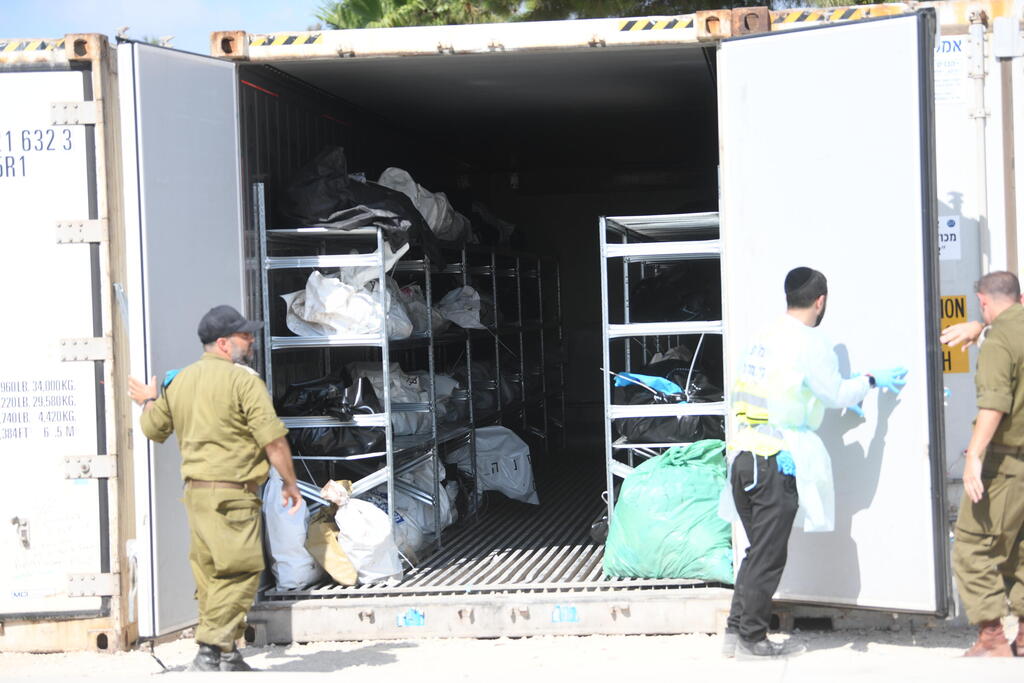
The body identification compound at Shura base in Ramla after the October 7 massacre
(Photo: Yair Sagi)
The bodies of young men from the Nova festival were brought in after they had been murdered and subjected to attempted beheadings.
“I saw the body of a young man who had been shot in the head, and then they dismantled the eye socket and dislocated the jaw. In the next bag was a body that had been desecrated and burned symmetrically on only half of it, to mock and humiliate. The more murdered victims we were exposed to, the more we identified a method: one bullet under the armpit so it would pass from the neck to the head, gouged-out eyes, shooting from behind the skull and smashing it with a rock.”
He adds quietly: “I was exposed to a bag that contained remains of a murdered person’s body and a severed sexual organ. We worked marathon shifts to give families certainty and closure, and also to reduce decomposition so the slaughtered victims could still be identified.”
‘Shura crematorium’
As the days passed and more bags piled up, the pace of work intensified.
“We couldn’t breathe. We worked almost without stopping, and when I finished each day like that, I came home flooded and shut down. When I reached the parking lot of the building, I undressed, peeled off my uniform and socks, and went upstairs barefoot and in my underwear.”
On the eighth day of reserve duty, he suffered an anxiety attack.
“I felt that if I went back to the Shura crematorium, there was a real risk to my soul.”
After 10 days of reserve duty, he was released — but not from the feelings.
“It took me quite a while to learn how to breathe, regulate my pulse, regulate my emotions. And to this day, two years and seven months later, I keep checking myself all the time: Am I OK? Am I functioning the way I did before October 7?”
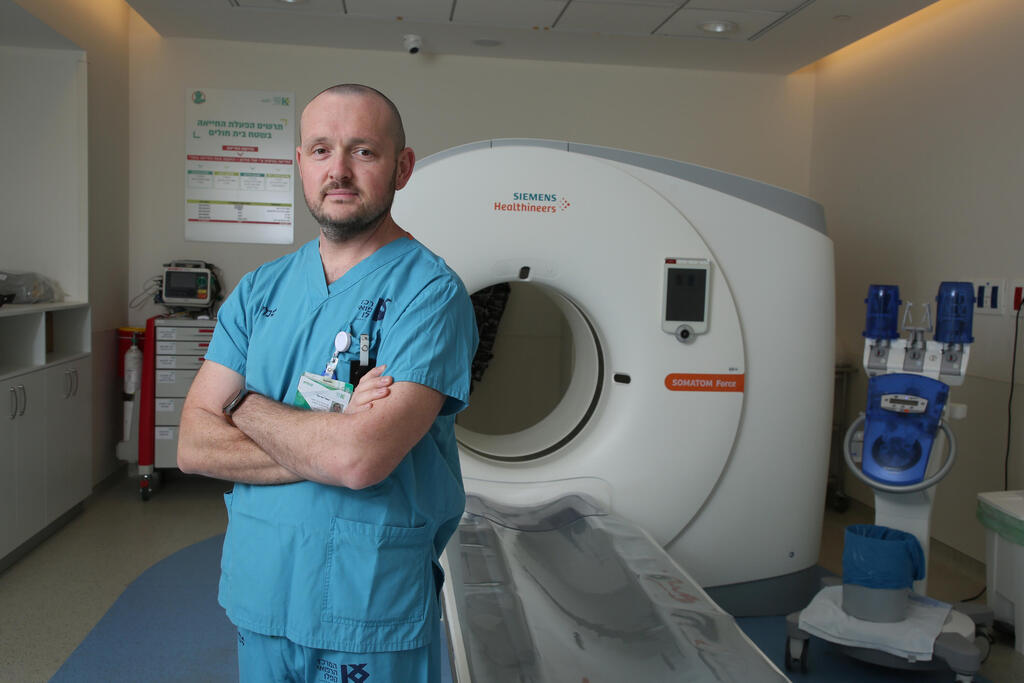
Yigal Foigel, a senior imaging technician at Kaplan Medical Center; the smells of Shura still follow him
(Photo: Ryan Frois)
Yigal Foigel, 39, married and a father of two, is a senior imaging technician at Kaplan Medical Center and deputy director of Clalit Health Services’ School of Imaging. He arrived at Shura about a week after October 7. He served 300 days in the reserves, and he has not returned to himself.
“I became vulnerable and sensitive, someone who cries over every little thing. I experience disconnections even when I am with friends and safe. In every aspect of life, I changed — in parenting, in my marriage, in my patience, in the lack of enjoyment from things that before that Saturday excited me and made me laugh. I am a different Yigal.”
At the base, they had one CT scanner, which arrived in a mobile structure from Ben-Gurion University. Later, they received another. One was used to identify soldiers and the other civilians.
“We worked shifts of eight or 12 hours, and from the very first scan, the sights of the disaster hit me in the face. I am a veteran in the profession, with 15 years of hospital experience. I have been exposed to difficult situations after car accidents, traumas and suicide attempts — none of them resembled in any way what I saw at Shura.”
In the first bag placed on the examination table, he identified “a salad of bones unrelated to anatomy. The head was not in its natural position, the legs and arms were scattered. I saw two skulls, and because there was a suspicion that more than one person had been compressed into the bag, I began counting: how many forearms, thighs, jaws and shins the bag contained. I had no time to feel, and throughout my reserve duty I worked on autopilot.”
The same was true when a bag was placed on the table containing only a skull, and another containing a section of thigh from the body of a young woman who had been abducted to Gaza.
“While I was working, I could shut myself off, but not when I heard the shattered cries of the families. One day, a father came to us with the body of his daughter, but the scan showed it was someone else.”
The bodies of children and babies broke the autopilot he had developed.
“As a father and as a person, the horrors done to them destroyed me. Seeing the small body of a child who was shot, stabbed and run over — that is something you cannot swallow. Nor when small bodies arrived in parts, with the body in one bag and the skull in a separate bag.”
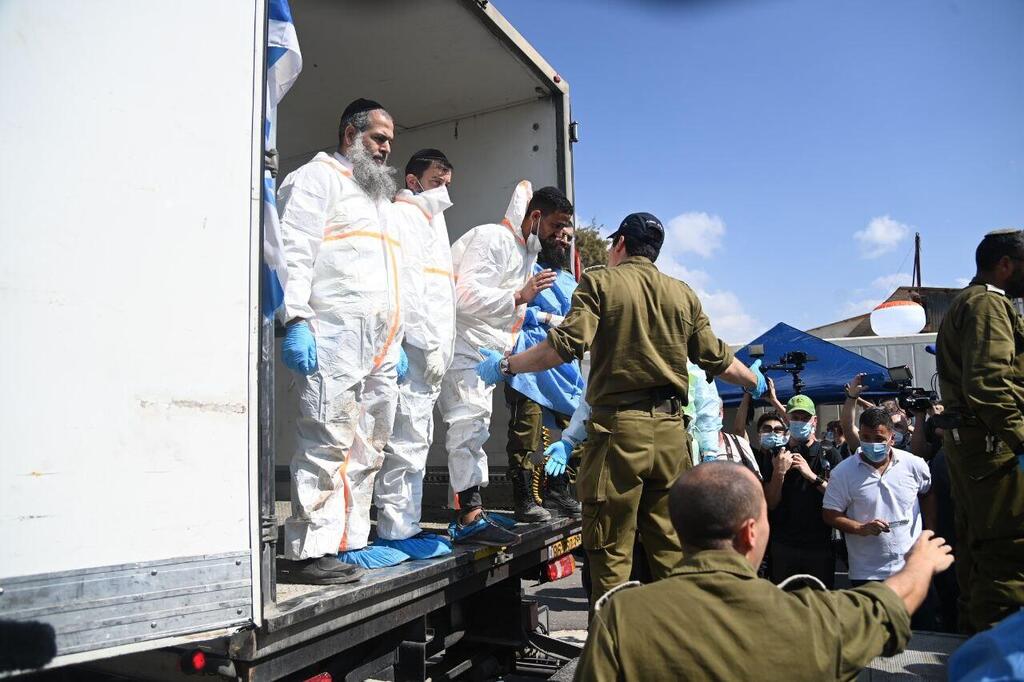
'Nothing resembled in any way what I saw at Shura'
(Photo: Yair Sagi)
The smell that won’t leave
As the days passed, the imaging technicians were also forced to contend with the smells rising from the bodies.
“What didn’t we do to blur the sharp odor that penetrated under our skin? We wore two masks and sprayed them with eucalyptus spray, but the smell of decomposition overcame everything.”
Since then, the memory of the smell has haunted him with undiminished force. Last week, he entered a store and the smell hit him.
“I fled from it, and I will never go back there.”
From the beginning of his reserve service, Foigel decided to disconnect from the news, fearing he would identify a fallen victim he had scanned.
“But life has its own decisions. During one shift, we received bags containing the bodies of police officers, and on the way home I accidentally heard their names on the radio. I understood that the body I had scanned had a name, and parents, and a wife, and children. That evening, when I got home, my wife saw a ghost at the door. Not her husband.”
Foigel does not define himself as traumatized. He sleeps well at night, was treated by a psychologist and attended resilience days organized by the IDF.
“All of that is true,” he says. “But I am not who I was. After 300 days of reserve duty at Shura, Yigal Foigel did not return to himself.”