

A tiny wearable sensor developed by researchers at the Technion – Israel Institute of Technology could eventually allow people to monitor their blood pressure continuously without using an inflatable cuff. The technology, which combines light, ultrasound and artificial intelligence, has shown promising results in initial tests on volunteers, although it remains at the proof-of-concept stage.
The research, published in the scientific journal "Nature Communications," was led by Professor Amir Rosenthal and Professor Daniel Lange of the Technion's Andrew and Erna Viterbi Faculty of Electrical and Computer Engineering, together with doctoral student Gil Gelbert. Their approach is designed to overcome some of the limitations of conventional blood pressure measurements, which generally provide a reading at a single point in time.
Gallery
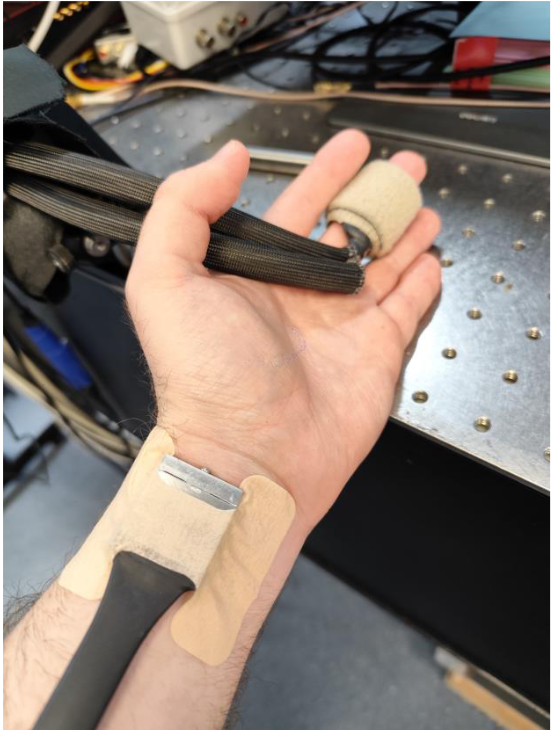
The new blood pressure measurement system developed by researchers at The Technion
(Photo: Technion)
Blood pressure is a key indicator of cardiovascular health, but standard monitoring typically requires an inflatable cuff placed around the upper arm. The Technion researchers are developing an alternative that could eventually provide measurements throughout the day, including during routine activities, without requiring users to take any action.
The system relies on silicon photonics and a technique known as optoacoustics, which uses light to generate sound waves. Short pulses of light create ultrasound waves inside an artery, while a miniature sensor called SPADE measures the artery's diameter and the subtle changes that occur with each heartbeat.
By analyzing these measurements, the researchers can reconstruct the blood pressure waveform, which describes how pressure changes throughout the cardiac cycle, and estimate blood pressure continuously. The sensor captured waveform characteristics at a rate of 100 measurements per second during initial testing.
A central feature of the technology is its ability to measure the artery's absolute diameter, rather than relying solely on changes in its size. According to the researchers, this addresses a major limitation of previous miniature sensing approaches. The measurements are combined with AI-based models of how arteries behave to estimate blood pressure.
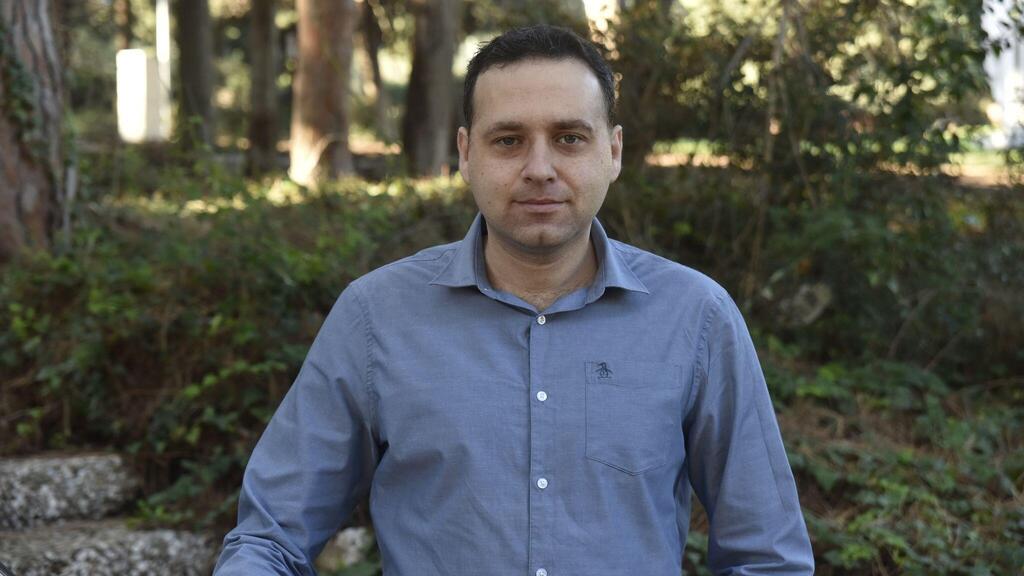
Prof. Amir Rosenthal of the Technion's Andrew and Erna Viterbi Faculty of Electrical and Computer Engineering
(Photo: Technion)

Prof. Daniel Lange of the Technion's Andrew and Erna Viterbi Faculty of Electrical and Computer Engineering
(Photo: Technion)
The researchers also sought to simplify the physical design. While some approaches to cuffless blood pressure monitoring require multiple sensors positioned precisely on the body, their system uses a single miniature sensing component and is relatively tolerant of changes in its position and angle.
This could make the technology more practical for wearable devices, although further development would be needed before it could become part of everyday health monitoring. The proof-of-concept tests demonstrated the sensor's ability to capture relevant arterial measurements, but the research does not establish that the device is ready to replace conventional blood pressure monitors in clinical use.
Looking ahead, the Technion team believes the sensor could potentially be incorporated into smartwatches, medical patches and other wearable devices. Continuous monitoring could provide a more detailed picture of blood pressure changes over time, including fluctuations that may not be captured during an occasional measurement at a clinic or at home.
Such information could be particularly useful in monitoring people with cardiovascular disease, though its clinical benefits will depend on further testing and validation.
The study also involved researchers Ron Moisseev, Yoav Hazan and Tamar Harary. It was supported by the Israel Innovation Authority, the United Israel Appeal and the Technion's Ollendorff Minerva Center for Vision and Image Sciences.